'Teach You a Lesson' cracks Netflix's all-time non-English top 10 — what 60.2M views really mean
Nine weeks in, 'Teach You a Lesson' is no longer Netflix's No. 1. Yet in late July the show's name landed somewhere more permanent than the weekly chart — the all-time list.
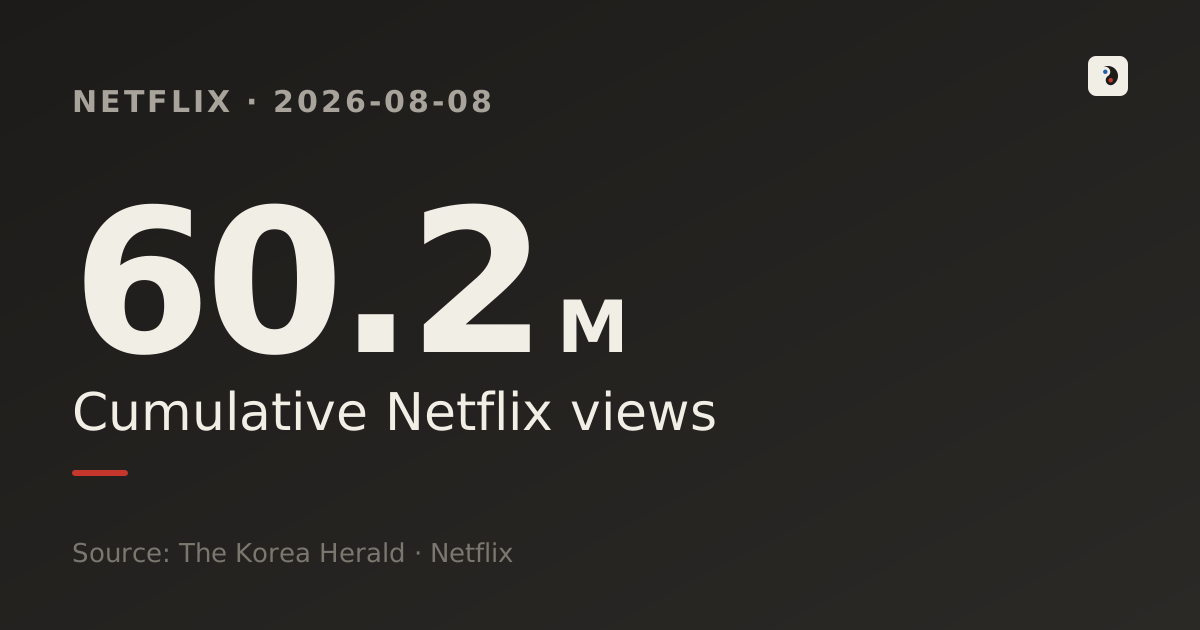
- Netflix's Korean original 'Teach You a Lesson' (released June 5, 2026) reached 60.2 million cumulative views in eight weeks, making it the No. 10 most-watched non-English series ever on Netflix — the fourth Korean entry after 'Squid Game' seasons 1, 2 and 3.
- The shape of that success is a front-loaded explosion, not a slow burn: it peaked at 21.1M views in week two, fell to 7.3M by week four and 2.3M by week eight — yet never left the weekly top 10.
- Its footprint narrowed just as fast, from 91 countries in week two to 37 in week eight. Where those 60.2 million views came from is the real story of this record.
What the show is
'Teach You a Lesson' (Korean title Chamgyoyuk) is a Korean Netflix original released on June 5, 2026, with every episode dropped at once. It is adapted from a Naver webtoon, directed by Hong Jong-chan ('Juvenile Justice') and written by Lee Nam-gyu ('Daily Dose of Sunshine'). Kim Mu-yeol plays Na Hwa-jin, an inspector at a newly created Bureau for the Protection of Teaching Authority; Lee Sung-min plays the education minister who founded it. It carries Korea's adults-only rating.
The premise fits in one line: what happens when the state itself moves in to clean up a school system that has collapsed. That is the factual part. What follows is the question worth asking — how that premise turned into 60.2 million views in two months.
The numbers behind the run
Netflix's official metric is views: total hours viewed divided by a title's runtime. It is closer to "how many complete watch-throughs" than "how many people watched." By that measure 'Teach You a Lesson' reached 60.2 million cumulative views eight weeks after release, and on July 29 Netflix listed it as the tenth most-viewed non-English series in its history.
The curve tells you what kind of hit this was. From 6.4M in a three-day opening week it jumped 3.3x to 21.1M in week two, then gave back nearly half its audience each week: 11.8M, then 7.3M. By weeks seven and eight it was at 2.9M and 2.3M — about a ninth of its peak.
The other half of the fact matters just as much: it never dropped out of the top 10 on the way down. It still ranked No. 7 among non-English shows in week eight, while the cumulative total climbed step by step — 54.9M at six weeks, 57.8M at seven, 60.2M at eight. At the seven-week mark that translated to 618.9 million hours viewed.
Why week two did most of the work
Add up only the published weekly figures and weeks one through four come to roughly 46.6M — about 77% of the eight-week total. Two months of performance was largely earned in the first month, and disproportionately in a single week.
The mechanism is not mysterious. All episodes at once, a No. 1 finish built in three days, that ranking buying algorithmic placement the following week, and then the surge. This is exactly why an opening week matters so much on Netflix: the show's top-10 footprint nearly doubled from 48 countries in week one to 91 in week two.
The subject travelled well, too. Collapsing teacher authority and abusive parental complaints are a specifically Korean debate, but the feeling that schools are breaking down is not confined to one country. And retribution stories carry the lowest subtitle barrier of any genre — you can miss a line and still know exactly what is happening on screen. Hitting No. 1 in 46 countries in week two reads as the product of that combination.
Competition is part of the picture as well. In late July, five of the ten non-English titles on the chart were Korean. That is a bigger pie for K-content and, at the same time, more forks in it. Week eight's No. 7 finish reflects both a cooling show and a crowded field.
From 91 countries to 37 — the real size of its reach
The country count moved 48 (week one) → 91 (week two) → 37 (week eight). It spread fast and contracted fast, unlike the long-tail giants that shed markets slowly over years.
That is not a small number, though. Non-English series still sitting in 37 countries' top 10 two months after release are rare. The accurate summary is this: it went very wide very quickly, narrowed quickly too, but held a solid floor.
The argument the show is having
The source webtoon drew criticism for discriminatory and demeaning content, and its serialisation was halted on North American platforms. The series reportedly dropped the most contentious episodes and reworked the material toward more grounded storylines about abusive complaints and overreach.
The critical objection that remains is structural: a state agency solving problems by force is a fantasy of punishment rather than reform. What makes that objection interesting is that it points at the same place as the show's appeal. The slower a real institution is, the better a story about instant consequences sells.
Sitting one row below 'Squid Game'
Netflix's all-time non-English top 10 is led by 'Squid Game' seasons 1, 2 and 3, followed by titles such as Spain's 'Money Heist' and France's 'Lupin'. 'Teach You a Lesson' now occupies the tenth slot, which makes four Korean entries on a list of ten.
One more piece of context changes the weight of that. Netflix's What We Watched report for the first half of 2026 ranked the show sixth overall — even though only about four weeks of the half-year fell after its June 5 release. Measured against titles that had the full six months, that is a dense result.
What comes next
The obvious question has no answer yet. As of July 23 Netflix said nothing had been decided about a second season, and that no casting or production details were confirmed.
Two conditional readings are fair. First, entering the all-time top 10 is leverage in itself — the show has already cleared the bar Netflix uses for non-English IP it wants to run as a franchise. Second, a front-loaded curve is a weaker argument for a franchise than a long-burning one. If a second season happens, the test will not be the opening firepower but whether unused material from the webtoon can stretch the view curve further out than this one managed.
- 'Teach You a Lesson' debuts at No. 1 globally, top 10 in 48 countries — ZAPZEE (2026.06.10)
- Holds No. 1 for a second week, reaches top 10 in 91 countries — About Netflix newsroom (2026.06)
- Third straight week at global No. 1 — Hankyung (한국경제) (2026.06.24)
- Still No. 1 among non-English shows in week four — TenAsia (텐아시아) (2026.07.01)
- Five Korean titles in Netflix's non-English top 10; 'Teach You a Lesson' at No. 6 — Star News (스타뉴스) (2026.07.27)
- Enters Netflix's all-time non-English top 10, fourth Korean title to do so — Financial News (파이낸셜뉴스) (2026.07.29)
- 'Teach You a Lesson' enters Netflix's all-time top 10 chart for non-English shows — The Korea Herald (2026.07.29)
- Week eight: No. 7 among non-English shows, top 10 in 37 countries — Korea Daily (2026.07)
- 618.9 million hours viewed across seven weeks — What's on Netflix (2026.07)
- Netflix says nothing decided on a second season — KDramaStars (2026.07.23)
This is nuloq's own analysis based on the public Netflix charts, viewing data, reporting, and official sources listed under Sources, written with the help of AI. It is an interpretation of public data for information and criticism only — not a definitive judgment of any title, cast, creator, or platform — and ranking and viewing figures reflect the time of writing. We correct the text if errors are found.
Related posts
Spooky in Love: Netflix Top 10 in 42 Countries — What the 8th-to-5th Climb Means
tvN's Spooky in Love opened at No. 8 on Netflix's non-English chart and climbed to No. 5. Here is why its 1.7M first-week views sit far below Agent Kim's 8.2M — and why that gap is not about quality.
Donggung Hit Netflix's Top 10 in 69 Countries — What 8.1M Views Mean
Netflix's Korean occult period drama Donggung pulled 8.1 million views and Top 10 spots in 69 countries in week two, up from 27 countries. Here is why its reach doubled and what the number says next to Kim Bujang.
'Teach You a Lesson' Tops 57.5M Views, Netflix's No. 2 K-Drama Ever
Netflix's 'Teach You a Lesson' passed 57.5 million views in seven weeks, becoming Netflix's second most-watched Korean title ever after Squid Game. Here's what its four-week non-English No. 1 run reveals.
Inside the Global Phenomenon of SBS and Netflix’s 'Manager Kim': The Ultimate K-Dad Revenge Fantasy
An in-depth analysis of the record-breaking drama 'Manager Kim,' examining its historic 23.1% domestic TV ratings and its three-week run at number one on Netflix's global charts.