Extreme Job's 16.26M Admissions — and the No. 2 Spot It Lost in 2026
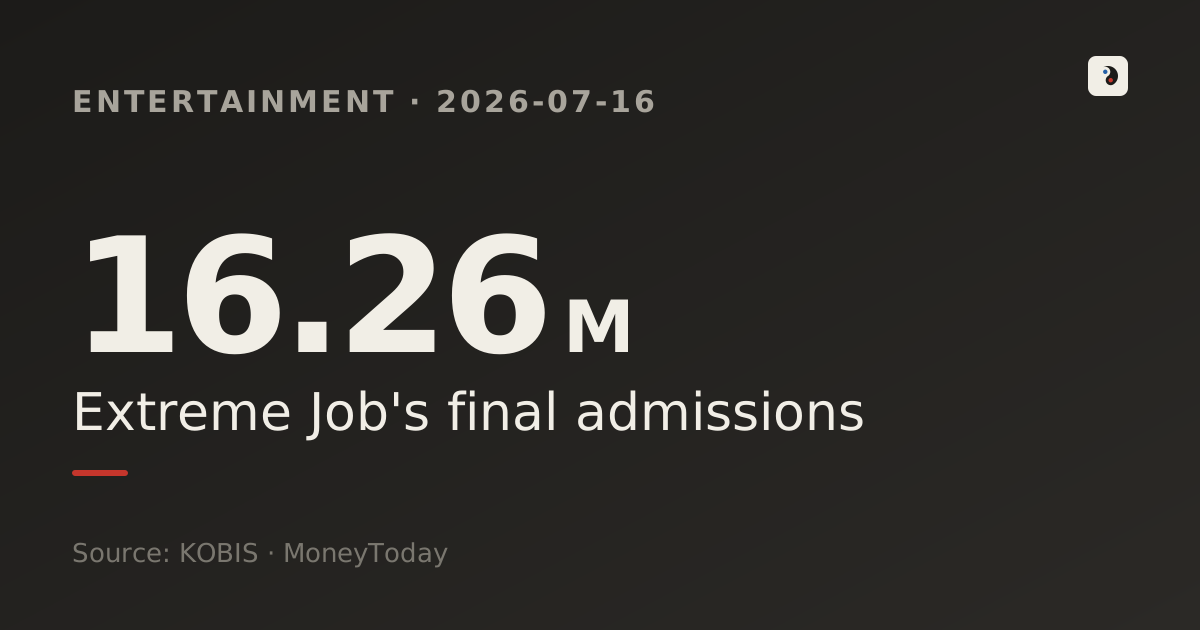
A narcotics squad's undercover fried-chicken shop rewrote Korean box-office history — and seven years later, that record itself got rewritten. Here's what the numbers say.
- Extreme Job broke even (2 million admissions) in just 4 days, passed 10 million in 15 days, and finished with roughly 16.26 million admissions.
- Revenue climbed to about KRW 136.9 billion — around 21 times its KRW 6.5 billion production budget — briefly making it Korea's top-grossing film of all time.
- But in April 2026, the film Wanggwa Saneun Namja overtook it, dropping Extreme Job from the No. 2 all-time admissions spot to No. 3.
What kind of film is this
Extreme Job is a 111-minute crime comedy directed by Lee Byeong-heon (not to be confused with actor Lee Byung-hun), starring Ryu Seung-ryong, Lee Ha-nee, Jin Seon-kyu, Lee Dong-hwi, and Gong Myoung. Distributed by CJ Entertainment, it opened in Korea on January 23, 2019, just ahead of the Lunar New Year holiday.
Five narcotics detectives, facing the dissolution of their unit, take over a fried-chicken shop across from a crime syndicate's hideout as cover for a stakeout — only for the shop to unexpectedly become a local sensation, tangling the investigation with the business itself.
The numbers behind the run
The opening alone was unusual. Made on a pure production budget of KRW 6.5 billion (about KRW 9.5 billion including marketing), the film crossed its break-even point of 2 million admissions in just 4 days, then passed 10 million admissions on February 6, 15 days after release. It was the first comedy to reach Korea's "10-million-admissions club" — the country's informal benchmark for a mega-hit, tracked by the official KOBIS box-office system — since Miracle in Cell No. 7 in 2013, a six-year gap.
The run didn't stop there. Final admissions landed around 16.26 million (reported figures range from 16,264,984 to 16,266,337), making it the No. 2 Korean film of all time by admissions at the time, while cumulative revenue passed roughly KRW 137 billion in early March 2019 — briefly the highest-grossing Korean film ever by revenue. Later reruns and ancillary revenue pushed the cumulative total to about KRW 136.9 billion as reported in 2023.
Audience reaction ran hot too. Around the 9-million-admissions mark, its Naver audience rating stood at 9.30 out of 10, and it holds a 7.1 rating on IMDb — unusually high for a broad comedy.
What drove this performance
Ironically, the run began from low expectations. Director Lee Byeong-heon's previous film, Twenty (2015), had topped out around 3 million admissions, a modest mid-tier comedy. Lead actor Ryu Seung-ryong, after peaking with Miracle in Cell No. 7 (2013) and Roaring Currents (2014), had gone through a 2015-2018 stretch without a clear hit. Amid a Lunar New Year lineup crowded with big-budget period dramas and spy thrillers, Extreme Job opened quietly, with little marketing buzz.
What filled that gap was ensemble chemistry. The five leads' near-improvised back-and-forth banter was built for word of mouth, and lines like "There's never been a taste like this — is it galbi or fried chicken?" spread as instant catchphrases. The action-comedy Ppyeongban (뺑반), its main domestic rival that same holiday season (released January 30), underperformed, and audiences looking for something lighter than heavy spectacle gravitated toward Extreme Job instead.
The subject matter was well-timed, too. Small-business ownership — fried-chicken shops especially — is an unusually familiar path in Korea. Grafting the realistic dilemma of "the business doing too well" onto the unlikely premise of undercover narcotics detectives let audiences laugh at something that felt close to home, without any heavy-handed social commentary.
Where the debate lands
The gap between international critics and domestic audiences is another useful lens on this film. Some overseas reviews called it "side-splittingly funny from start to finish," while others noted that stretching a single joke across 111 minutes means "that point arrives early" and the film loses steam. In Korea, by contrast, that same single-minded structure read as a strength, reflected in the 9.30 Naver audience score — wordplay- and improv-heavy comedy tends to lose force in translation and subtitling, so a split verdict across language markets is close to the expected outcome, not an anomaly.
What's critically interesting is that the film touched a shared emotional nerve — "everyone's grinding through an extreme job just to get by" — without foregrounding any social message. Brushing lightly against the exhaustion of small-business ownership and emotional labor, through comedy rather than heavy class narrative, put it at the opposite end of that year's Korean-film spectrum from a more socially pointed film like Parasite, which opened four months later in May 2019.
Records and legacy
Extreme Job's impact went beyond that year's box office. Director Lee Byeong-heon jumped from Twenty's 3 million admissions straight to 16.26 million, and Ryu Seung-ryong picked up his fourth 10-million-admissions film after Miracle in Cell No. 7, Masquerade, and Roaring Currents — ending a five-year cold streak.
But the ranking has since shifted. On April 11, 2026, the new release Wanggwa Saneun Namja passed 16.28 million admissions after just 67 days in theaters, overtaking Extreme Job's No. 2 all-time spot, and went on to a final tally of about 16.9 million, widening the gap further. As of 2026, Korea's all-time admissions ranking now reads Roaring Currents (about 17.61M), Wanggwa Saneun Namja (about 16.9M), Extreme Job (about 16.26M) — meaning Extreme Job has slipped from a No. 2 spot it held for more than seven years to No. 3.
What's next
Extreme Job's success didn't stay confined to the screen. Universal Pictures, CJ ENM, and Kevin Hart's Heartbeat Productions teamed up on a Hollywood remake, with Tracy Oliver — writer of Girls Trip (2017) — handling the script. Whether the ensemble-comedy formula translates across language and culture will depend on how well that remake lands.
Domestically, the film is credited with proving that a low-budget ensemble comedy can reach 10 million admissions, a formula that's since shaped how studios approach comedy projects. Its rank may have slipped to No. 3, but by reviving a stagnant genre and resetting the trajectory of its cast's careers, Extreme Job's real legacy is still playing out.
- Extreme Job's surge puts spotlight back on director Lee Byeong-heon's earlier film Twenty — Money Today (Korean) (2019.02.09)
- Extreme Job crosses 10 million admissions, first comedy to do so in 6 years — YTN (Korean) (2019.02.06)
- Extreme Job passes 9 million admissions, nearing the 10-million mark — Seoul Economic Daily (Korean) (2019.02.05)
- 'Extreme Job' becomes second most watched film — The Korea Times (2019.02.18)
- 'Extreme Job' becomes highest-grossing film of all time in Korea — Screen International (2019.03.02)
- Extreme Job, watched by 16 million, to be remade in Hollywood — Hankook Ilbo (Korean) (2019.04.30)
- Director Lee Byeong-heon's KRW 136.9 billion in revenue from Extreme Job — Money Today (Korean) (2023.04.19)
- Wanggwa Saneun Namja finally overtakes Extreme Job, becomes No. 2 all-time with 16.28M admissions — The Korea Daily (2026.04.10)
- 16.9 million moved to tears — what the Wanggwa Saneun Namja phenomenon left behind — StarNews Korea (Korean) (2026.06.30)
- Extreme Job (2019) rating page — IMDb (accessed 2026.07.16)
This is nuloq's own analysis based on the public box-office data, ratings, reporting, and official sources listed under Sources, written with the help of AI. It is an interpretation of public data for information and criticism only — not a definitive judgment of any film, filmmaker, or studio — and box-office and rating figures reflect the time of writing. We correct the text if errors are found.
Related posts
Na Hong-jin's 'Hope' Passes 4 Million — What the Break-Even Fight Reveals
Na Hong-jin's record-budget film 'Hope' crossed 4 million admissions three weeks after release. Amid a break-even controversy and sharply split reviews, here's what the box-office numbers actually mean.

Parasite's 4 Oscars, By the Numbers — Box Office and Ratings Data
How Bong Joon-ho's Parasite went from Cannes' Palme d'Or to a 4-Oscar sweep, read through domestic and global box-office and ratings data.

Snowpiercer: 9.35 million Korean admissions, worldwide gross and overseas distribution
Snowpiercer: 9.35 million Korean admissions, worldwide gross and overseas distribution

The Odyssey passes USD 1 billion in three weeks: reading worldwide box office
Christopher Nolan's 'The Odyssey' crossed $1 billion worldwide in three weeks, and topped 1 million admissions in South Korea faster than 'Oppenheimer' did. Here's what the numbers show.