· Updated 2026-09-10
Parasite's 4 Oscars, By the Numbers — Box Office and Ratings Data

Correction (2026-09-10): The scope, comparisons and interpretation of key figures have been reviewed and corrected below. The original publication date is retained.
How Bong Joon-ho's Parasite conquered both Cannes and the Oscars, told through box-office numbers and ratings data.
- Parasite opened in Korea on May 30, 2019, crossed 10 million domestic admissions in just 53 days (July 21), and finished with roughly 10.08 million tickets sold.
- Worldwide box-office gross of about USD 260 million is not net profit. Production cost alone cannot establish returns; cinema shares, distribution and marketing must also be considered.
- With rare critical unanimity (99% on Rotten Tomatoes, 97 on Metacritic), it swept 4 Oscars including Best Picture.
What the Film Is
Parasite is a black-comedy thriller directed by Bong Joon-ho, starring Song Kang-ho, Lee Sun-kyun, Cho Yeo-jeong, Choi Woo-shik, and Park So-dam. It opened in South Korea on May 30, 2019, distributed by CJ Entertainment. Its runtime is 132 minutes. The story follows two families — one living in a semi-basement, the other in a hillside mansion — whose lives become entangled, using their collision to explore class inequality.
The Numbers
Domestic box office was dominant from day one. Parasite sold 568,114 tickets on its opening day alone — the best Korean-film opening of 2019 — and reached a cumulative 3,367,382 admissions by the end of its first weekend. That momentum never slowed: on day 53 (July 21), cumulative admissions hit 10,000,249, making it a so-called "10-million admissions film" (Korea's benchmark for a mega-hit, tracked by the official KOBIS box-office system), and its final domestic tally landed around 10.08 million admissions.
Debates and Interpretation
Critical discussion of Parasite centers largely on what the film is actually about. On its surface it's a thriller about two entangled families, but most criticism reads it as an allegory for the widening income and housing gap under modern capitalism. Bong Joon-ho himself has said in multiple interviews that it's not a story about one particular country, but one that applies broadly to capitalist societies. Structurally, its sharp pivot from comedy to thriller to tragedy was praised by critics as "genre-defying," though some viewers found the tonal whiplash jarring — a minor point of disagreement that did little to dent its overall rating distribution.
Records and Legacy
Parasite won the Palme d’Or in 2019 and then Best Picture, Director, Original Screenplay and International Feature at the 92nd Academy Awards. It was the first non-English-language Best Picture winner.
What's Next
Parasite's success is often cited alongside the broader wave of Korean content reaching global audiences that followed. By proving a non-English-language film could win a major Academy Award, it remains a reference case for how foreign-language films campaign during awards season. That said, some observers note this breakthrough didn't immediately translate into a sustained wave of similar success for Korean cinema as a whole, so whether it was a singular achievement by one director and one film, or a structural shift for the industry, is something only continued box-office data from Korean films abroad can settle.
- Parasite — Box Office Mojo (2026.07.18)
- Parasite (2019) — Rotten Tomatoes (2026.07.18)
- Parasite Reviews — Metacritic (2026.07.18)
- Parasite: the 2019 Palme d'or winner triumphs at the Oscars 2020! — Festival de Cannes (Official Press Release) (2020.02.10)
- '기생충' 천만 관객 기록…올 들어 네번째 천만 영화 — Khan (경향신문) (2019.07.22)
- '기생충' 개봉 첫 주 박스오피스 1위, 누적 관객수 336만 관객 동원 — Sedaily (서울경제) (2019.06.03)
- Every Bong Joon-ho Movie, Ranked by Box Office Gross — MovieWeb (2026.07.18)
This is nuloq's own analysis based on the public box-office data, ratings, reporting, and official sources listed under Sources, written with the help of AI. It is an interpretation of public data for information and criticism only — not a definitive judgment of any film, filmmaker, or studio — and box-office and rating figures reflect the time of writing. We correct the text if errors are found.
Related posts

Snowpiercer: 9.35 million Korean admissions, worldwide gross and overseas distribution
Snowpiercer: 9.35 million Korean admissions, worldwide gross and overseas distribution

Na Hong-jin's 'Hope' Passes 4 Million — What the Break-Even Fight Reveals
Na Hong-jin's record-budget film 'Hope' crossed 4 million admissions three weeks after release. Amid a break-even controversy and sharply split reviews, here's what the box-office numbers actually mean.
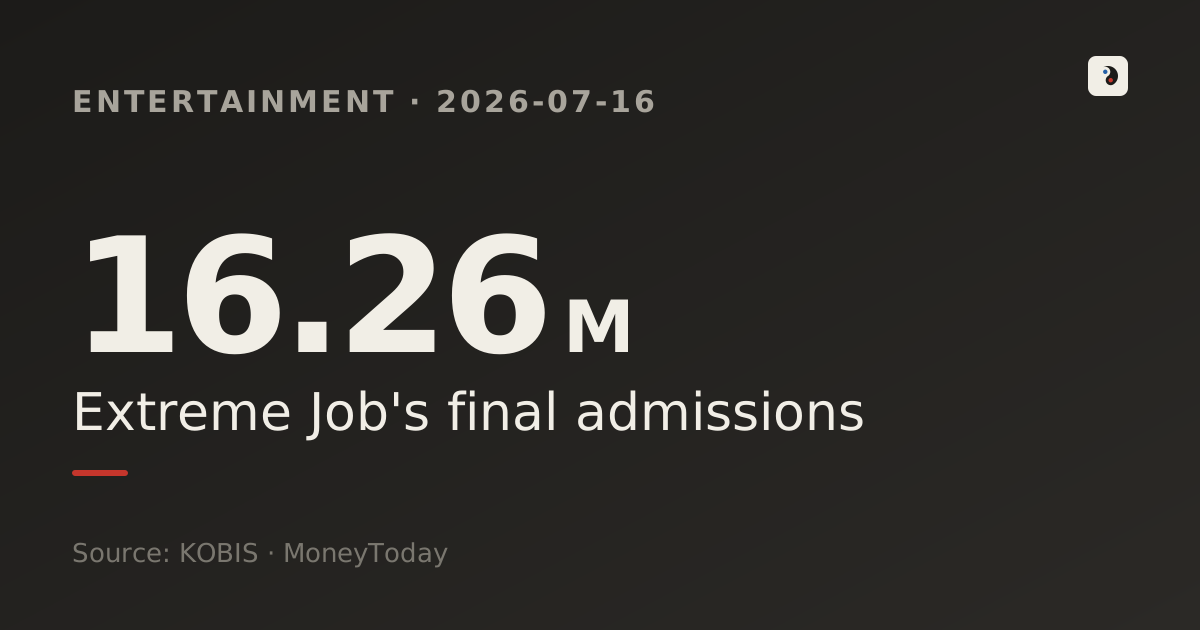
Extreme Job's 16.26M Admissions — and the No. 2 Spot It Lost in 2026
Korean comedy Extreme Job broke even in 4 days and drew 16.26M admissions and KRW 136.9B in revenue — and in 2026 a new hit finally took its No. 2 all-time spot. A data-driven look at both.

The Odyssey passes USD 1 billion in three weeks: reading worldwide box office
Christopher Nolan's 'The Odyssey' crossed $1 billion worldwide in three weeks, and topped 1 million admissions in South Korea faster than 'Oppenheimer' did. Here's what the numbers show.