· Updated 2026-09-10
Street Restaurant Fighter ratings: separating episode averages and peaks
Correction (2026-09-10): The scope, comparisons and interpretation of key figures have been reviewed and corrected below. The original publication date is retained.
A tvN survival show that competes on business skill, not cooking, is one month in -- here's what the ratings and buzz data actually show.
- tvN's 'Street Restaurant Fighter' is a business-survival show where 20 star chefs and seasoned restaurateurs are eliminated based solely on real customers' spending.
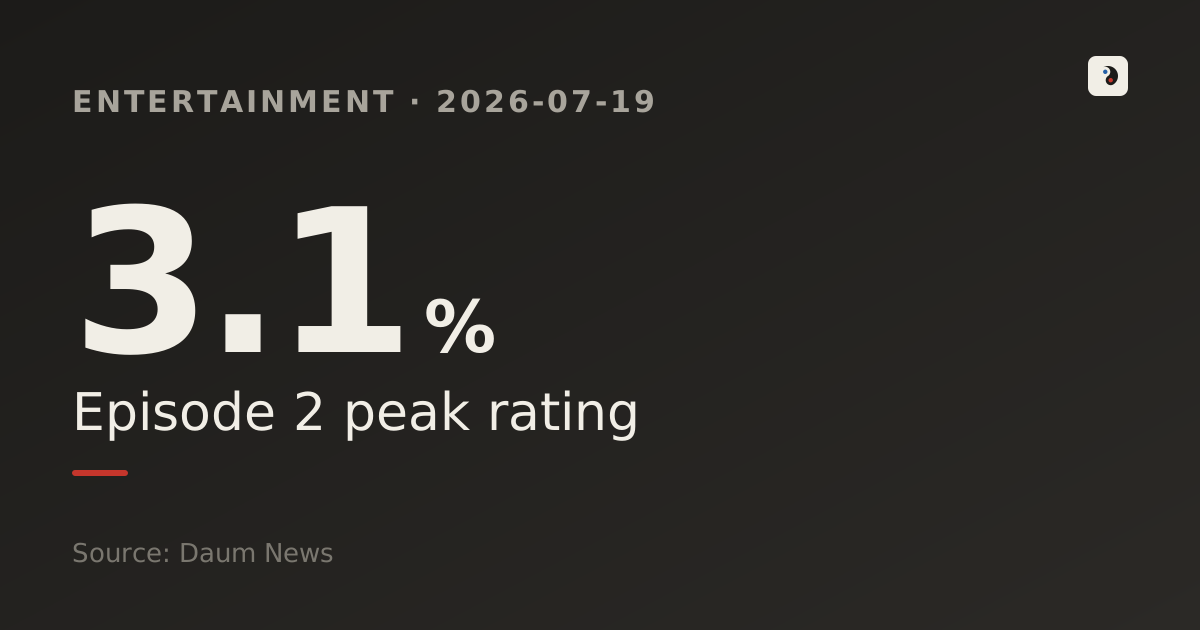
- Reported national household ratings are 2.2% for episode 1’s average, 3.1% for episode 2’s peak and 2.1% for episode 3’s average. These different metrics cannot yield a growth rate or three-episode average.
- The former “half” and “61% decline” claims compared a predecessor’s series peak with early episode averages. Those comparisons are withdrawn because the metrics differ.
What the Show Is
tvN's 'Street Restaurant Fighter' is a business-survival variety show that premiered on Sunday, June 21, 2026, at 7:40 p.m. It's the latest work from PD Lee Woo-hyung, who built the 'real-world business variety' genre with the 'Baeksajang' series and 'Would It Sell Here?', and it airs weekly on tvN and streams on TVING.
The show's core rule: 20 top figures from the food-service world compete with no expert judges -- survival and elimination are decided purely by how much real, unsuspecting customers are willing to pay. Media-famous star chefs like Lee Yeon-bok, Edward Kwon, Jung Ho-young, and Hong Suk-cheon share the stage with hands-on business veterans such as Yang Ji-sam, Kwak Dong-hun, and Kim Hoon, who built their reputations across both back-alley commerce and fine dining.
The Numbers Behind the Buzz
According to Nielsen Korea figures cited in reporting, episode 1 (June 21) averaged 2.2% nationwide, ranking No. 1 among cable channels in its timeslot. Episode 2 (June 28) climbed to a nationwide peak of 3.1% and a Seoul-metro peak of 3.4%, overtaking competing channels.
Reported national household ratings are 2.2% for episode 1’s average, 3.1% for episode 2’s peak and 2.1% for episode 3’s average. These different metrics cannot yield a growth rate or three-episode average.
What's Driving These Results
The format itself has drawn plenty of praise. Press coverage has described 'Street Restaurant Fighter' as tasting 'familiar yet new' next to 'Culinary Class Wars' -- it uses a grammar viewers already know from cooking-competition shows, but adds the variable of 'business': foot traffic, cost calculations, table turnover, even store-location logistics. Some critics also note that a real-world, wallet-based standard -- rather than an expert judge's aesthetic verdict -- has built strong viewer resonance.
Points of Debate
The show's judging standard -- revenue, and nothing else -- carries both a strength and a weakness. The strength is clear: because outcomes are decided by the coldest possible metric, 'customers paying with their own money,' instead of a judge's subjective call, the format is relatively insulated from accusations of bias or manipulation, and viewers can grasp results intuitively. Some critics, however, flag as a fundamental risk that this standard can hinge on incidental variables -- location, foot traffic, marketing -- more than on cooking skill, meaning a genuinely talented contestant could be knocked out early simply due to bad luck with location.
Another point of debate is whether this counts as 'variety' or 'documentary.' Competing for real revenue on actual streets, rather than in a studio set, heightens immersion, but it also delivers a documentary-like tension rather than variety TV's usual lightness. That seems to be producing two kinds of viewers at once: those who find it refreshing, and those who find it a bit too serious for a Sunday-evening variety slot.
Records and What They Mean
'Street Restaurant Fighter' is counted among the first tvN variety shows to build a survival competition entirely on revenue, with no expert judging panel at all. It's also notable that it has held the No. 1 spot in its timeslot -- including against general cable/comprehensive channels -- since early in its run. Beyond streaming on TVING, it's also listed on overseas platforms like Apple TV, showing that K-variety's international reach is expanding past cooking competitions into 'business' as a subject.
Within PD Lee Woo-hyung's own filmography, this is the third entry in the 'real-world business variety' lineage he's built through 'Would It Sell Here?' and 'Baeksajang' -- and it also represents an attempt to expand the format from a single-star structure to a multi-person ensemble.
What's Next
In the bigger picture, whether this show succeeds or fails is also a test of whether 'business' can stand on its own as a new category in a cooking-and-dining variety market that's already saturated since 'Culinary Class Wars.' Nothing is confirmed about a possible season 2, since neither the broadcaster nor the production company has made an official statement -- but if overseas platform reception, via Apple TV and others, comes through, the case for a follow-up series could take shape independent of domestic ratings.
- 'Street Restaurant Fighter' Premieres With a Fresh 2.24% Start -- Nate Entertainment (2026.06.22)
- 'Street Restaurant Fighter' Debuts at 2.2%, No. 1 on Cable -- S-List (2026.06.22)
- Unpredictable Twists Grab Viewers' Attention -- This Show Topped Its Timeslot -- Daum News (2026.06.29)
- Three Straight Weeks in the 2% Range -- Cooking-Survival Show 'SRF' Delivers a Twist From Round One -- Tenasia (2026.07.06)
- 'Baeksajang' PD Lee Woo-hyung Launches Chef Business-Survival Show 'Street Restaurant Fighter' -- Nate Entertainment (2026.02.12)
- 'Street Restaurant Fighter': Familiar Ingredients, New Flavor [Variety Breakdown] -- MoneyToday (2026.06.26)
- Like 'Culinary Class Wars,' Yet Not -- the New Flavor of 'Street Restaurant Fighter' -- Herald Biz (2026.06.25)
- Competing on Business, Not Cooking -- the Experiment of 'Street Restaurant Fighter' -- Daum News (2026.07.06)
- 'Baeksajang2' PD Lee Woo-hyung Interview -- 'I Wanted to Throw Baek Jong-won Into an Adventure' -- SPOTV News (2024.02.05)
This is nuloq's own analysis based on the public ratings, charts, reporting, and official sources listed under Sources, written with the help of AI. It is an interpretation of public data for information and criticism only -- not a definitive judgment of any show, cast, creator, or broadcaster -- and ratings and chart figures reflect the time of writing. We correct the text if errors are found.
Related posts
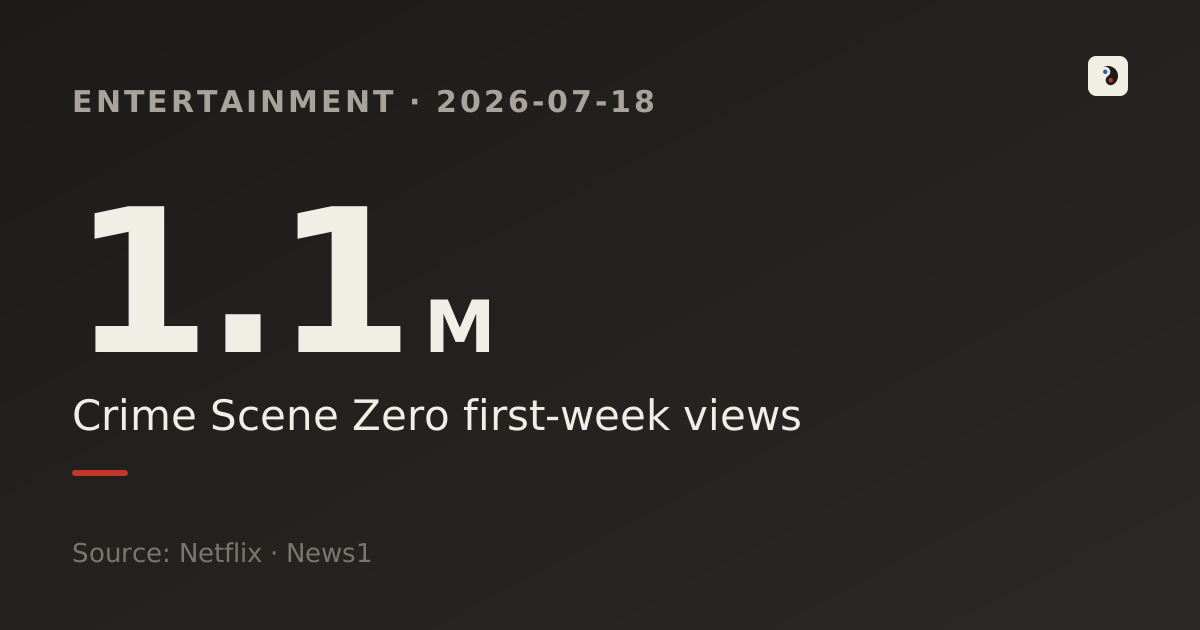
'Crime Scene Zero': No. 1 in Korea, Off the Global Top 10 by Week 2
Netflix's 'Crime Scene Zero' hit No. 1 in Korea and the Global Top 10 in week one, then fell off the world chart by week two. What the data says.

Spooky in Love: Netflix Top 10 in 42 Countries — What the 8th-to-5th Climb Means
tvN's Spooky in Love opened at No. 8 on Netflix's non-English chart and climbed to No. 5. Here is why its 1.7M first-week views sit far below Agent Kim's 8.2M — and why that gap is not about quality.

NCT 127 'BLINGY': 940K First-Week Sales, Still No. 1 in 3 Countries
NCT 127's 10th-anniversary album 'BLINGY' sold 940K copies in week one, ending a million-seller streak — yet it topped iTunes in 10 countries and swept Hanteo's US, Japan, and China charts.

ENHYPEN's 'THE SIN : BLISS' Nabs First Billboard 200 No. 1
ENHYPEN's 'THE SIN : BLISS' sold 2.1 million copies in week one, giving the group its first-ever Billboard 200 No. 1 six years after debut.