· Updated 2026-09-10
KOSPI Plunges 5.72% in a Day, Triggers Sell-Side Circuit Breaker
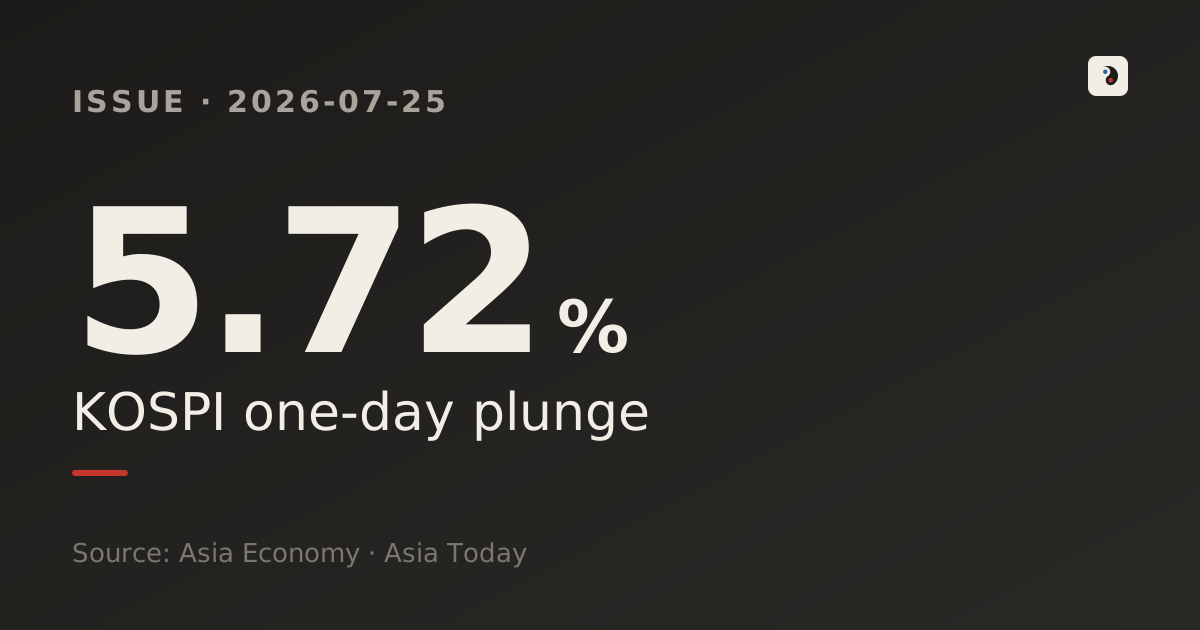
Correction (2026-09-10): The scope, comparisons and interpretation of key figures have been reviewed and corrected below. The original publication date is retained.
We examine the KOSPI fall and sell-side sidecar activation. Historical counts from different markets, mechanisms and periods cannot be directly compared.
- On July 24, the KOSPI fell 5.72% (406.27 points) to close at 6,690.62, triggering a sell-side circuit breaker — driven by a Wall Street tech sell-off and Brent crude breaking back above $100 a barrel.
- The 26 in 2008 counts annual KOSPI sidecars. The 45 through June 18, 2026 combines sidecars and circuit breakers on KOSPI and KOSDAQ. Different markets and mechanisms mean 45 exceeding 26 is not a like-for-like record.
- Trigger counts must be compared separately by market and mechanism.
What happened
On July 24, the KOSPI closed at 6,690.62, down 406.27 points (5.72%) from the prior session. As the drop deepened, the KOSPI200 futures contract stayed down more than 5% for over a minute, triggering a sell-side circuit breaker that suspended program sell orders for five minutes. The KOSDAQ fell in tandem, down 42.06 points (5.32%) to 748.22. By investor type, institutions net-sold 1.9513 trillion won and foreign investors net-sold 3.2828 trillion won, while retail investors net-bought 5.1783 trillion won, cushioning the fall. The won-dollar rate climbed to around 1,475 — a weaker won.
Why now — the background
Two triggers converged. The first was Wall Street. On July 23 (local time), the Nasdaq Composite fell 553.21 points (2.15%) after Google parent Alphabet announced expanded AI data-center capex alongside its first-ever negative free cash flow ("cash burn"), sending its stock down 7.13%; Tesla also posted its first negative quarterly free cash flow in more than two years and fell 14.52%. As AI spending pressure showed up in the numbers, "AI bubble" worries flared again. The second was oil. After President Trump said he was weighing the "biggest attack ever" on Iran and Houthi rebels in Yemen struck tankers in the Red Sea, Brent crude jumped 7.04% to $100.69 a barrel — its first close above $100 since May — reviving inflation and Fed-tightening concerns.
By the numbers
The 26 in 2008 counts annual KOSPI sidecars. The 45 through June 18, 2026 combines sidecars and circuit breakers on KOSPI and KOSDAQ. Different markets and mechanisms mean 45 exceeding 26 is not a like-for-like record.
This crash is nothing new, in fact. KOSPI first broke 7,000 in May on a rally in semiconductor stocks (Samsung Electronics, SK Hynix) and a wave of money moving out of real estate into equities, then hit an all-time high of 9,114.55 on June 22 — the day SK Hynix's market cap overtook Samsung Electronics's. Just two weeks later, on July 9, it had fallen nearly 20% to 7,291.91, and it has swung between sharp drops and sharp rebounds ever since. In July alone, by one count, there were only three days without a circuit breaker or sidecar trigger.
The debate — has the chip rally peaked?
Opinions inside and outside the market are split. Morgan Stanley's chief investment officer said the semiconductor-led bull run "is entering its final stage," and some analysts warn that SK Hynix's market cap overtaking Samsung Electronics — despite smaller projected 2026-2027 net profit — is itself a sign of overheating, where expectations ran ahead of earnings. JPMorgan, by contrast, calls the pullback a buying opportunity, and retail investors have indeed bought every dip (again net-buying more than 5 trillion won on July 24). Earnings will settle it: after Alphabet's July 22 report, Microsoft and Meta report on July 29 and Amazon on July 30, and markets will watch for signs that AI spending is translating into real revenue.
What's next — the implications
For now, three pressures are converging at once: rising oil prices push up import costs, the weaker won (around 1,475) raises costs for importers, and the burden of implementing the U.S. tariff deal adds a third headwind — together seen as a key second-half risk for Korea's economy. For individual investors, it looks safer to wait for late-July Big Tech earnings before deciding whether this pullback signals a structural slowdown in the chip cycle or just a temporary valuation correction. Still, the sheer frequency of circuit breakers and sidecars is itself a signal — that the market hasn't settled on either story, and that frightened money and bargain-hunting money are locked in a standoff.
- KOSPI Falls Below 7,000 as Institutions, Foreigners Sell Heavily — Asiae (아시아경제) (2026.07.24)
- Wall Street Falls on AI Spending Worries and $100 Oil, Nasdaq Down 2.15% — Newspim (뉴스핌) (2026.07.24)
- Oil Breaks $100 a Barrel; Refiners Rally — Newsis (뉴시스) (2026.07.24)
- Oil Spike Adds to Tariff, Won Pressure — Korea's Second-Half Wild Cards — Fnnews (파이낸셜뉴스) (2026.07.24)
- KOSPI Sidecar Fires for the 20th Time This Year, Nearing the All-Time Record — Newsis (뉴시스) (2026.06.03)
- Circuit Breakers and Sidecars Hit 45 This Year — Biggest Surge in a Decade — Asia Today (아시아투데이) (2026.06.18)
- Has the Semiconductor-Led KOSPI Rally Peaked? Views Diverge — Fnnews (파이낸셜뉴스) (2026.07.08)
This is nuloq's own analysis based on the public reporting and official data listed under Sources, written with the help of AI. It is for information only — not investment, legal, or medical advice — and reflects the situation at the time of writing. We correct the text if errors are found.
Related posts
KOSPI Surged a Record 17.91% in One Day — What SK Hynix's Limit-Up Really Means
KOSPI jumped a record 17.91% in one day and SK Hynix hit its price limit for the first time in 17 years. Here's the data behind Korea's wild semiconductor rally.
$350 Billion US Investment — No ‘First Project’ Confirmed as of September 7
We split the $350 billion into $200 billion of investment and $150 billion of shipbuilding cooperation investment, and worked out what a cap of $20 billion a year actually means. On September 7, 2026 the Ministry of Trade and Industry said the Encinal project had not been confirmed.
Korea's Growth Forecast Hits 3.2% — So Why Are New Jobs Falling?
KDI raised South Korea's 2026 growth forecast to 3.2% in 3 months on a chip boom — but new-jobs forecast fell from 170,000 to 110,000. The numbers, explained.
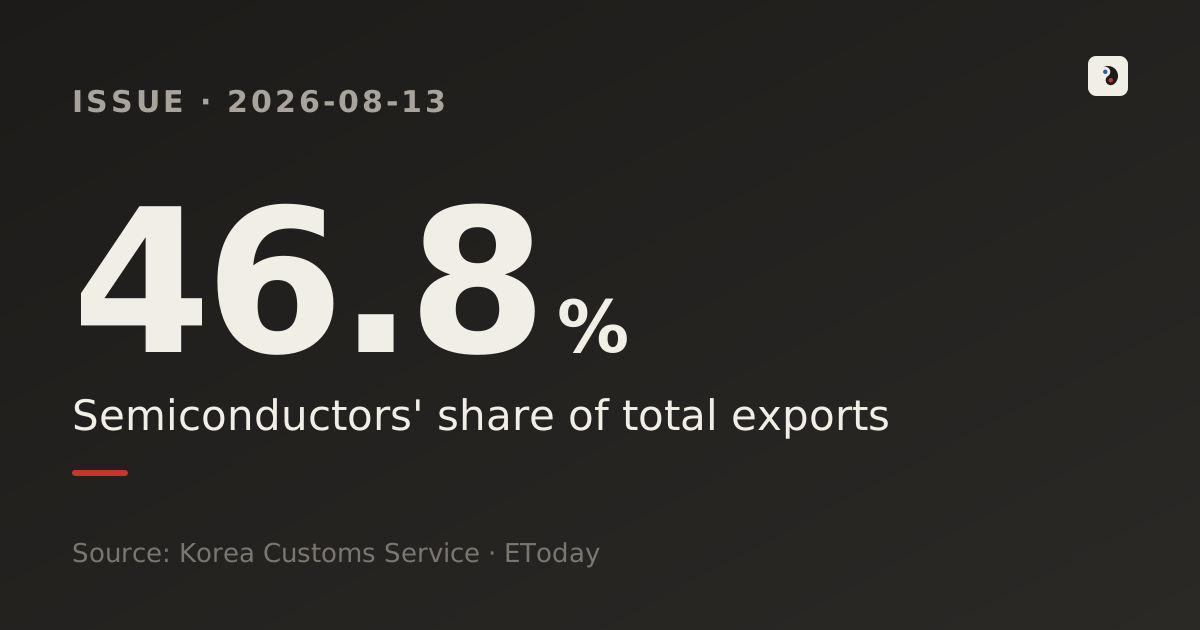
Chips Hit 46.8% of Korea's Exports — Inside a Record-High Warning Sign
Korea's exports hit a record $21.3B in early August, and 46.8% of it was chips alone. Here's the data behind how a share once in the low 20s doubled in two years — and why the boom itself is a red flag.