KOSPI Surged a Record 17.91% in One Day — What SK Hynix's Limit-Up Really Means
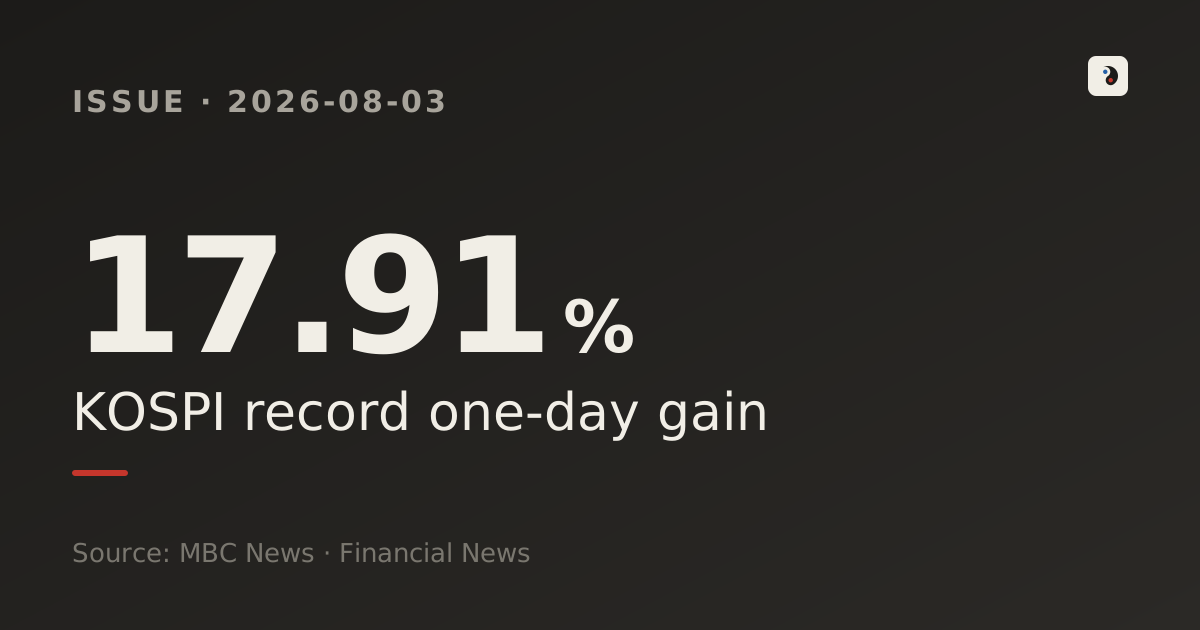
A stock that had been cut in half within five days hit its daily limit the very next session — so what does this rollercoaster actually tell us?
- On July 31, 2026, Korea's KOSPI index jumped 1,001.89 points (17.91%) to close at 6,595.45 — the largest single-day percentage gain and point gain since the index began in 1980.
- SK Hynix closed up 29.95% at 1,718,000 won, hitting the exchange's daily price limit for the first time since the band widened to ±30% in 2015, and the first limit-up for the stock since January 28, 2009.
- The trigger was Microsoft's stronger-than-expected earnings and AI capex guidance, plus a record 7.22 trillion won of net foreign buying — but this is the same market that hit a circuit breaker just ten days earlier, so opinions differ on whether this is a real rebound or overheating.
What happened
On July 31, 2026, the KOSPI closed at 6,595.45, up 1,001.89 points (17.91%) from the previous session — the largest single-day percentage gain and point gain on record since the index was first calculated in 1980. It was also the first time the KOSPI had ever risen by more than 1,000 points in a single day.
The same day, SK Hynix closed up 29.95% at 1,718,000 won, hitting the exchange's daily price-move limit. That's the first limit-up for the stock since the band was widened from ±15% to ±30% in 2015, and its first limit-up of any kind since January 28, 2009 — 17 years ago. Samsung Electronics also jumped 26.81% to close at 262,500 won. Foreign investors were net buyers of a record 7.22 trillion won in KOSPI stocks that day, with more than half of that — 3.61 trillion won — going into SK Hynix alone.
Why now — the rollercoaster's backstory
To understand the surge, you have to start ten days earlier. On July 13, the KOSPI plunged 8.95% (669.01 points) to 6,806.93 amid Middle East geopolitical tension and a semiconductor sell-off, triggering the market's seventh circuit breaker of the year. SK Hynix alone fell more than 15% that day.
Sentiment then swung the other way: SK Hynix hit an intraday all-time high of 2,987,000 won on July 25, only to crash to 1,322,000 won by July 30 — down 54.7% from that peak in barely a month. What reversed the slide overnight was Microsoft's earnings beat and its reaffirmed AI capital-expenditure plans. With confidence in AI spending by major customers restored, buying flooded into the HBM (high-bandwidth memory) suppliers feeding that demand: SK Hynix and Samsung Electronics.
SK Hynix had just reported its biggest quarter ever for April–June: revenue of 79.32 trillion won and operating profit of 60.54 trillion won, a 76% operating margin. Revenue was up 257% and operating profit up 557% year over year, and first-half revenue topped 100 trillion won for the first time — driven by HBM and AI-server DRAM.
The numbers
What makes this rally "record-breaking" only becomes clear next to history. The previous record for a single-day KOSPI gain was 11.95%, set on October 30, 2008, at the height of the global financial crisis. This year's move beat that by nearly six percentage points.
Looking at SK Hynix's stock alone makes the whiplash of the past two weeks even clearer.
Industry estimates (citing TrendForce data) put SK Hynix's 2026 HBM market share at around 50%, with Samsung at 28% and Micron at 22%. UBS, however, expects Samsung to close much of that gap by 2027 — so whether SK Hynix stays this rally's biggest winner is still an open question.
The debate — real rebound or overheating?
Analysts are split. Hanwha Investment & Securities (4.3 million won), along with KB Securities, Shinhan Investment, Mirae Asset Securities and Daol Investment (4.2 million won each), have set SK Hynix price targets well above its current level, citing expanding long-term HBM supply contracts and continued AI server spending. Others have pulled back: Shinhan Investment cut its target from 4.2 million to 2.7 million won, and Hanwha from 4.3 million to 3.15 million won, reflecting worries about a memory-price peak and stretched valuations.
Some are more worried about the volatility itself. One analyst at an overseas bank compared the KOSPI's recent swings to a meme stock or cryptocurrency, arguing that a pattern of losing half its value in days and then hitting a limit-up the next day looks less like healthy price discovery and more like buy or sell orders piling up around a single moment and stock. Leveraged-product trading volume during the rally, in fact, fell to roughly a quarter of what it had been during the crash — suggesting plenty of retail investors sold at the bottom and missed the rebound.
What's next
Most brokerages expect a "stepwise" recovery through August. One forecast puts the KOSPI's worst-case support around 5,150, with resistance near 6,350 once uncertainty clears — a cautiously optimistic view that still leaves room for further pullbacks.
- The HBM race: Samsung has said it aims to lift its second-half HBM share to match its overall DRAM market share, making SK Hynix's ability to defend its lead the key thing to watch next earnings season.
- Retail and leveraged investors: if 30%-ish daily moves keep repeating, the swings for anyone holding leveraged or inverse products will be far larger than the index itself.
- Macro variables: Middle East geopolitical risk and the next round of Big Tech earnings and capex guidance remain the outside factors that will decide whether this rally has legs.
In the end, this KOSPI–SK Hynix rollercoaster says less about the "AI semiconductor supercycle" itself than about how much faster — and further — markets are now swinging in response to it.
- SK Hynix hits limit-up, Samsung Electronics jumps 25% — Hankook Ilbo (2026.07.31)
- KOSPI surges 17.9%, a record gain — SK Hynix, Samsung Electro-Mechanics also hit limit-up — MBC News (2026.07.31)
- KOSPI jumps 1,001 points in a day on record foreign buying — Financial News (fnnews) (2026.07.31)
- "Sold it all yesterday" — records pile up as KOSPI jumps 1,001 points, SK Hynix hits limit-up — Seoul Shinmun (2026.07.31)
- SK Hynix hits limit-up for first time in 17 years, Samsung Electronics up 26% — Hankyung (Korea Economic Daily) (2026.07.31)
- KOSPI closes down 8.95%, seventh circuit breaker of the year — YTN (2026.07.13)
- "Numbers you'd only see in a war or a pandemic" — KOSPI swings 2,164 points in four days — Financial News (fnnews) (2026.08.02)
- SK Hynix's "historic limit-up" — brokerages eye 4 million won — Financial News (fnnews) (2026.08.01)
- SK hynix Announces Q2 2026 Business Results — SK hynix Newsroom (2026.07.29)
- "2026 HBM market share: SK Hynix 50%, Samsung 28%, Micron 22%" (citing TrendForce) — 4th Journal (2026.02.14)
- [Market Close] KOSPI jumps 17.91% on 7 trillion won of foreign buying, settles above 6,590 — Businesskorea (2026.07.31)
This piece is nuloq's own analysis, built solely from the public reporting and official data listed under Sources, with the help of AI writing tools. Treat it as information, not investment, legal, or medical advice — it reflects the situation as of publication, and we'll correct it if we learn something was wrong.
Related posts
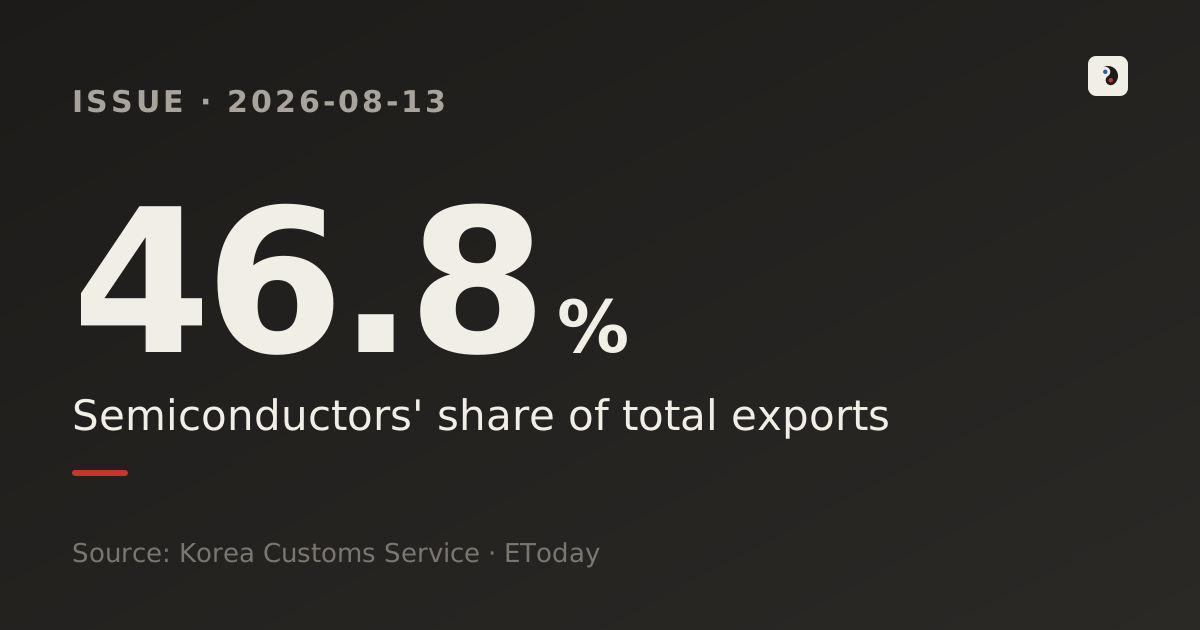
Chips Hit 46.8% of Korea's Exports — Inside a Record-High Warning Sign
Korea's exports hit a record $21.3B in early August, and 46.8% of it was chips alone. Here's the data behind how a share once in the low 20s doubled in two years — and why the boom itself is a red flag.
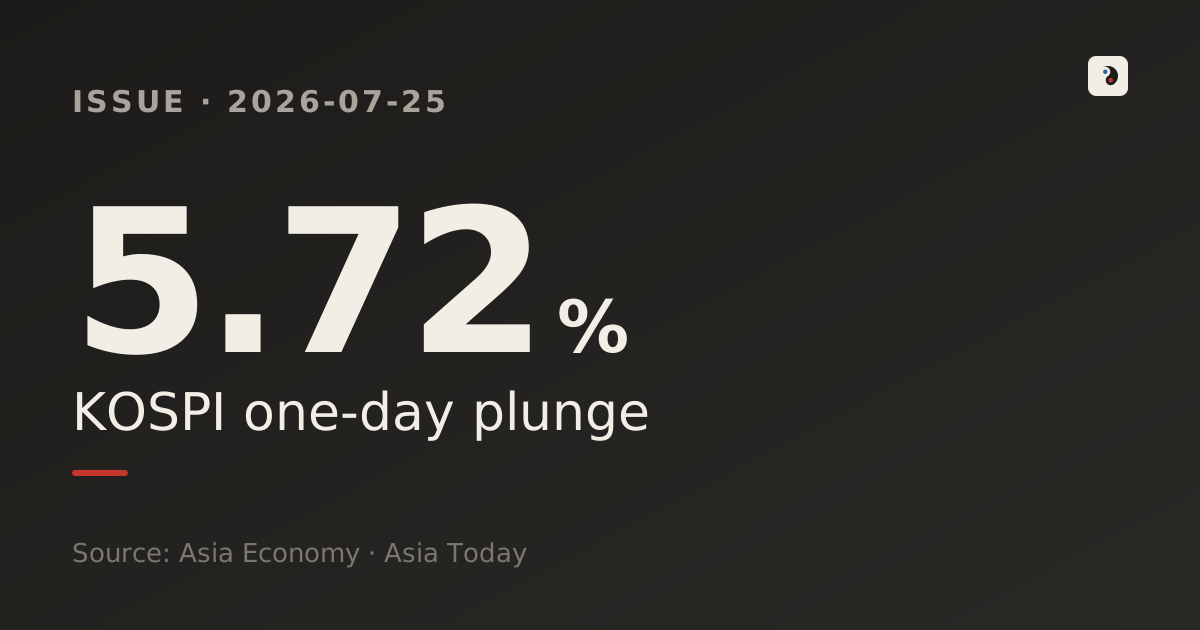
KOSPI Plunges 5.72% in a Day, Triggers Sell-Side Circuit Breaker
South Korea's KOSPI sank 5.72% in a day and triggered a sell-side circuit breaker. What a record 45 triggers this year reveal about the chip rally's future.
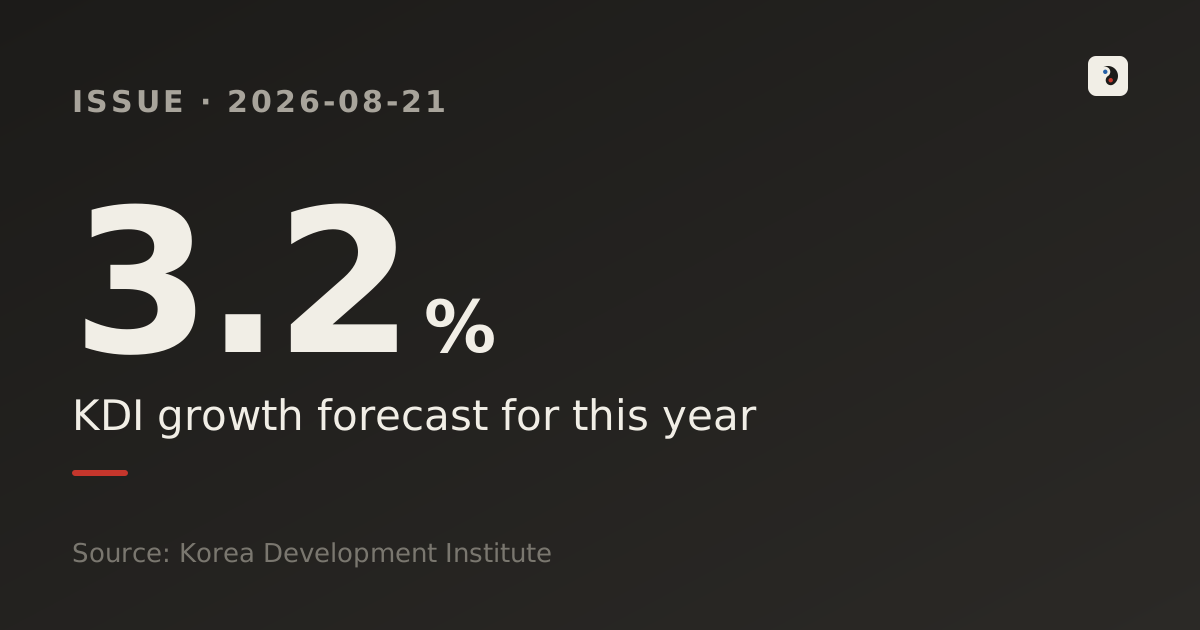
Korea's Growth Forecast Hits 3.2% — So Why Are New Jobs Falling?
KDI raised South Korea's 2026 growth forecast to 3.2% in 3 months on a chip boom — but new-jobs forecast fell from 170,000 to 110,000. The numbers, explained.
Korea's Current Account Hits Record $49.7B — Why the Chip Boom Isn't in Your Paycheck
South Korea's current account hit a record $49.7 billion in June, powered by a semiconductor export boom. Here's why the Bank of Korea itself is warning the windfall isn't reaching ordinary paychecks.