2026-07-20 KOSPI Drops 4.46%, 80mm/h Rain Alert, and BTS at the First World Cup Halftime Show
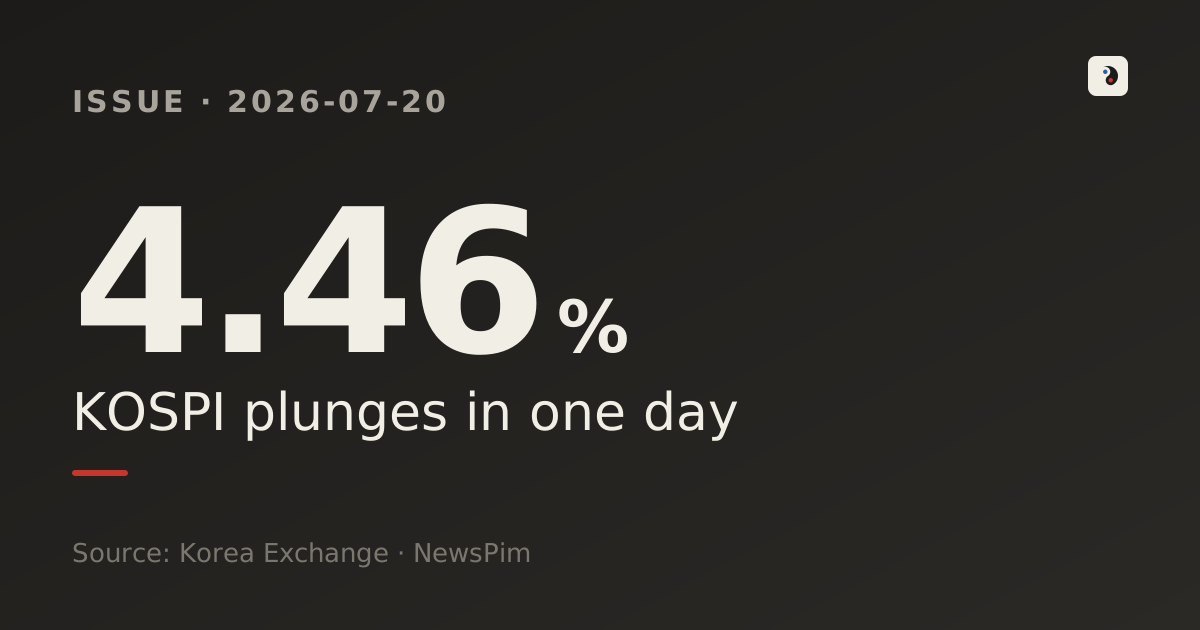
The 4.46% KOSPI plunge triggered by Kimi K3, 80mm-per-hour rain aimed straight at tomorrow's commute, and the first halftime show in the World Cup's 96 years, opened by BTS — today's three stories read with the DeepSeek precedent and 1.5-billion-viewer data, beyond what the original articles say.
KOSPI -4.46%: from 9,000 to 6,516, a month's three turning points
The KOSPI plunged 4.46% to 6,516. We unpack Kimi K3, the Chinese AI model that pulled the trigger, the structure of a 27% one-month correction — and what the DeepSeek precedent suggests.
Monday's opening bell in Seoul brought another wave of selling — and another 4% day.
The KOSPI closed at 6,516.27 on July 20, down 304.33 points (4.46%), while the KOSDAQ sank 5.33% to 749.64, losing the 750 line. According to Newspim, sell-side sidecars were triggered in both markets — the KOSDAQ at 10:52 a.m., the main board at 11:21 a.m. Samsung Electronics fell 4.31% to 244,000 won and SK Hynix dropped 4.23% to 1,764,000 won, breaking below the 2-million-won mark.
By the end of this card you'll know where the slide began — and what the DeepSeek precedent suggests comes next.
The trigger: Moonshot AI's Kimi K3
According to Newsis, the immediate trigger was Kimi K3, a new model from Chinese AI startup Moonshot AI. With 2.8 trillion parameters and a 1-million-token context window, it reportedly rivals top U.S. models — reviving doubts about whether massive AI infrastructure (that is, memory chip) spending must continue at this scale. Institutions drove the fall, net-selling 1.1466 trillion won, while retail investors (+597.1bn won) and foreigners (+442.9bn won) actually bought the dip.
About -27% in a month: three inflection points
This was not a bolt from the blue but the extension of a month-long correction. The KOSPI first broke 9,000 on June 18. On July 2, Meta's plan to resell spare AI computing ("neocloud") was read as a chip-cycle-ending signal; on July 13 the index crashed 8.95% (910 points) to 6,806.93, losing the 7,000 line (KBS). Today's close of 6,516 sits about 27% below the 9,000 mark.
The DeepSeek precedent
The setup mirrors the DeepSeek shock of January 2025: back then, too, a low-cost Chinese model hammered chip stocks — and, as Financial News notes, semiconductor shares soared over the following year. Some analysts argue this time as well that spreading open models could open the upside for AI hardware demand rather than end it.
China's AI catch-up may signal not the end of chip demand but a change in who is buying — that is the lesson DeepSeek's year left behind.
80mm-an-hour forecast — tonight's checklist for Tuesday's commute
Up to 80mm of rain per hour is forecast for Incheon and northern Gyeonggi overnight into Tuesday morning. Here's how strong that really is, plus a pre-commute checklist.
Before you go to bed tonight, take one more look at tomorrow's commute route.
The Korea Meteorological Administration (KMA) and SBS forecast that a revived stationary front will dump very heavy rain overnight: 50–80mm per hour over Incheon and northern Gyeonggi between late night and Tuesday morning (July 21), and 30–50mm per hour over Seoul and southern Gyeonggi in the morning. Kyunghyang Shinmun reports Monday's commute already saw sudden downpours of up to 80mm, and cumulative totals through Tuesday could exceed 150mm in Incheon, northern Gyeonggi and inland northern Gangwon.
By the end of this card you'll know how intense this rain really is — and what to check before heading out.
What 80mm an hour actually means
Seoul's average July rainfall is around 414mm (KMA, 1991–2020 normals). At 80mm per hour, roughly a fifth of a monsoon month's rain falls in a single hour — wipers become useless and road drainage hits its limit. The real problem is timing: the heaviest band is forecast for the pre-dawn-to-morning window, exactly overlapping the commuting peak.
Why 150mm on saturated ground is worse
After weeks of monsoon rain, soil and streams are already loaded with water. The same 150mm now runs off faster instead of soaking in, raising flood and landslide risk — which is why cumulative totals matter as much as hourly intensity.
Tonight's checklist
Pick detours around underpasses, riverside roads and low-lying areas, and check first-train times and service notices. If you live in a semi-basement or on the ground floor, check flood barriers and drains. Drivers: if water rises, open a door or window before the power fails. One more look at emergency alerts and the KMA radar in the morning goes a long way.
Tomorrow morning's safety is decided by ten minutes of preparation tonight — start with your route.
12 minutes before 1.5 billion — BTS and the first World Cup halftime show
BTS performed at the first halftime show in the World Cup's 96-year history. We explain FIFA's break with tradition through one number pair: 1.5 billion vs 127.7 million viewers.
At the 4 a.m. kickoff (KST), Korean viewers were waiting for more than just football.
In the 2026 World Cup final at MetLife Stadium in New Jersey, Spain beat Argentina 1-0 after extra time on Ferran Torres's winner, lifting their second title 16 years after 2010 (YTN). And at halftime came something never seen in the tournament's 96-year history: a 12-minute show, with BTS performing "Dynamite" alongside Madonna, Shakira and Justin Bieber.
By the end of this card you'll see why FIFA broke a 96-year custom — and why BTS stood on that stage.
Why FIFA broke the custom: the Super Bowl playbook
The numbers explain the calculation. FIFA says 1.5 billion people watched the 2022 Qatar final — about 12 times the record 127.7 million (Nielsen) who watched the most-viewed Super Bowl. Yet FIFA still imported the Super Bowl's halftime formula, because it turns the minutes when play stops into advertising, sponsorship and cultural-event revenue. Coldplay's Chris Martin served as creative director, Global Citizen produced the show, and it is tied to a $100-million children's education fund (Sports Kyunghyang).
Why we argue about it
Per Wikitree, plenty of fans pushed back, calling it a violation of football's basic rhythm. The argument itself is the interesting part: those who see halftime as rest treat football as a communal ritual; those who see it as a stage treat it as a global media product. The desire to protect 90 minutes of purity and the industry logic of chasing 1.5 billion viewers collided head-on in these 12 minutes. And the fact that the first act to open that door included seven members from Korea says the clearest thing about where both football and pop now live — beyond any one continent.
The 12-minute show marked the line where football shifts from a match to the planet's biggest media event — worth remembering who opened that door.
Each issue is nuloq's own analysis, drawing on the original reporting and public data (official statistics and institutional sources), written with the help of AI. See each card's link and in-text citations for sources.
Related posts
2026-07-19 Korean Won Globalization Roadmap, 89mm/h Night Rain and DK's EWC Title
Korea unveiled a roadmap to make the won a freely exchangeable currency — yet only 3.4% of exports settle in won. Plus a night-rain safety checklist after 89mm fell in one hour, and Dplus KIA's first international title in six years.
Homeplus Creditor Vote: MBK's ₩4.1 Trillion Exit, ₩1.9 Trillion Accounting Mystery
Creditors voted Sept. 2 on Homeplus's fate. Here's how MBK drained ₩4.1 trillion from the retailer over eight years, then turned ₩1.9 trillion of debt into equity six days before its rehabilitation filing.
Korea's Growth Forecast Hits 3.2% — So Why Are New Jobs Falling?
KDI raised South Korea's 2026 growth forecast to 3.2% in 3 months on a chip boom — but new-jobs forecast fell from 170,000 to 110,000. The numbers, explained.
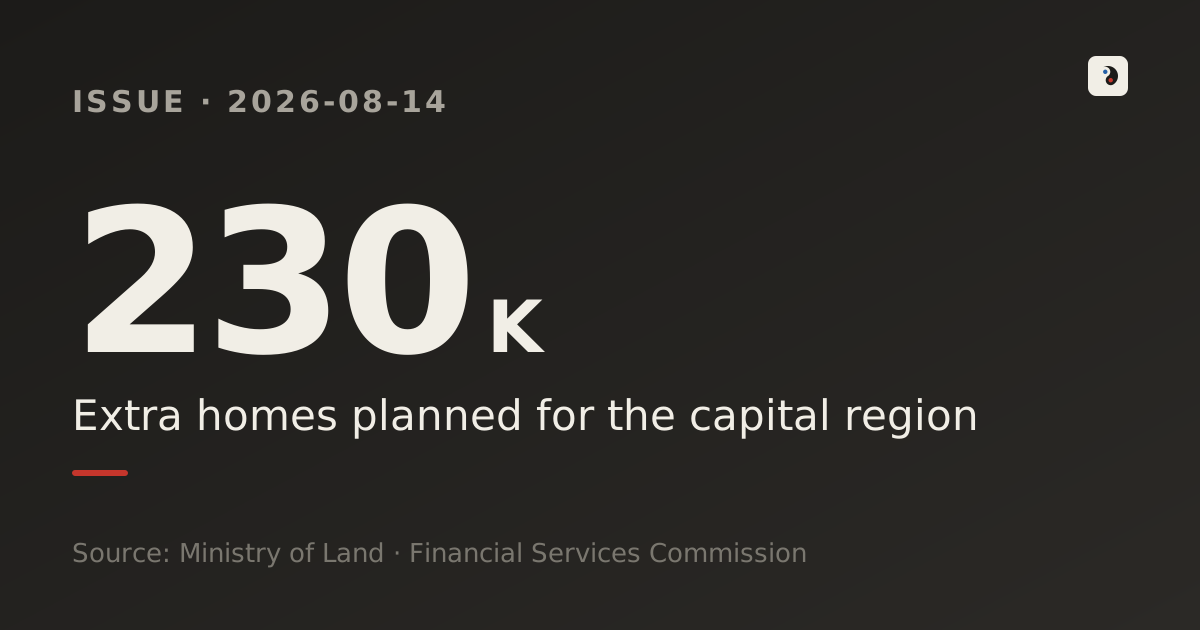
Korea Doubles Housing Loans, Adds 230,000 Homes — Will It Work?
Korea unveiled a housing plan on Aug. 13 adding 230,000+ homes and doubling household loan quotas, as Seoul's jeonse prices rose six times faster than a year ago. Here's whether it can actually cool the market.