Homeplus Creditor Vote: MBK's ₩4.1 Trillion Exit, ₩1.9 Trillion Accounting Mystery
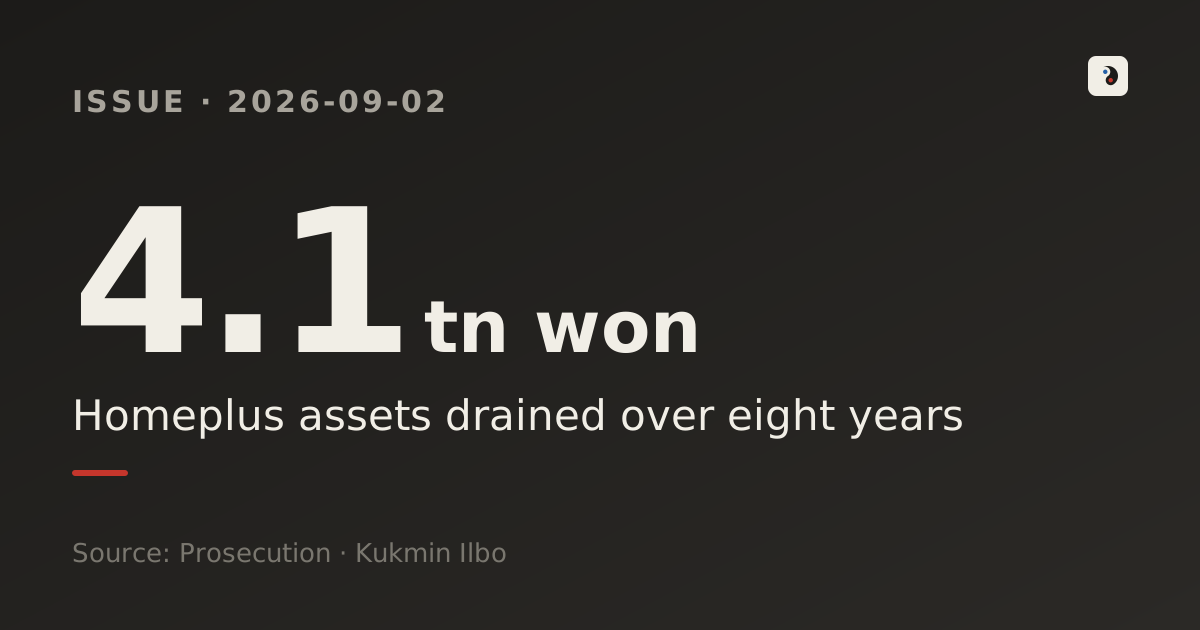
On the day creditors decided Homeplus's fate, the numbers behind the vote tell the real balance sheet of a decade under private equity ownership.
- On Sept. 2, a Seoul Bankruptcy Court creditors' meeting voted on Homeplus's revised rehabilitation plan; if secured creditors (75%), general creditors (66.7%) and shareholders (50%) approve, the court will confirm it on Sept. 4.
- MBK Partners pulled ₩4.1 trillion out of Homeplus between 2016 and 2024 while reinvesting only ₩760.6 billion, and six days before the rehabilitation filing it reclassified ₩1.16 trillion of debt as equity to dodge full capital impairment.
- Whatever the vote's outcome, the legislation needed to rein in leveraged-buyout private equity and assign bankruptcy liability is still stuck in Korea's National Assembly — so nothing yet stops the next Homeplus.
What happened
At 3 p.m. on Sept. 2, a creditors' meeting convened in Courtroom 1 of the Seoul Bankruptcy Court to vote on Homeplus's revised rehabilitation plan. Approval requires at least 75% of secured creditors, 66.7% of general creditors and 50% of shareholders. As of Aug. 31, consent stood at 59% for installment repayment of common-benefit claims, 64.4% among trade-payable (supplier) creditors and 87.9% among employees — supplier consent was the biggest variable. If approved, the court decides final confirmation on Sept. 4; if rejected, the rehabilitation proceeding is dismissed and Homeplus heads toward bankruptcy.
The road to this vote was rocky. Homeplus filed for rehabilitation in March last year, but the proceeding was terminated on July 3 this year after it failed to secure the required funds, and ten days later, on July 13, it abruptly shut all 67 stores nationwide without prior notice. The court revived the case after top shareholder MBK Partners chairman Michael ByungJu Kim and top creditor Meritz Financial Group agreed to back ₩200 billion in operating funds, with Kim personally guaranteeing part of it.
Why this vote is a turning point
What makes this vote heavier than its price tag is how the company got here. Homeplus's 2015 acquisition by MBK Partners for ₩7.2 trillion was one of Korea's largest leveraged buyouts (LBOs) — a deal structured so much of the purchase price was financed against Homeplus's own assets, effectively making the company repay the debt used to buy it.
After Korea Investors Service downgraded Homeplus's credit rating from A3 to A3- in February 2024, prosecutors suspect MBK and management knew a downgrade was coming yet kept issuing short-term paper — commercial paper and asset-backed short-term bonds — including a further ₩82 billion issued even after learning of the downgrade. About half of the roughly ₩600 billion in outstanding short-term bonds, some ₩300 billion, was sold to individual and corporate investors through some 20 securities firms — retail investors bought paper whose repayment capacity was already in doubt, drawing repeated comparisons to the 2013 Tongyang Group scandal that burned individual investors.
The numbers
The substance of this crisis compresses into two numbers — how much the private equity owner pulled out of the company, and how much its books were adjusted to dodge bankruptcy.
Between March 2016 and February 2024, MBK sold off or extracted ₩4.1 trillion in Homeplus assets. Over the same period it reinvested just ₩760.6 billion — less than a fifth of what came out. The ₩3.36 trillion gap is presumed to have gone mostly toward repaying acquisition debt and interest: rather than growing the company, the buyout debt was repaid with the company's own assets.
An even more decisive number surfaced six days before the rehabilitation filing. On Feb. 26, Homeplus signed a contract with special-purpose vehicle Korea Retail Investment that shifted the redemption right on ₩1.16 trillion of redeemable convertible preferred shares (RCPS), reclassifying that amount from debt to equity. Combined with a land revaluation, the total added to equity came to ₩1.93 trillion. Without that adjustment, prosecutors calculate, total equity at the end of February would have been minus ₩444.9 billion instead of the reported ₩1.49 trillion — full capital impairment. Homeplus counters that the reclassification was "legitimate accounting, reviewed objectively by an outside auditor."
The dispute — was the accounting legal, and is private equity supervised enough?
The two sides are sharply divided. Homeplus and MBK maintain the RCPS reclassification and land revaluation complied with accounting standards and passed outside audit. Prosecutors and the Financial Supervisory Service lean toward suspecting the timing was engineered to mask full capital impairment, and FSS Governor Lee Chan-jin has said heavy sanctions against top shareholder MBK will be pushed through swiftly. Labor groups and opposition lawmakers go further, arguing private equity's "capital extraction" should carry bankruptcy liability.
This pattern isn't unique to Korea. Toys "R" Us, bought by Bain Capital, KKR and Vornado for $7.5 billion in 2005, saw debt service swallow 97% of operating income before it collapsed in 2017, wiping out 30,000 jobs. Sears, Payless and Claire's followed similar leveraged-buyout paths into bankruptcy — a recurring warning sign for any structure that makes an acquired company repay its own takeover debt with its own assets.
What comes next
If the plan is approved, the court decides on final confirmation Sept. 4 and Homeplus clears its first hurdle toward exiting court receivership. But the harder part follows: the current plan calls for shrinking the company and selling it to a new buyer, and without a real buyer stepping forward, the plan itself may not hold together. With 12,000 direct employees plus partner firms and specially employed workers, up to 100,000 livelihoods hinge on whether that sale actually happens.
If rejected, the rehabilitation proceeding is dismissed and Homeplus will likely head toward bankruptcy. Either way, the unfinished business this case leaves behind — how far to regulate leveraged private equity buyouts and how to assign liability in bankruptcy — stays with the National Assembly regardless of the vote's outcome. Whether the bills already stuck there actually pass is what will decide if the next acquired company's workers and creditors have to ask the same questions again.
- Homeplus creditors' meeting set for Sept. 2 to vote on revised rehabilitation plan (2026.08.29)
- Homeplus's fate to be decided Sept. 2 — creditor consent is the key variable (2026.09.01)
- Homeplus's rehabilitation plan goes to a vote today, fate hanging in the balance (2026.09.02)
- Seoul court revives Homeplus rehabilitation after MBK, Meritz back ₩200 billion funding plan (2026.07.17)
- Homeplus secures ₩200 billion DIP financing, but supplier distrust and ₩1 trillion accounting controversy cloud restructuring (2026.07.19)
- [Exclusive] Six days before filing, ₩1 trillion in debt vanished from Homeplus's books (2026.03.15)
- Homeplus on the brink of bankruptcy: a look inside the crisis (2026.07.14)
- The private equity firm that broke Homeplus — 'regulate capital extraction, impose bankruptcy liability' (2026.07.15)
- 'Private equity's excessive leverage caused the Homeplus crisis' — regulator moves to sanction MBK swiftly (2026.07.21)
- Homeplus bonds: ₩200 billion from individuals, ₩300 billion from companies — a repeat of the Tongyang and LIG scandals? (2026.03.20)
- How private equity killed Toys "R" Us (2018.03.20)
This is nuloq's own analysis based on the reporting and disclosures listed under Sources, written with the help of AI tools. It is for information only — not investment or legal advice — and reflects the situation as of the time of writing; we correct the piece if errors are found.
Related posts
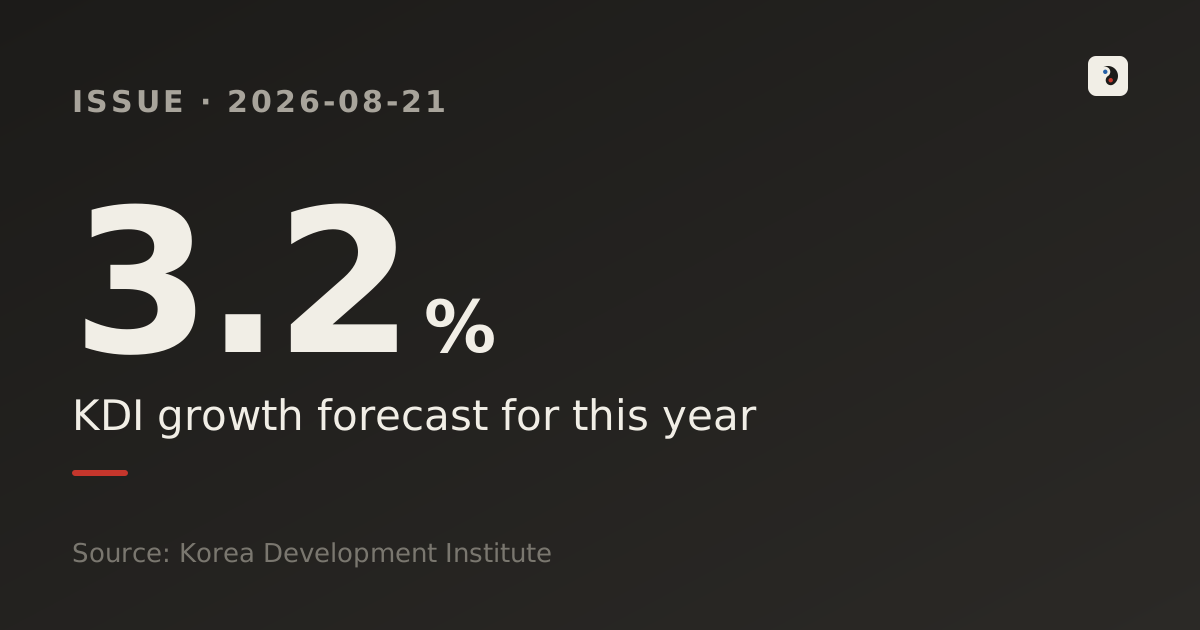
Korea's Growth Forecast Hits 3.2% — So Why Are New Jobs Falling?
KDI raised South Korea's 2026 growth forecast to 3.2% in 3 months on a chip boom — but new-jobs forecast fell from 170,000 to 110,000. The numbers, explained.
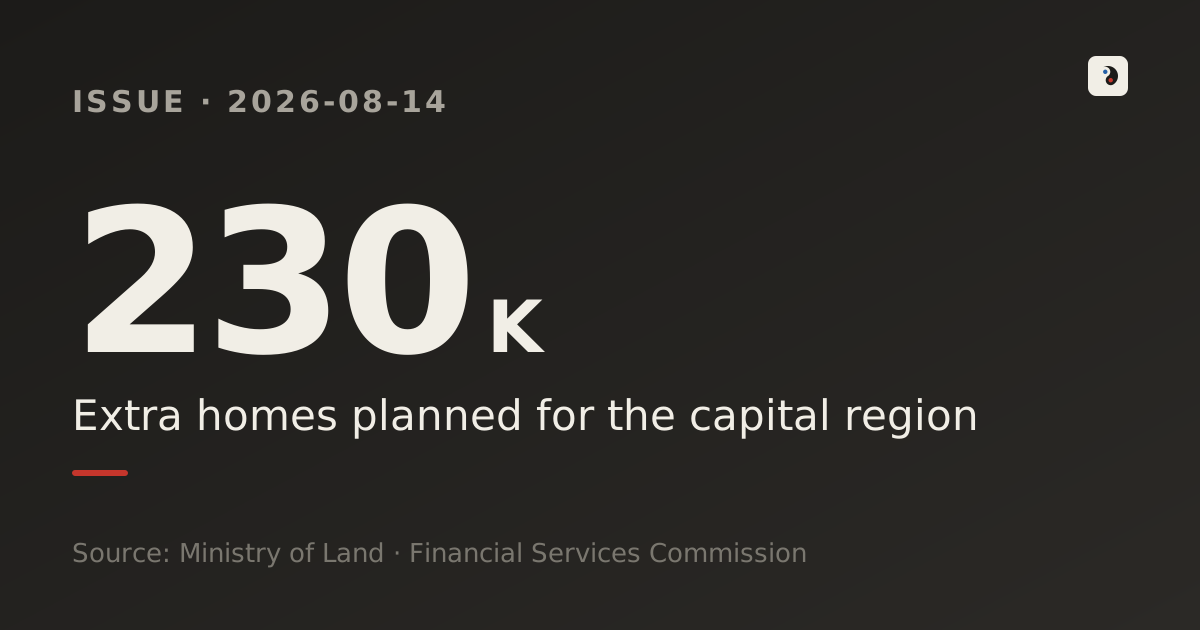
Korea Doubles Housing Loans, Adds 230,000 Homes — Will It Work?
Korea unveiled a housing plan on Aug. 13 adding 230,000+ homes and doubling household loan quotas, as Seoul's jeonse prices rose six times faster than a year ago. Here's whether it can actually cool the market.
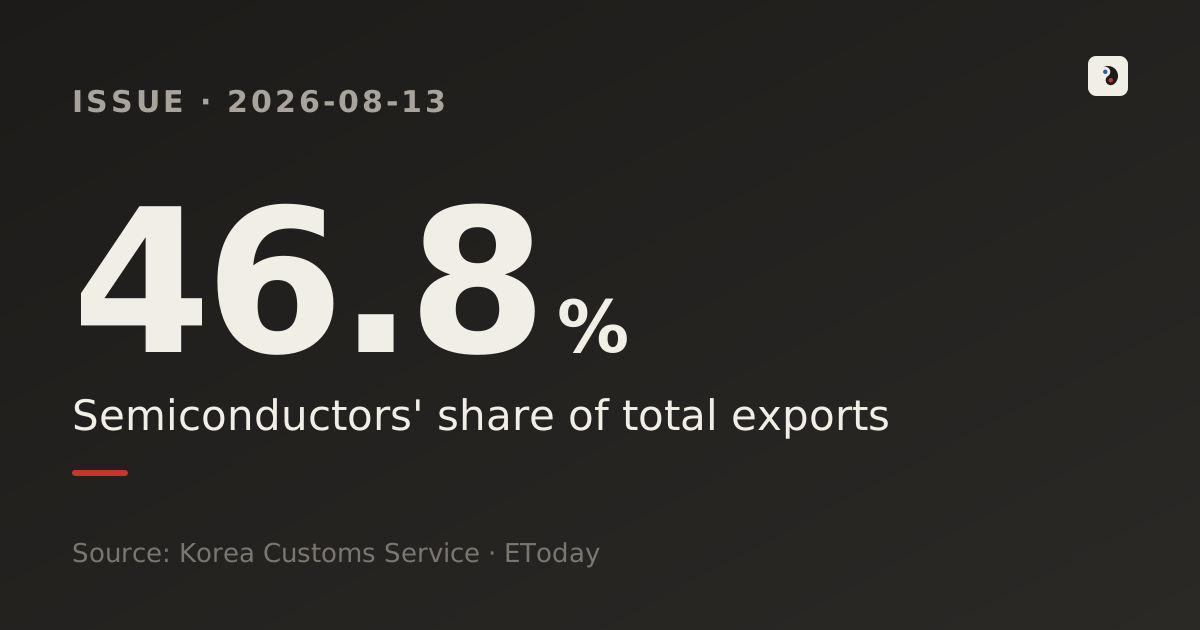
Chips Hit 46.8% of Korea's Exports — Inside a Record-High Warning Sign
Korea's exports hit a record $21.3B in early August, and 46.8% of it was chips alone. Here's the data behind how a share once in the low 20s doubled in two years — and why the boom itself is a red flag.
Korea's Current Account Hits Record $49.7B — Why the Chip Boom Isn't in Your Paycheck
South Korea's current account hit a record $49.7 billion in June, powered by a semiconductor export boom. Here's why the Bank of Korea itself is warning the windfall isn't reaching ordinary paychecks.