Kospi Circuit Breakers Two Days Straight, 40.3°C Record Heat, a 1,000-Trillion-Won AI Bet — Korea in Three Numbers
First-ever back-to-back circuit breakers with the Kospi at 5,663, a record 40.3°C in Yangsan, and a 1,000-trillion-won AI datacenter pledge — we reread today's three stories through halt statistics, record cycles and power math the original reports don't provide.
Back-to-Back Circuit Breakers, Kospi at 5,663 — Why 6 Halts in 27 Years Became 9 in 2026
The Kospi opened up 1% and still ended down 5.98%, halting trade for a second straight day — a first in Korean market history. Halt statistics and money flows reveal what kind of crash this is.
A session that opened with a rebound ended at 5,663.24.
On July 29 the Kospi opened 1.09% higher at 6,089.11, but the index sank more than 12% intraday; a circuit breaker froze trading for 20 minutes at 12:32 p.m., and the market closed down 360.42 points (5.98%) at 5,663.24 (Newspim). The Kosdaq lost 6.12% to 662.68 — the first time since the system was introduced in 1998 that both markets have been halted on two consecutive days. After Monday's 10.84% plunge, the Kospi has now lost more than 30% in July alone (Herald Business).
By the end of this card you'll know why a failed rebound is a worse signal than a plain crash — and what happened after past circuit breakers.
Six halts in 27 years, nine in seven months
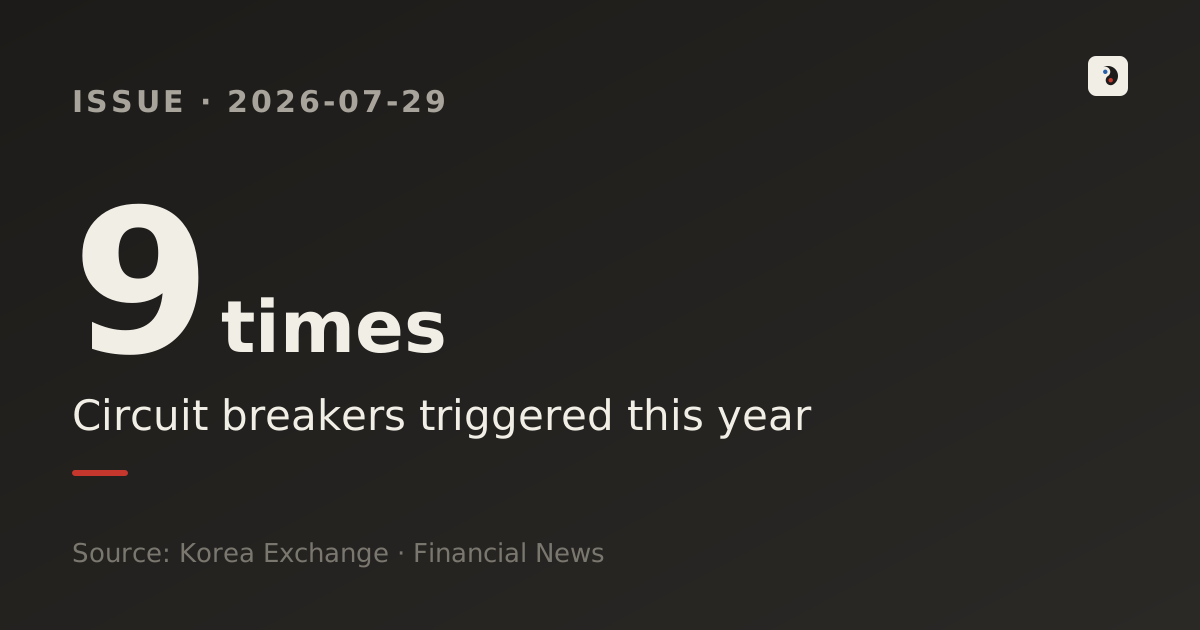
Since its introduction in December 1998, the Kospi circuit breaker had fired six times in 27 years — the 2000 dot-com bust (twice), 9/11 in 2001, the COVID crash of March 2020 (twice) and the August 2024 sell-off. This year alone it has fired nine times, 1.5 times the previous 27 years combined (Korea Exchange data via Financial News). The frequency itself says this is not a one-off shock like 9/11 or COVID, but an AI-inflated valuation deflating in stages over several weeks.
The sellers changed — this time it was retail
Foreign investors, who dumped 4.97 trillion won of stock on Monday, scaled back to 791.1 billion won of net selling; retail investors sold 2.93 trillion won instead, while institutions bought 3.63 trillion won and still could not hold the line (Newspim). Dip-buyers who chased the morning bounce to 6,228.52 capitulated in the afternoon — a classic failed rebound. Fear migrating from foreign desks to retail accounts is hard to read as a bottom signal.
The next variable — the speed of the response
Roughly 864 trillion won of market value has evaporated in this crash, and the government hastily convened its 'F4' meeting of top economic and financial officials (Seoul Economic Daily). Analysts argue the fall has detached from fundamentals and call for immediate cool-down steps such as a market stabilization fund — the tool that helped turn the March 2020 COVID crash after two circuit breakers. The variable, once again, is speed.
Nine circuit breakers measure not the size of the fall, but the market's failure so far to agree on where the bottom is.
40.3°C in Yangsan — How a Once-in-76-Years Number Became an Annual Event
Yangsan hit 40.3°C and Busan logged its hottest day in 122 years. Eight decades of temperature records show how fast 40°C is becoming routine in South Korea.
In South Korea, 40°C is turning from an event into a season.
At 3:34 p.m. on July 29, Yangsan in South Gyeongsang reached 40.3°C, the highest since observations began there in 2008 — breaking the 39.3°C mark it had set just three days earlier, on July 26. The same afternoon Busan hit 38.8°C, its hottest reading since modern records began in 1904, 122 years ago (Hankook Ilbo). Korea has now crossed 40°C three years in a row, and in July for a second consecutive year (Financial News).
This card shows how much the weight of '40°C' has changed over 84 years — and why numbness, not the number, is the real danger.
Once in 76 years → 6 years → every year
Korea's first recorded 40.0°C came in Daegu on August 1, 1942. That reading stood alone for 76 years, until Hongcheon set the all-time record of 41.0°C on August 1, 2018. Since 2024, somewhere in Korea has crossed 40°C every single year (KMA observation records). A renewal cycle collapsing from 76 years to six to annual means extreme heat has moved from statistical outlier to part of the distribution.
Why we stop noticing
Each hotter summer resets the reference point, so perceived risk fails to keep up with actual risk — the shifting-baseline effect. Busan's 122-year record shows this heat is statistically exceptional, yet the feeling that 'last year was hot too' quietly erodes vigilance. And unlike a typhoon, a heatwave arrives without sirens — familiarity itself becomes the risk factor for heat illness.
A record is most dangerous not when it breaks, but when nobody is surprised anymore.
18.4GW, the Power of 13 Nuclear Reactors — Inside Korea's 1,000-Trillion-Won AI Datacenter Bet
The government and 400 companies launched an alliance to build 18.4GW of AI datacenters by 2035. Converting the target into power terms shows how big — and how conditional — it really is.
On the very day semiconductor fear crushed the stock market, the government and 400 companies gathered to build the house those chips will live in.
The Ministry of Science and ICT launched the AI Datacenter (AIDC) Alliance on July 29 at the Lotte Hotel in Seoul — the executing body for the 'mega project' strategy announced on June 29: 8.4GW of AI datacenters by 2029, 18.4GW by 2035, and more than 1,000 trillion won of cumulative investment. Around 400 companies and institutions joined, including SK Telecom, Naver Cloud, LG Electronics and Kakao; SK Telecom CEO Jung Jae-hun serves as the private-sector co-chair (Money Today).
By the end of this card you'll know how big 18.4GW really is — and what has to be solved first for the blueprint to stand.
18.4GW is a power problem, not a construction problem
18.4GW equals the capacity of roughly 13 of Korea's newest APR1400 nuclear reactors (1.4GW each). The essence is not building datacenters but generating and moving electricity. The alliance's structure — three divisions for demand, supply and infrastructure plus an export-industrialization task force (Digital Daily) — reflects that, aiming to grow the entire upstream-downstream chain, from servers to cooling to power equipment, into an 'intelligence export factory.'
The irony of the timing
The Kospi fell for a second day on fears of China's semiconductor catch-up. On the day the market doubted the present of Korean chips, the government wagered 1,000 trillion won on the future demand for them. Unlike chips, though, the bottleneck here is not technology but grid capacity, siting and electricity prices — whether the power and transmission answers arrive within the three years to the first-stage 8.4GW target in 2029 is this blueprint's first test.
The 1,000-trillion-won question is ultimately a single one: where will the electricity come from?
Each card layers public data — Korea Exchange tallies, KMA observation records — on top of the original reporting; the analysis is nuloq's own, written with the help of AI tools. The sources behind every claim are noted in each card's link, in-text citations and chart footnotes.
Related posts
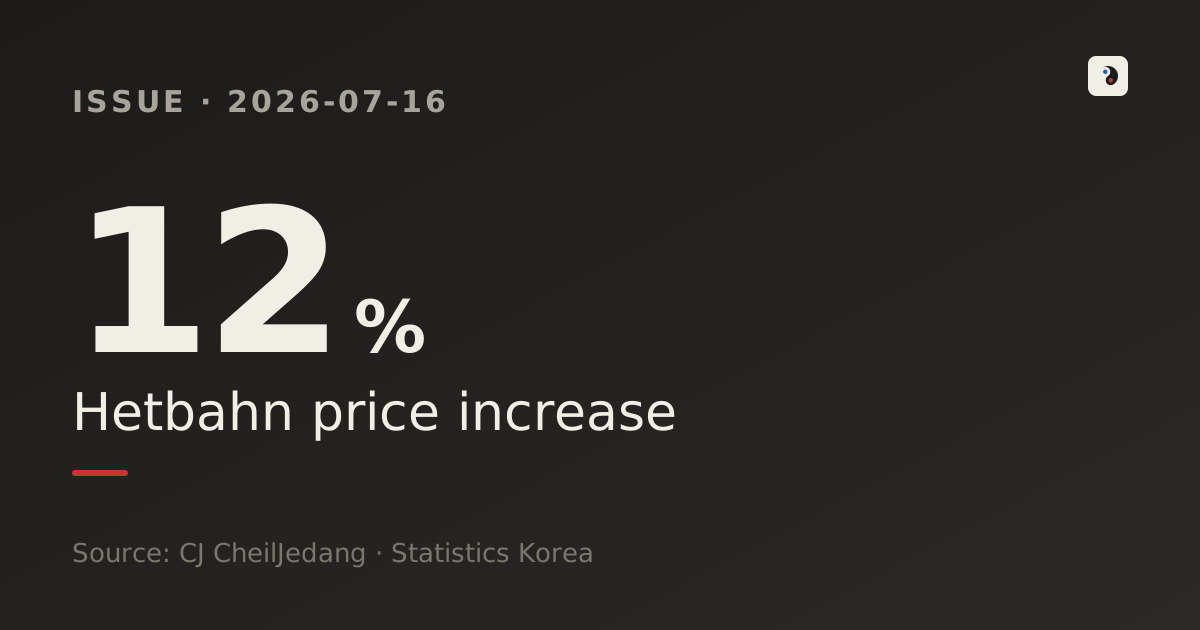
2026-07-16 Rice Packs Up 12%, a 550-Trillion-Won AI Bet, 933 Heat Cases: What 3 Numbers Mean
Rice-price increases, private-sector plans for KRW 550 trillion in AI data centres, and 933 heat-illness cases: a briefing that separates actors and measurement scopes.
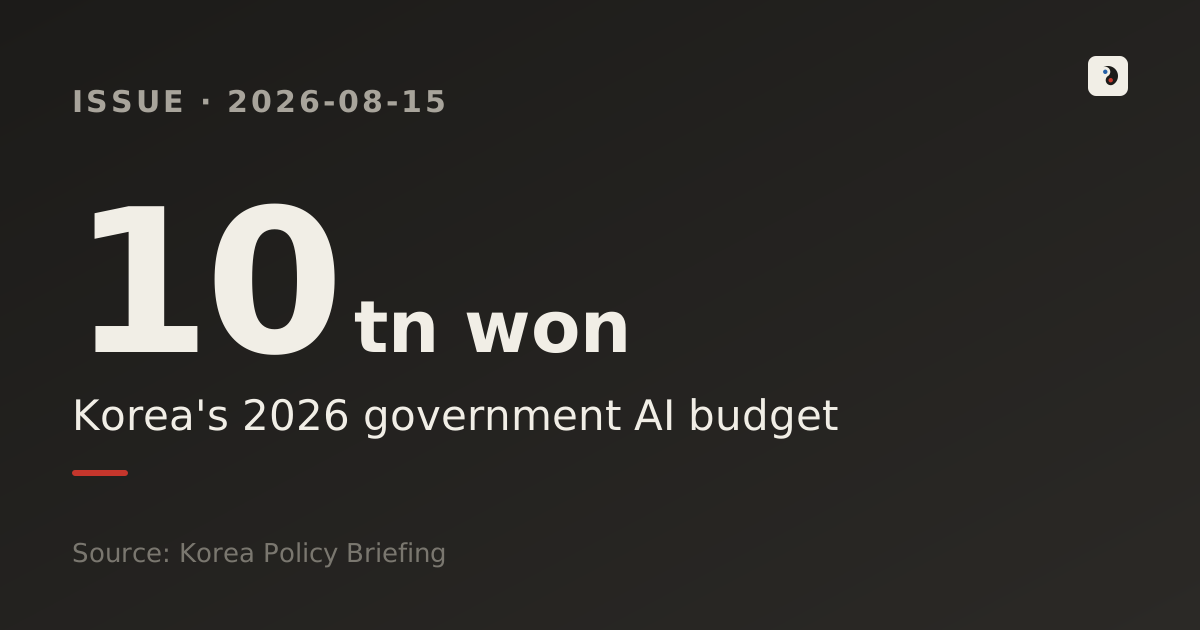
South Korea's AI Budget Jumps 211% to ₩10.1 Trillion — Can It Catch Up?
South Korea's 2026 AI budget jumped 211% to ₩10.1 trillion. As President Lee's Liberation Day speech leans into an 'AI top-3' vision, we checked the numbers.
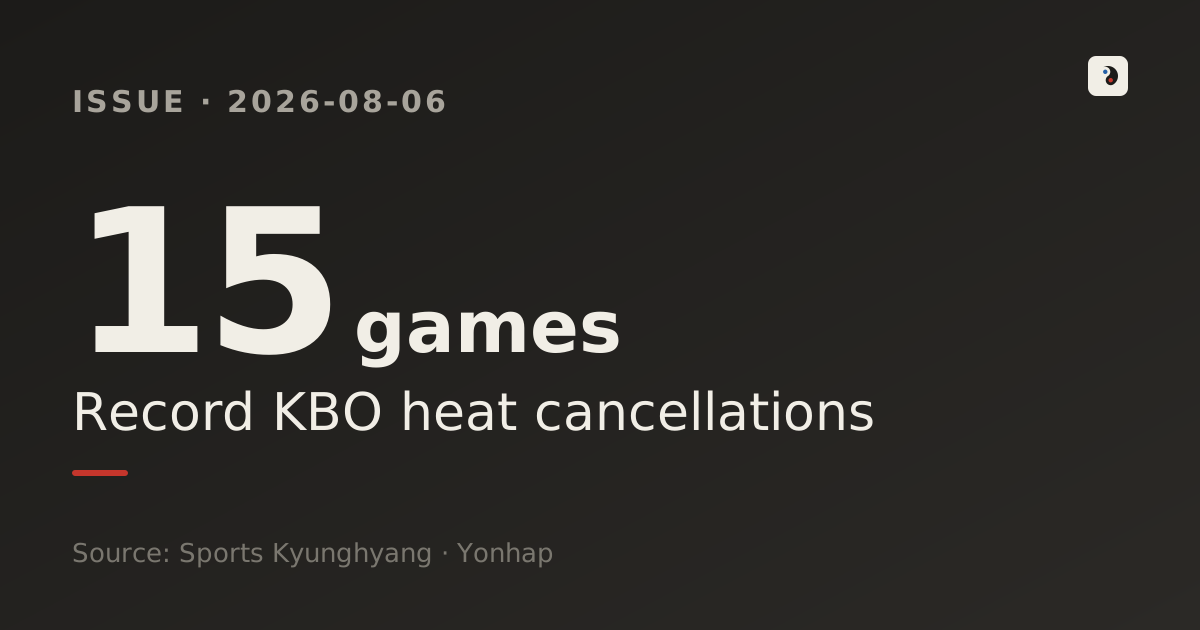
Korea Baseball Heatwave Crisis: Why KBO's New Heat Rule Failed in a Day
KBO scrapped its new heat-cancellation rule a day after announcing it, following a fan's CPR emergency. Here's what a temperature-only safety rule missed, in the numbers — plus a record 15 games called off this season.
Korea Elderly Workers Top 10 Million, KOSPI Jumps 3.76%, Galaxy Z8 Hits 1.44M Presales — Why 3 Records Fell in One Day
Koreans aged 55-79 in work topped 10 million for the first time. Why they leave jobs at 53 yet hope to work until 73.6, what 29 sidecar halts in six months say about the KOSPI's 3.76% surge, and the price math behind 1.44 million Galaxy Z8 presales — all in numbers.