Korea Elderly Workers Top 10 Million, KOSPI Jumps 3.76%, Galaxy Z8 Hits 1.44M Presales — Why 3 Records Fell in One Day
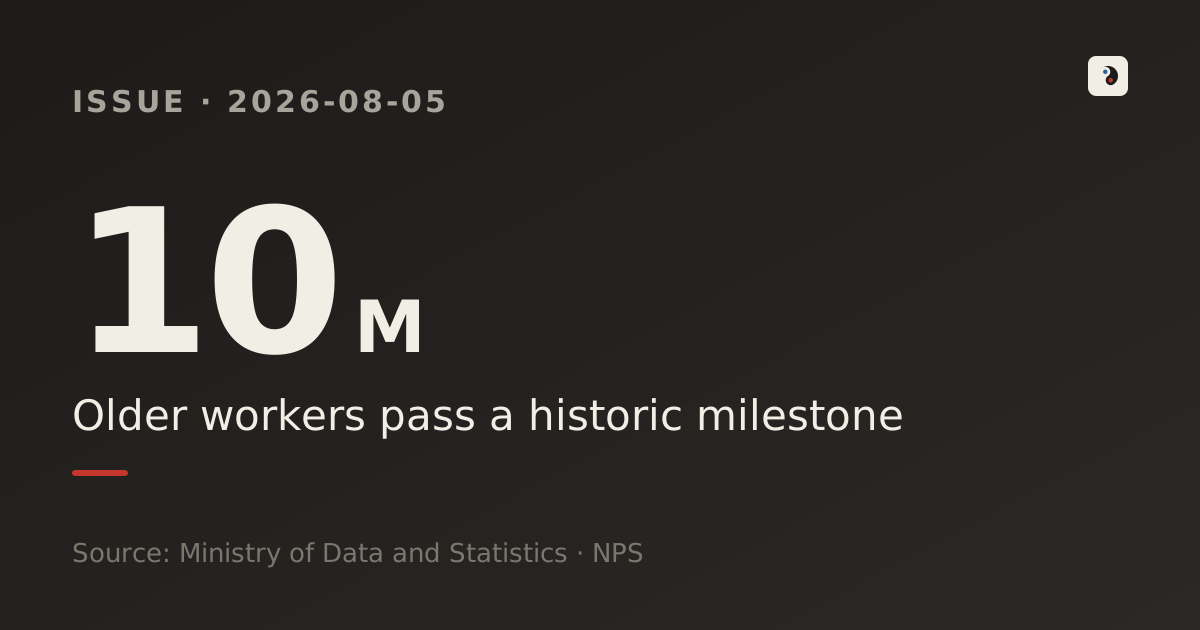
Ten million older Koreans in work, a 3.76% KOSPI surge that tripped the buy sidecar, and 1.44 million Galaxy Z8 presales — three all-time records landed on the same day, so we dug into the structures behind each with figures and comparisons you won't find in the original reports.
10 Million Elderly Workers — Why Koreans Pushed Out at 53 Want to Work Until 73.6
Workers aged 55-79 topped 10 million for the first time in the survey's 21-year history. Only one in ten made it to official retirement age — and a pension of 880,000 won a month explains why so many keep heading to work in their seventies.
In Korea, retirement is increasingly less a life stage than a wish.
According to the May 2026 supplementary survey of older workers released on August 5 by Korea's national statistics office, employed people aged 55-79 numbered 10,125,000 — up 345,000 (3.5%) from a year earlier and above 10 million for the first time since the series began in 2005. The age group now counts 17,017,000 people, 37.0% of everyone 15 or older, and their employment rate held at a record 59.5%. Seven in ten (69%) said they want to keep working, to an average age of 73.6.
Two numbers sitting below the headlines explain why they intend to work so long.
Only One in Ten Retires on Schedule — the Main Job Ends at 53
The same survey found that people left their longest-held job at an average age of 53.0. The top reasons were business slumps, shutdowns and closures (24.9%) and poor health (22.1%) — mostly exits that were forced, not chosen. As Newspim noted, only about one in ten ended their main career through formal retirement at the statutory age. Korea's legal retirement age of 60 is, in practice, a minority experience.
An 880,000-Won Pension and a 20.6-Year Gap People Fill Themselves
Just 52.7% of this age group receive a pension, averaging 880,000 won a month (national statistics office). Leaving the main job at 53.0 means bridging roughly 12 years before the National Pension starts paying (at 65 for those born from 1969, per the National Pension Service) — and stretching to the desired working age of 73.6 means covering 20.6 post-career years with one's own labor. The top reason for wanting to work is "to help with living costs" (53.4%), ahead of "enjoyment of working" (36.7%): elderly work in Korea is less a preference than a household-budget necessity.
Before it is a sign of vitality, the 10-million mark is a signal that Koreans are bridging the 20 years between a 53-year-old exit and an 880,000-won pension with their own labor.
KOSPI Surges 3.76% and Trips Another Sidecar — Half a Year That Beat the 2008 Record
The KOSPI closed 3.76% higher at 6,598.26, recouping most of Monday's plunge in three sessions. We checked 24 years of trading-halt statistics to see why the buy sidecar keeps firing this year.
Minus 5.12% on Monday, plus 3.76% on Wednesday — these days the KOSPI swings between bear and bull inside a single week.
On August 5 the index closed at 6,598.26, up 239.31 points (3.76%), per the Seoul Economic Daily. Overnight gains in the US — Nasdaq +2.59%, Philadelphia Semiconductor Index +6.55% — lifted chip heavyweights, with Samsung Electronics up 2.5% (246,000 won) and SK Hynix up 5.77% (1,668,000 won), while foreign investors led the rebound with 1.446 trillion won of net buying. Twenty-five minutes after the open, at 9:24 a.m., KOSPI 200 futures spiked 5.12% and triggered a buy sidecar, freezing program buy orders for five minutes (Asia Today). Here is why this surge is not purely good news, told through sidecar statistics.
A Brake Meant for 2.5 Times a Year, Pulled 29 Times in Six Months
The sidecar is a safety mechanism that pauses program trading for five minutes when futures move violently. Exchange tallies cited by Newsis show that from 2002, when the current criteria were introduced, through last year, it fired 60 times in 24 years — about 2.5 times a year. This year it fired 29 times by the end of June alone (15 buy-side, 14 sell-side), overtaking the full-year record of 26 set in crisis-hit 2008 and marking an all-time high (Asiae). And the pace has carried into August.
The Index Came Back in Three Days — the Amplitude Didn't Go Away
This week ran Monday -5.12% → Tuesday +1.62% → Wednesday +3.76%. The index is back near where it started, but the problem is amplitude, not direction. Both the plunge and the surge were concentrated in semiconductor heavyweights and program trading, so a single piece of US AI-stock news now swings the whole index — a pattern that has become routine. A rebound driven by 1.4 trillion won of foreign net buying also means the same concentration can work just as powerfully in reverse.
What matters today is less the 6,598 close than the fact that a brake designed for 2.5 uses a year has been slammed 29 times in six months.
Galaxy Z8 Presales Hit 1.44 Million — Is Korea's 880,000-Won Discount a Reason to Buy Now?
The Galaxy Z8 set a new all-time Galaxy presale record of 1.44 million units, the first in seven years. Here are three number-based checks for timing a phone upgrade in the age of memory-driven price hikes.
Just as phones approach the 3-million-won mark, people are opening their wallets faster than ever.
Samsung's Galaxy Z Fold8 and Flip8 sold 1.44 million units in Korean presales from July 28 to August 3, breaking the all-time Galaxy record of 1.38 million set by the Galaxy Note10 in 2019 (ETNews). That is 38% more than last year's Z Fold7/Flip7 (1.04 million), and the big-screen Fold8 line took about 70% of sales. Presale units began activating on August 4, with official launch on August 7. Here is why the phone sold out upward despite rising prices — and what to check if you are weighing an upgrade.
"Buy Before It Goes Up" — the Last-Train Psychology of Chipflation
As AI data centers soak up memory, DRAM and NAND prices are climbing. Research firm TrendForce projects third-quarter contract prices for commodity DRAM to rise another 13-18% quarter-on-quarter, after jumps of 40-50% in each of Q4 last year and Q1 this year (Seoul Economic Daily). With component costs pushing up finished-device prices — "chipflation" — the calculation that the next model will cost more is pulling purchases forward.
Korea's Launch Price Is Among the World's Lowest — Three Things to Check
The Fold8 256GB lists at 2,278,100 won in Korea, versus $2,099 in the US — about 3.16 million won at the reported conversion (Seoul Economic Daily). That makes Korea roughly 880,000 won cheaper and effectively the lowest-priced major market. If an upgrade is on your list, check these:
- Further memory contract-price increases are forecast for the second half, so year-end and next-year models will carry more built-in cost pressure.
- Korea's launch price is held about 880,000 won below the US — a rare moment when buying domestically beats importing.
- Carrier promotions and presale perks cluster around the launch window (activations from Aug 4, release Aug 7).
1.44 million units is a win for foldables — but it is also proof that the old rule "electronics get cheaper if you wait" has been flipped by the memory crunch.
Today's briefing layers public data — national statistics office figures, Korea Exchange sidecar tallies, TrendForce forecasts — over the three source articles, recalculated and interpreted by nuloq as its own analysis, written with the help of AI tools. The evidence for each figure is kept in the cards' source buttons and the citations in the text and infographics.
Related posts
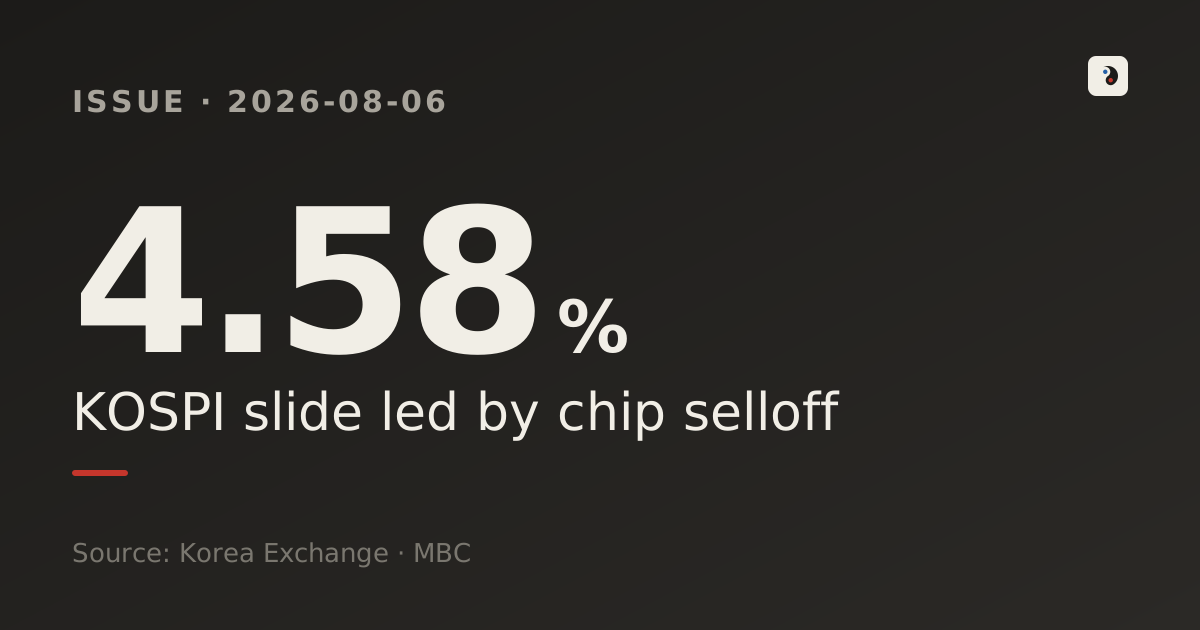
KOSPI Falls 4.58%, Heat Halts Korean Baseball, Kakao Hits Record Profit: What the Numbers Mean
KOSPI fell 4.58% on a chip selloff, yet the structure differs sharply from the 8.77% crash of 2024. Plus Korea’s first-ever two-day baseball heat shutdown, and why Kakao’s record +36% profit still leaves the AI question open.
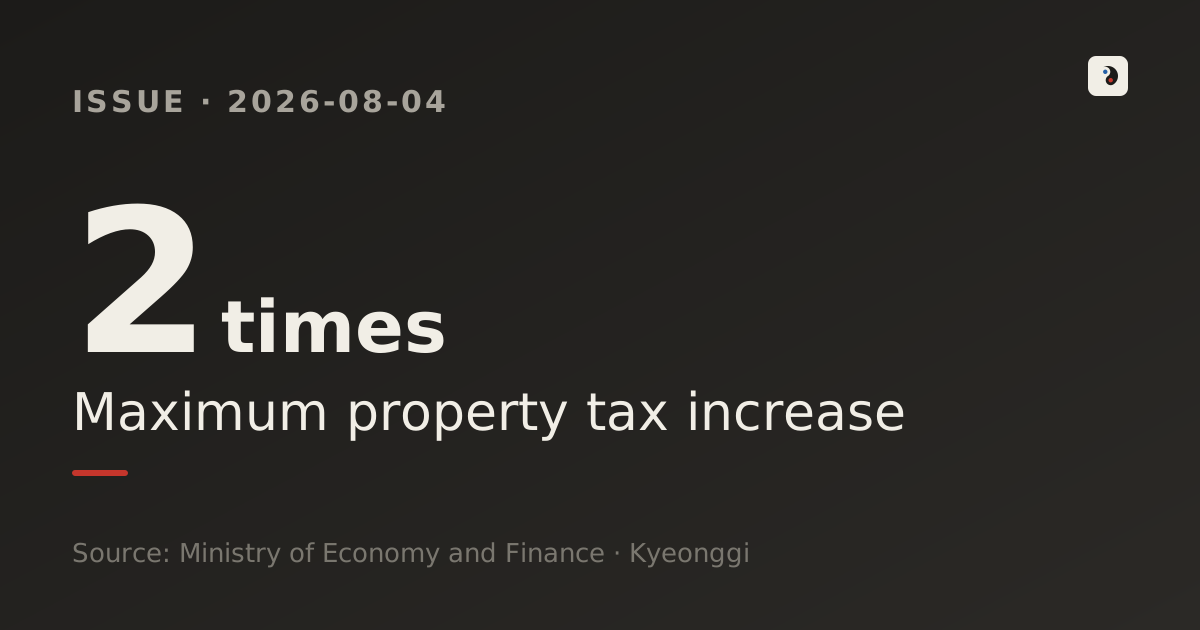
Korea Doubles Top Property Tax, KOSPI Sinks 5.12%, K-Beauty Grows 10x in Brazil
Korea's 2026 tax reform doubles the top property tax - and 64% of its 3.4tn won revenue gain comes from that single levy. Plus the structure behind the KOSPI's 5.12% plunge and K-beauty's 10x surge in Brazil.
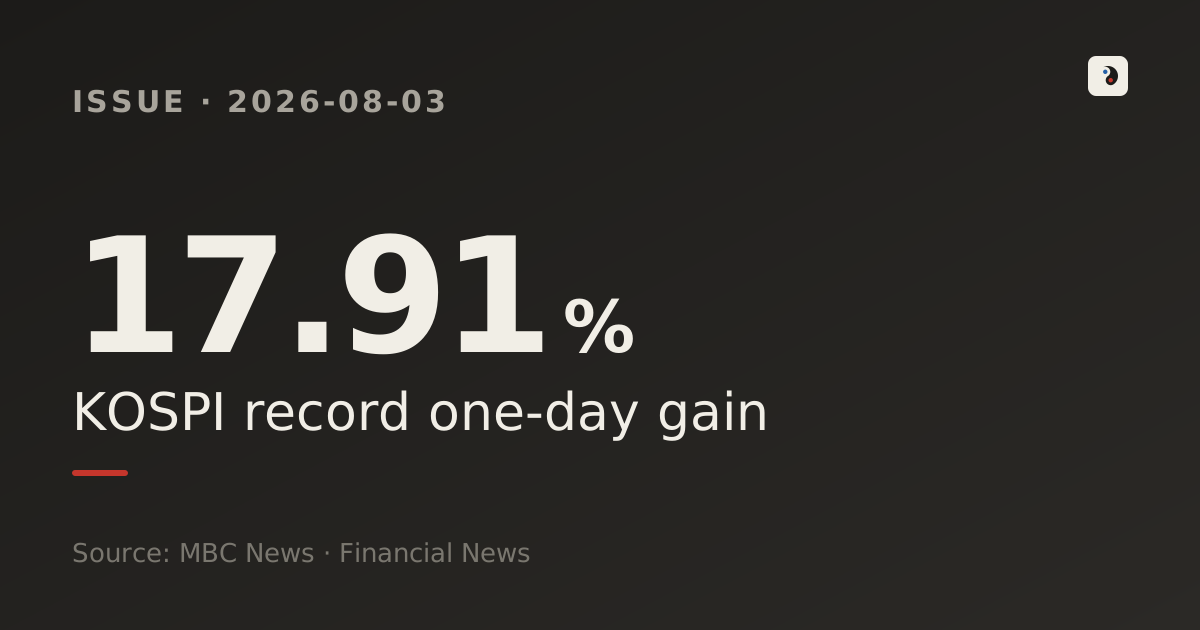
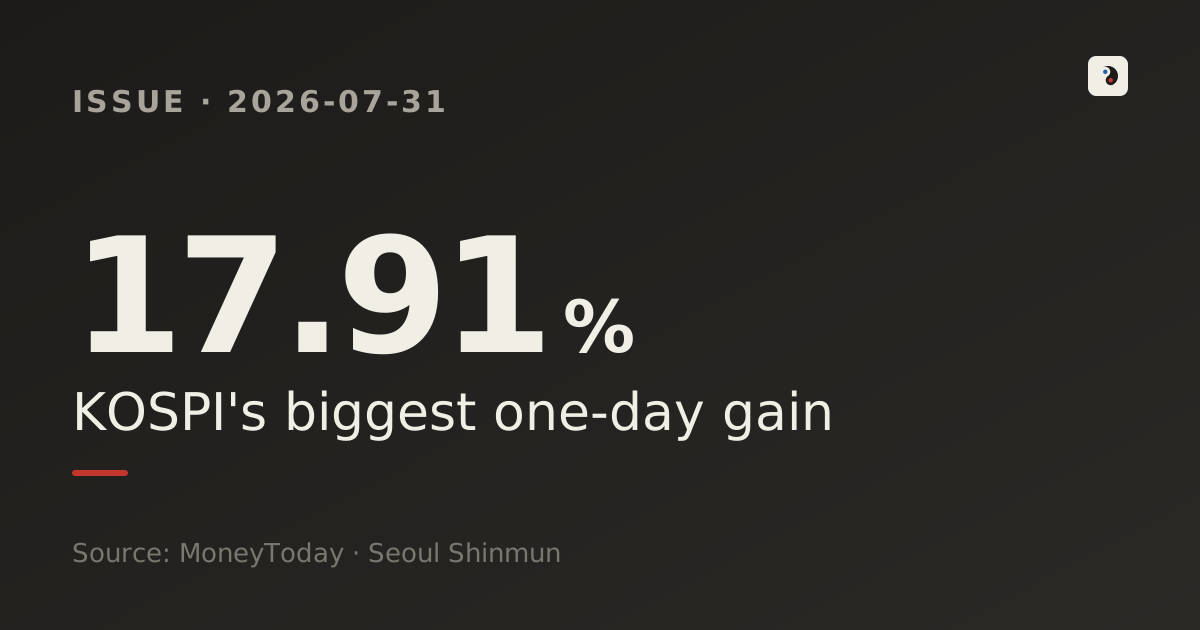
KOSPI Surged a Record 17.91% in One Day — What SK Hynix's Limit-Up Really Means
KOSPI jumped a record 17.91% in one day and SK Hynix hit its price limit for the first time in 17 years. Here's the data behind Korea's wild semiconductor rally.
KOSPI Record 17.91% Surge, Korea's 70-Year Prosecution Reform and Record Tropical Nights Explained
The KOSPI jumped 17.91% in one day, its biggest gain ever. Korea also ended prosecutors' 70-year investigation powers, and tropical nights hit a record 8.8 days.