South Korea's AI Budget Jumps 211% to ₩10.1 Trillion — Can It Catch Up?
Behind the AI vision President Lee is set to unveil in his Liberation Day address lies a budget that tripled in a year — and a 161-fold gap with the United States.
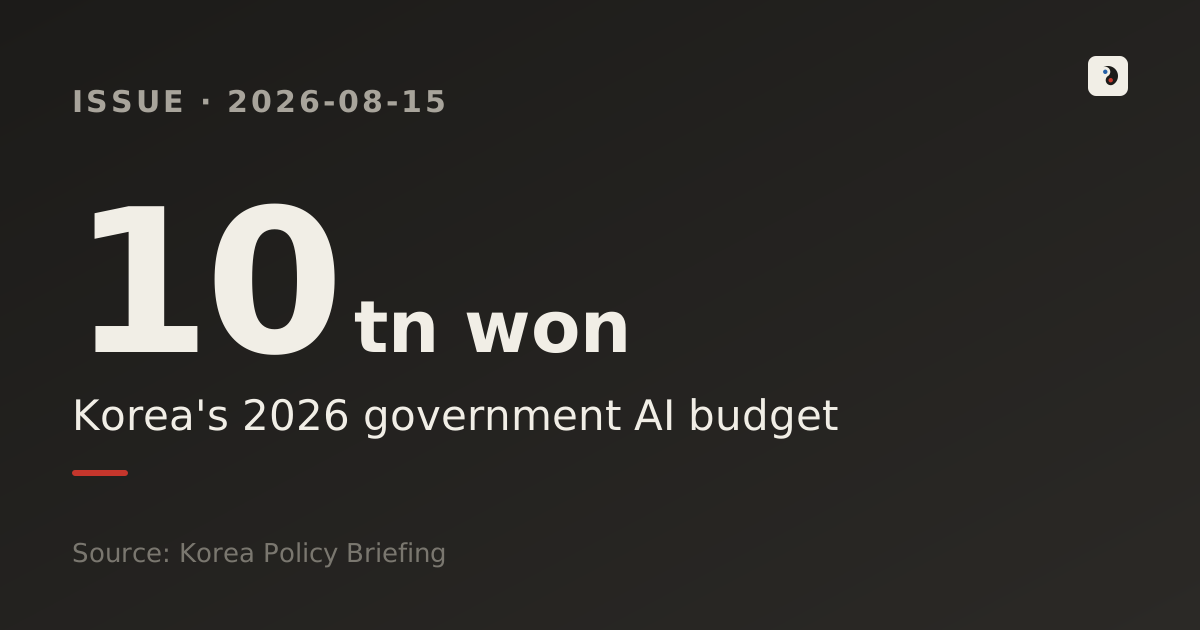
- The government set its 2026 AI budget at ₩10.1 trillion — up 211% from 2025's ₩3.2 trillion, the largest allocation on record.
- On the 81st anniversary of Korea's liberation, President Lee Jae-myung is expected to lay out a vision for national competitiveness in the AI era.
- Even with the budget tripling, Korea's 2025 private AI investment ($1.78 billion) was only about 1/161st of the United States' ($285.9 billion) — how much of that gap can close is the real question.
What happened
On August 15, President Lee Jae-myung attends the 81st anniversary Liberation Day ceremony and delivers an address themed "An Irreplaceable Korea, Brighter Tomorrow." The government has signaled the speech will lay out a vision for strengthening national competitiveness in the age of artificial intelligence. Lee's campaign pledge to make Korea one of the world's "top-3 AI powers" already has an execution body behind it — the presidential National AI Strategy Committee, launched on September 8 last year — and today's address is where that vision gets restated on the country's biggest national stage.
Why AI, why now — the background
Behind the rhetoric is an urgency visible in the numbers. The government earmarked ₩10.1 trillion for AI in its 2026 budget — up 211% from 2025's base budget of ₩3.2 trillion, the largest AI allocation on record. At its launch, the National AI Strategy Committee called the "top-3 AI power" vision "not just a hopeful slogan, but a core survival strategy that will determine Korea's future," effectively naming AI as the next growth engine after semiconductors and manufacturing. Korea also has real strengths to build on: it ranked third worldwide in notable AI model releases in 2025 (5), and first in patents per capita — feeding a bet that catching up on investment alone could be enough.
By the numbers
The ₩10.1 trillion splits five ways. Technology development and infrastructure/research funding are the largest slices, followed by AX (applying AI across industry and government), talent development, and ecosystem building. A large share of the infrastructure budget goes toward GPUs — the government is spending ₩2.08 trillion to build out cutting-edge GPU computing infrastructure this year, with plans to offer it as GPUaaS (GPU-as-a-service) to academia and industry starting in 2027.
Closing that gap on government spending alone won't be easy. That's why the National AI Strategy Committee's "three policy pillars" focus less on how the money gets spent and more on building an ecosystem that can pull in private capital.
The debate — government-led or private-led?
The United States isn't betting on government budgets so much as private-sector-led projects like Stargate, which have signaled hundreds of trillions of won in AI infrastructure spending. That contrast splits opinion. One camp argues that in a country with a serious shortage of private capital, government has to lay the groundwork — GPUs, data centers — before the private sector will follow. The other worries that government-led spending concentrated in a handful of large firms and research institutes breeds inefficiency, while AI adoption among startups and small businesses lags behind. In practice, Korea performs well on "quantity" metrics like patents and model releases, but hasn't yet shown clear results turning that into revenue and jobs at commercial scale.
What to watch next
The specifics of today's address — new investment pledges, how it balances AI with references to Korea-Japan and inter-Korean relations — are worth watching, but what comes after matters more. Whether the ₩10.1 trillion actually translates into GPU utilization, AI startup investment, and results from public-sector AX will be tested when next year's budget comes up for review. Internationally, the question is whether Korea can hold onto its "third place" position in the US-China AI rivalry — or close the real gap by as much as its budget has grown — in the first real test of this administration's term.
- President Lee's 81st Liberation Day address to outline vision for an 'irreplaceable Korea' — Financial News (Aug 15, 2026)
- The Lee Jae-myung administration's first budget for the AI era! — Korea.kr Policy Briefing (Nov 5, 2025)
- Lee administration's 2026 AI budget tops ₩10 trillion — first step toward a 'top-3 AI power'? — IT Daily (Nov 5, 2025)
- From 'Blackwell' to 'Vera Rubin' — government announces ₩2 trillion GPU infrastructure program — Electronic Times (Mar 12, 2026)
- National AI Strategy Committee launches, kicking off drive for 'top-3 AI power' — Financial News (Sep 8, 2025)
- US drew ₩670 trillion in AI investment over 11 years — where does Korea stand? — AI Post Korea (2026)
- US-China AI model performance gap has closed — Korea ranks 3rd in notable models — Hankook Ilbo (Apr 14, 2026)
This is nuloq's own analysis based on the public reporting and government data listed under Sources, written with the help of AI tools. It's for information only — not investment or policy advice — and reflects the situation at the time of writing; we correct the text if errors are found.
Related posts
73 Years After the Armistice, Lee Jae-myung Proposes 'End-of-War' Talks With North Korea
President Lee Jae-myung's Liberation Day speech proposed peace talks to replace Korea's 73-year armistice. Here's why this attempt differs, backed by data.
Kospi Circuit Breakers Two Days Straight, 40.3°C Record Heat, a 1,000-Trillion-Won AI Bet — Korea in Three Numbers
Korea's Kospi fell 5.98% to 5,663.24 — the first back-to-back circuit breakers in the market's history. Add a 40.3°C heat record in Yangsan and a 1,000-trillion-won AI datacenter alliance: here is the context the headlines skip.
2026-07-16 Rice Packs Up 12%, a 550-Trillion-Won AI Bet, 933 Heat Cases: What 3 Numbers Mean
Rice-price increases, private-sector plans for KRW 550 trillion in AI data centres, and 933 heat-illness cases: a briefing that separates actors and measurement scopes.
150 Troops, 70% of Oil: South Korea's Hormuz Dilemma by the Numbers
Squeezed between US pressure and Iran's war warning, South Korea is weighing sending 150 troops to the Strait of Hormuz — the route for 70% of its oil imports. Here's the dilemma in numbers.