· Updated 2026-09-10
Yangsan’s 40°C days, investigation powers and leveraged losses: July 30 briefing
Correction (2026-09-10): The scope, comparisons and interpretation of key figures have been reviewed and corrected below. The original publication date is retained.
Yangsan’s two consecutive 40°C days
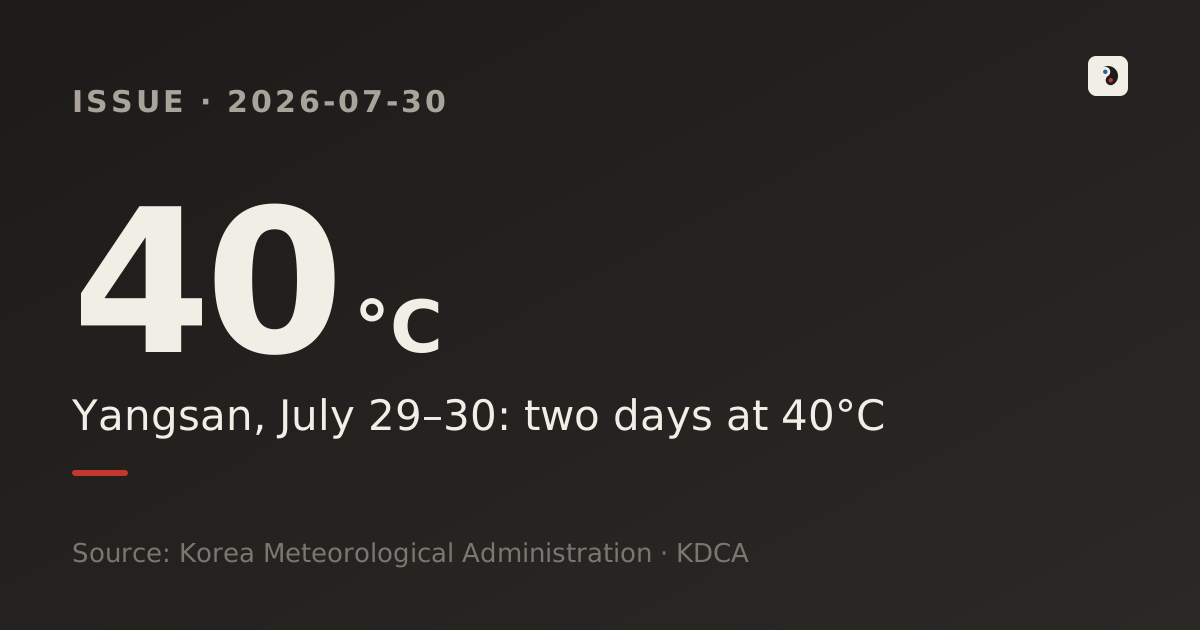
Yangsan recorded 40.3°C on July 29, 2026 and 40.0°C at 13:10 on July 30. The consecutive-day record refers to Yangsan observations since 2008, not a first across all Korean stations.
At 1:10 p.m. on July 30, Yangsan in South Gyeongsang reached 40.0°C, a day after hitting 40.3°C — the first back-to-back 40°C days since observations there began in 2008. The same day, Busan set an all-time local record of 38.4°C (Kukmin Ilbo).
By the end of this piece you'll know how this heatwave compares with past records — and what to do about it today.
Who is collapsing
Korea Disease Control and Prevention Agency surveillance (May 15–July 29) counts 1,638 heat-illness patients and 12 deaths so far this year. People aged 65 or older make up 31.4% of patients, and heat exhaustion is the most common diagnosis at 60.7%. The total is lower than the 2,779 recorded in the same period last year — but cases have accelerated sharply since the monsoon ended.
Five things to do today
Against record heat, the strategy is avoidance, not endurance. The five habits below cut most of the risk behind heat exhaustion and heat stroke.
In a summer whose records moved up to July, surviving the heat means dodging it, not toughing it out.
Supplementary-Investigation Abolition, D-1 — a Vote Touching 46% of Cases
The supplementary-investigation step that 45.59% of police-referred cases passed through faces an abolition vote tomorrow. We reread the fight through numbers: a 220,241-case police backlog and 110,623 case returns a year.
Korea's National Assembly is pulling another all-nighter.
On July 30 the Democratic Party tabled a Criminal Procedure Act amendment abolishing prosecutors' supplementary-investigation power, and the People Power Party immediately launched a filibuster (Hankook Ilbo). The bill unifies investigative authority under the police, removes prosecutors' right to supplementary investigation, and adds indictments built on gravely unlawful investigations to the grounds for dismissal. The ruling party plans to end debate after 24 hours with a three-fifths majority and vote on July 31.
Strip away the slogans, and the numbers actually at stake make the dispute much clearer.
45.59% — the path half of all cases travel
Of 55,174 police-referred cases closed by 12 district prosecutors' offices in March–April this year, 45.59% — 25,152 cases — were resolved only after prosecutors' supplementary investigation (Hankook Ilbo, June). Abolition removes a step that nearly one case in two currently passes through, so the bill's real question is how the police absorb that 46%.
A police desk already overloaded
Prosecutors sent 110,623 cases back to the police for supplementary work last year — up 27.2% from 2021, the system's first year — and topped 60,000 in the first half of this year alone (Financial News). Meanwhile, the police backlog of unresolved cases jumped 62.6%, from 135,431 in 2018 to 220,241 last year. Supporters cite the inefficiency of duplicated, ping-ponging investigations; opponents warn of adding a new gap to an already saturated police force. Both arguments start from these same statistics.
The next 24 hours
Under Assembly rules a filibuster can be closed by three-fifths of sitting members, so the vote itself is hard to block. The PPP floor leader has demanded a presidential veto if the bill passes, but for government-backed legislation that looks unlikely. The thing to watch is less the passage than whether follow-up decrees and legislation fill the 46% gap.
What changes tomorrow is not one prosecutorial power, but the route half of all referred cases used to take.
Down $38.7B, Buying the Dip Anyway — the Psychology of Korea's Leveraged-ETF Retail
Despite an estimated $38.7 billion in losses, Korean retail investors poured another 770 billion won into leveraged ETFs in one week. We unpack why losses fuel bigger bets — and what a proposed 20% cap can and can't fix.
After losing an estimated 56.3 trillion won, Korea's retail investors put another 770 billion won on the table this week.
Citi estimates that Korean individuals have lost about $38.7 billion (roughly 56.3 trillion won) on single-stock leveraged ETFs in the recent downturn (Financial News). Yet in the week of July 23–29, the top retail net purchases were KODEX Leverage (778.5 billion won) and the KODEX SK hynix single-stock leveraged ETF (770.1 billion won). That is the backdrop to the government's July 30 discussion of a personal cap limiting single-stock leveraged bets to 20% of total investment (Newspim).
Here is the psychology of betting bigger as losses grow — and whether regulation can change it.
Why we buy more as prices fall
Behavioral economics calls it loss aversion: the refusal to lock in a loss. Averaging down is its most common outlet — but in leveraged products, declines compound at a multiple, so a same-sized rebound no longer gets you back to even. Korea Capital Market Institute data show that from the May 27 launch of the Samsung Electronics and SK hynix single-stock leveraged ETFs through June 19, cumulative net buying reached about 8.2 trillion won — more than 27 times the roughly 0.3 trillion won that went into inverse products. Even in a shaking market, money flowed one way only: up.
What the new rules actually target
An entry barrier already exists — a 30-million-won minimum deposit — but the 20% cap is different in kind: it limits how much of a portfolio can be concentrated in high-risk products after an investor is already in the market. Regulators are also weighing higher trading costs, mandatory mock trading, and a legal basis for adjusting leverage multiples in turbulent markets, modeled on Hong Kong's flexible leverage (Newspim). Whether the cap counts per account or per person, and whether it covers overseas-listed products, will decide how much it bites.
Can a cap beat a bias?
A cap can shrink the size of losses, but it cannot remove the urge to buy the dip. If domestic limits tighten, flows may simply detour into overseas-listed leveraged products — a remaining headache for supervisors. The last line of defense is not the rulebook but the boring discipline of position sizing.
This week's numbers show that leverage is less a weapon against the market than a mirror held up to our own psychology.
Today's three pieces are nuloq's own analysis, layering public data — Korea Meteorological Administration and KDCA statistics, police and prosecution figures, Korea Capital Market Institute research — on top of the original reporting, written with the help of AI tools; the sources behind each claim are noted in every card's link, text and infographic.
Related posts

Korea Baseball Heatwave Crisis: Why KBO's New Heat Rule Failed in a Day
KBO scrapped its new heat-cancellation rule a day after announcing it, following a fan's CPR emergency. Here's what a temperature-only safety rule missed, in the numbers — plus a record 15 games called off this season.
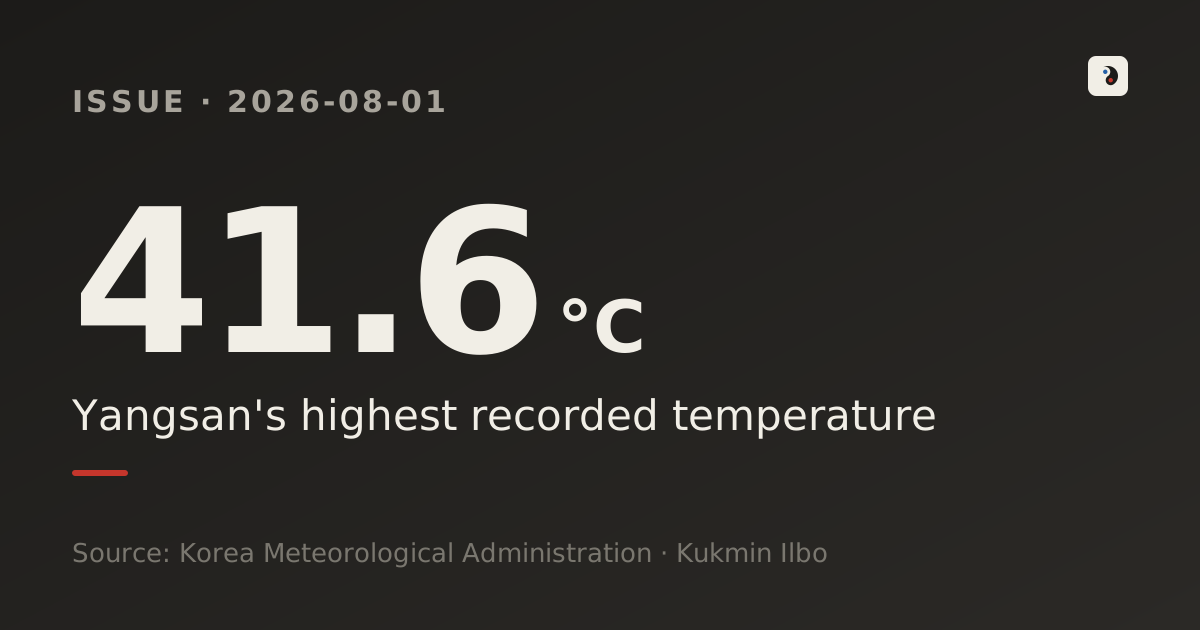
Korea July Exports Hit $98.9B, Yangsan Logs Record 41.6°C — What Three Numbers Reveal
South Korea's July exports reached $98.89 billion, the second-highest month ever — semiconductors alone added $41 billion (+178.8%). The same day Yangsan hit 41.6°C, an all-time national record, and a one-night DUI crackdown caught 320 drivers. Here is the context behind the numbers and what comes next.
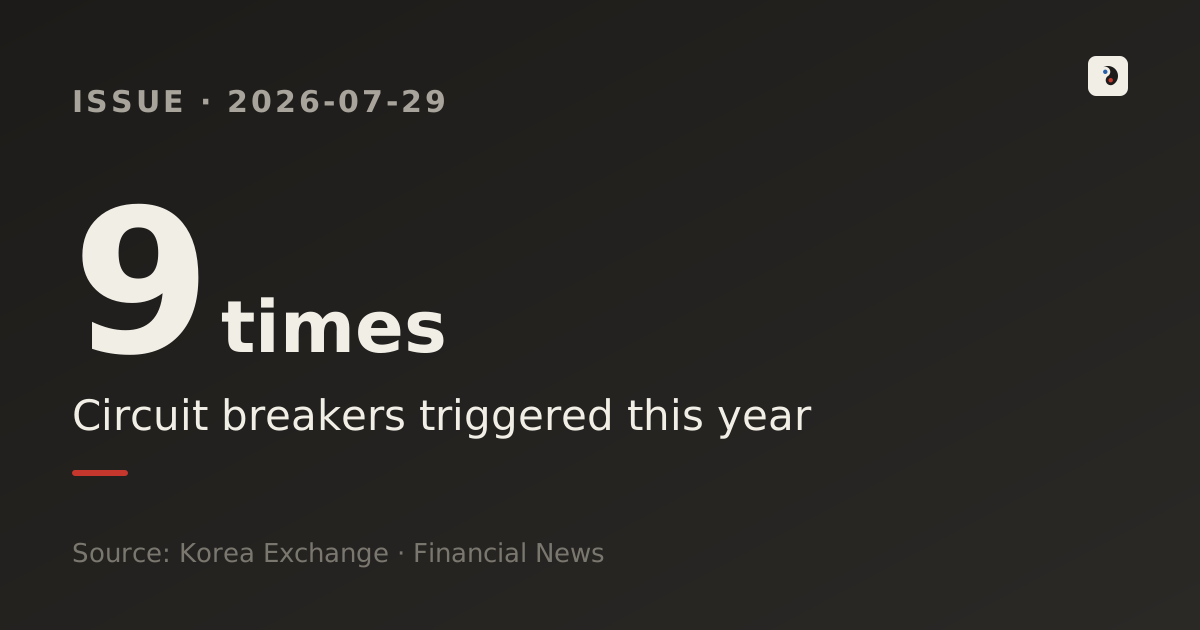
Kospi Circuit Breakers Two Days Straight, 40.3°C Record Heat, a 1,000-Trillion-Won AI Bet — Korea in Three Numbers
Korea's Kospi fell 5.98% to 5,663.24 — the first back-to-back circuit breakers in the market's history. Add a 40.3°C heat record in Yangsan and a 1,000-trillion-won AI datacenter alliance: here is the context the headlines skip.
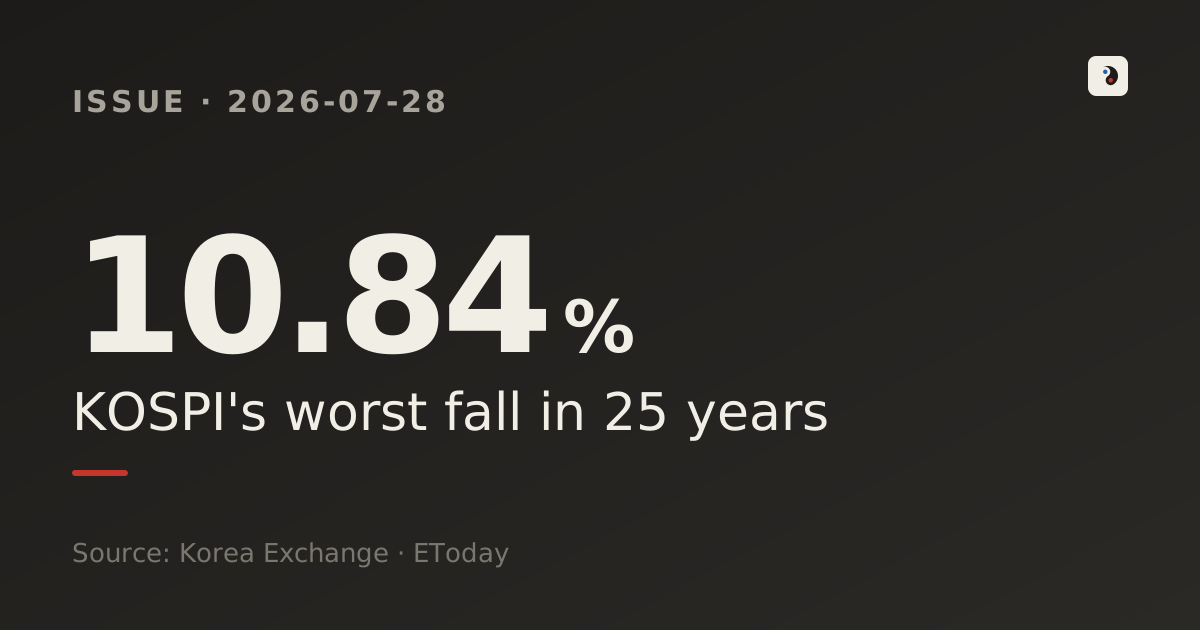
KOSPI Crashes 10.84%, Worst Day Since 9/11 — Plus Korea's Record 6.7% Welfare Hike
The KOSPI plunged 10.84% to 6,023.66 — its steepest one-day fall since September 2001 — as China chip fears crushed Samsung and SK Hynix. We also unpack Korea's record 6.7% welfare benchmark increase and why the real heat-wave risk starts this week.