Korea July Exports Hit $98.9B, Yangsan Logs Record 41.6°C — What Three Numbers Reveal
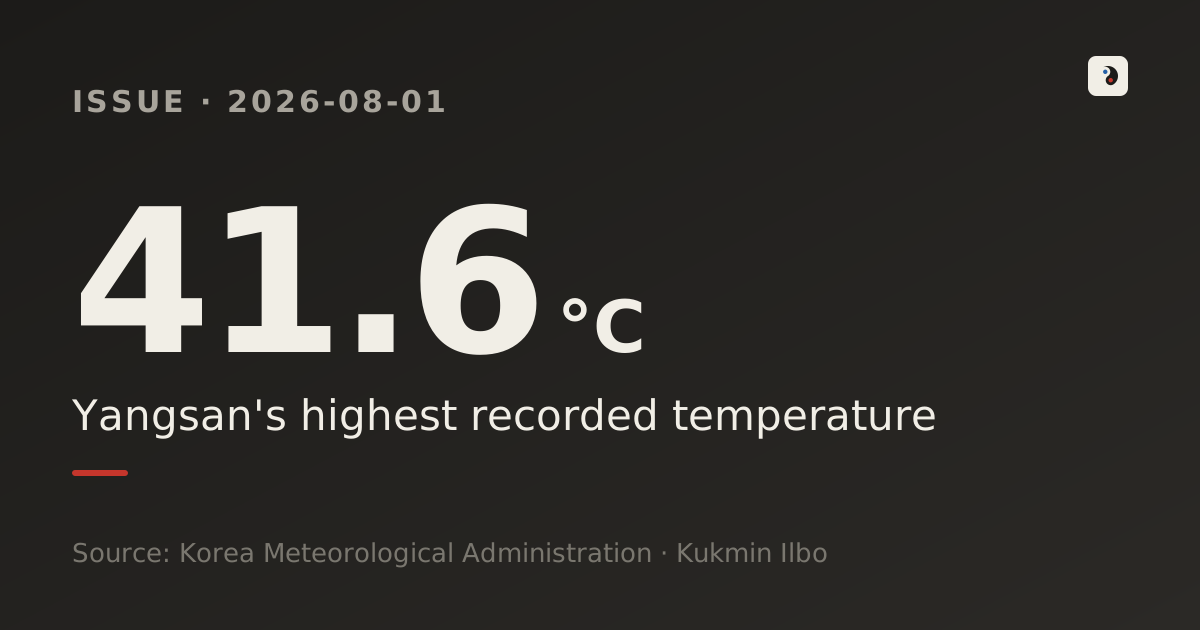
A second-best export month, an all-time 41.6°C heat record and 320 DUI arrests in a single night — we read a record-filled day through statistics and outlooks the original reports left out.
July Exports at $98.9 Billion — Semiconductors Drove 69% of the Gain
Korea's trade ministry reported July exports of $98.89 billion, the second-highest month on record. We break down how much of that shine comes from a single product — and what could dim it.
In the very week the stock market crashed and rebounded, the real economy quietly posted its second-best export month ever.
According to the July trade figures released on August 1 by the Ministry of Trade, Industry and Energy, exports reached $98.89 billion, up 62.8% from a year earlier — second only to June, which broke the $100 billion mark for the first time at $102.25 billion. Imports rose 26.5% to $68.56 billion, leaving a trade surplus of $30.32 billion.
Read on to see who the real hero of this record is — and the risk the headline number hides.
69% of the increase came from semiconductors
Semiconductor exports surged 178.8% to $41.01 billion, topping $40 billion for a second straight month (E-Today). That is 41% of all exports in a single product line, and by e-Focus's tally chips supplied 69% of July's entire export increase. The drivers are AI-fueled server memory demand and steadily rising DRAM and NAND contract prices — which also means the headline total will swing the moment the memory price cycle turns.
Where it went — China +96%, the US +69%
Exports to China jumped 96.2% to $21.68 billion, above $20 billion for a second consecutive month, while shipments to the US rose 68.7% to $17.43 billion on AI data-center investment. By contrast, categories outside chips grew far more slowly — autos managed just +7% at $6.24 billion — which is why the export boom feels so different depending on the industry.
Why a $1 trillion year suddenly looks possible
Money Today notes that exports have now set a record for their respective month for 14 straight months, putting an annual $1 trillion within reach. The key to that milestone, though, is the same as the risk: memory prices and continued AI investment.
The record's other name is semiconductor concentration — the bigger the boom, the heavier the volatility that comes with it.
320 DUI Arrests in One Vacation-Season Night — Over Half at License-Revocation Level
Police ran a one-night nationwide crackdown at 733 checkpoints and caught 320 drunk drivers. Here is what the numbers say about summer-holiday risk, plus three habits to take on vacation.
On the first Friday night of the summer holiday rush, 320 people across the country were caught driving after drinking.
The National Police Agency deployed 4,225 officers and 1,580 patrol cars to 733 checkpoints nationwide on the night of July 31 (Hankyung). The result: 320 violations — 185 at license-revocation level, 129 at suspension level, and 6 refusals to take the breath test. Police are running a special summer DUI enforcement period from July 1 through August 31.
This card gives you the pattern behind one night's numbers, and three precautions you can use at your holiday destination.
More than half were at revocation level
In this sweep, 185 of 320 drivers — 58% — blew above Korea's license-revocation threshold (0.08% blood alcohol). July's full-month statistics reported by Herald Business point the same way: of 8,742 violations, 5,604 (64%) were revocation-level, 2,923 suspension-level, and 215 refused testing. In other words, most offenders were not marginally over the line after 'just one drink' — they drank heavily and drove anyway.
In holiday season, deaths rise faster than crashes
The Korea Road Traffic Authority analyzed July 20–August 31 over the past five years (2021–2025): holiday-season crashes averaged 544.6 a day, barely above the usual 541.3, but daily deaths averaged 7.8 versus 7.2 normally — 8.3% higher, with injuries up 2.1%. The season raises not the number of accidents but their severity, a product of long-distance and late-night driving. Gangwon province saw the steepest rise in crashes at 13.8%, the highest in the country.
When you pack for vacation, plan the way back too — it is the cheapest insurance of the summer.
Yangsan 41.6°C: a Record Broken Again in One Day — the End of a Mark That Held for 8 Years
On August 1, Yangsan rewrote Korea's all-time high temperature at 41.6°C. We look at what back-to-back record days mean, and at typhoon Dolphin — the variable that will set next week's heat.
The record set in the summer of 2018 stood for eight years; the record set in 2026 did not survive a single day.
Korea Meteorological Administration observations show Yangsan in South Gyeongsang province reached 41.6°C on the afternoon of August 1 — the highest reading since modern observation began in 1904, across the 97 stations used for official climate statistics (Financial News). Just one day earlier the same city had hit 41.4°C, surpassing the 41.0°C measured in Hongcheon on August 1, 2018 — and that brand-new record fell within a day. Changwon also reached 40.4°C, one of several cities in the southeast above 40°C.
Read on for what a summer of repeating 'all-time highs' means, and the typhoon that will set the ceiling on next week's heat.
Records are living shorter and shorter lives
Hongcheon's 41.0°C held the national title for eight years; this week's 41.4°C was replaced within 24 hours by a mark 0.2°C higher (Newspim). While we grow numb to the phrase 'hottest ever,' the interval between extremes is visibly collapsing. When extreme heat shifts from a rare disaster to an annually updated routine, the baseline a society must endure rises with it.
Typhoon Dolphin could cool the heat — or feed it
The next variable is Typhoon Dolphin, the season's 13th. On the morning of July 31 it had intensified to a central pressure of 910 hPa with maximum winds of 56 m/s in waters about 1,300 km northeast of Guam, and most forecast models track it toward seas south of Japan late next week (Money Today). The concern is a westward-leaning path: it could push the North Pacific High up over the Korean peninsula and strengthen the heat dome instead of breaking it. With Seoul forecast at 37°C and Daegu at 39°C next week, the typhoon's track will effectively set the upper limit of Korea's heat.
The summer question is no longer 'how hot will it get' but 'how many days will this record survive.'
These three pieces are nuloq's own analysis, layering public data from Korea's trade ministry, weather agency and road traffic authority on top of the original reporting, written with the help of AI tools; every source is noted in each card's link and in the text and infographics.
Related posts
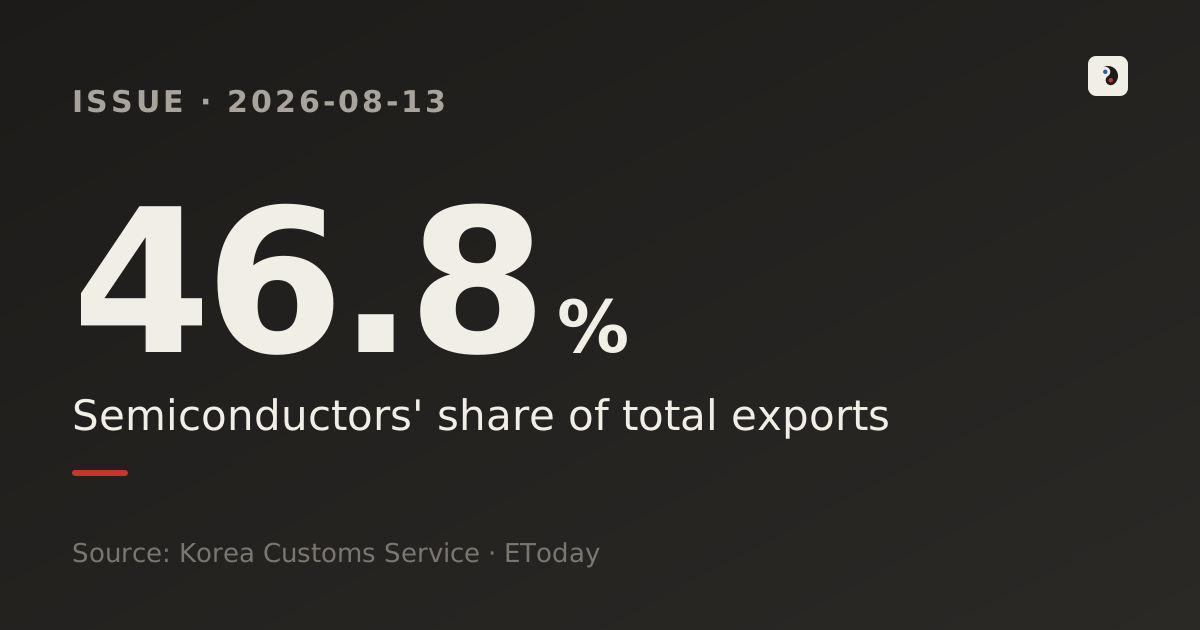
Chips Hit 46.8% of Korea's Exports — Inside a Record-High Warning Sign
Korea's exports hit a record $21.3B in early August, and 46.8% of it was chips alone. Here's the data behind how a share once in the low 20s doubled in two years — and why the boom itself is a red flag.
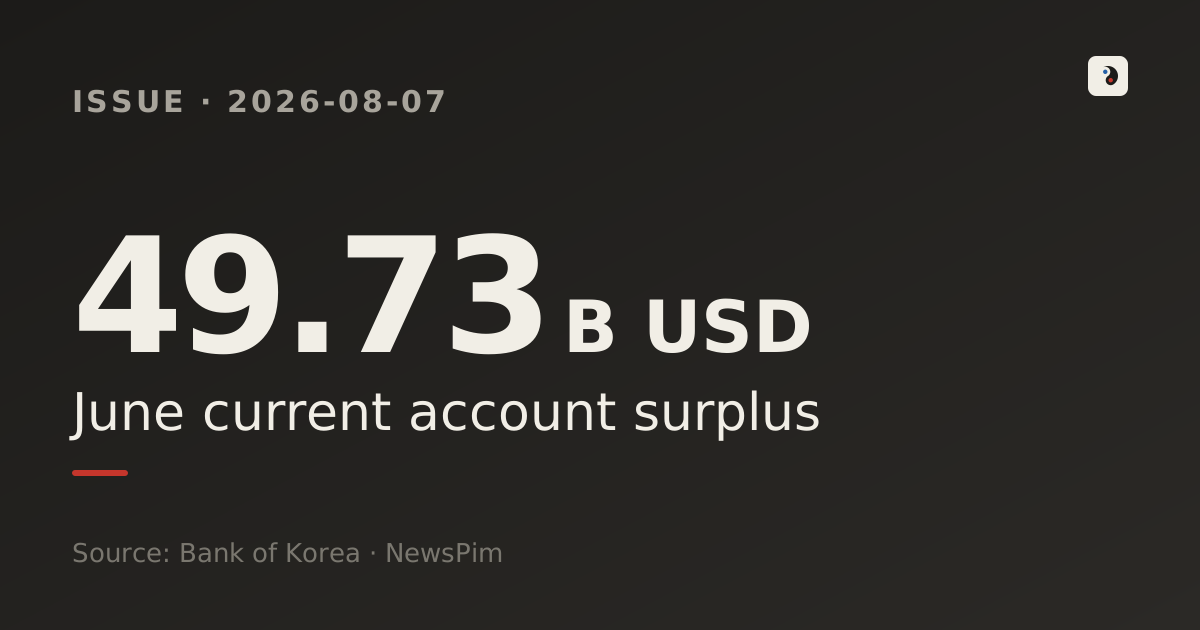
Korea's Current Account Hits Record $49.7B — Why the Chip Boom Isn't in Your Paycheck
South Korea's current account hit a record $49.7 billion in June, powered by a semiconductor export boom. Here's why the Bank of Korea itself is warning the windfall isn't reaching ordinary paychecks.

Korea Baseball Heatwave Crisis: Why KBO's New Heat Rule Failed in a Day
KBO scrapped its new heat-cancellation rule a day after announcing it, following a fan's CPR emergency. Here's what a temperature-only safety rule missed, in the numbers — plus a record 15 games called off this season.
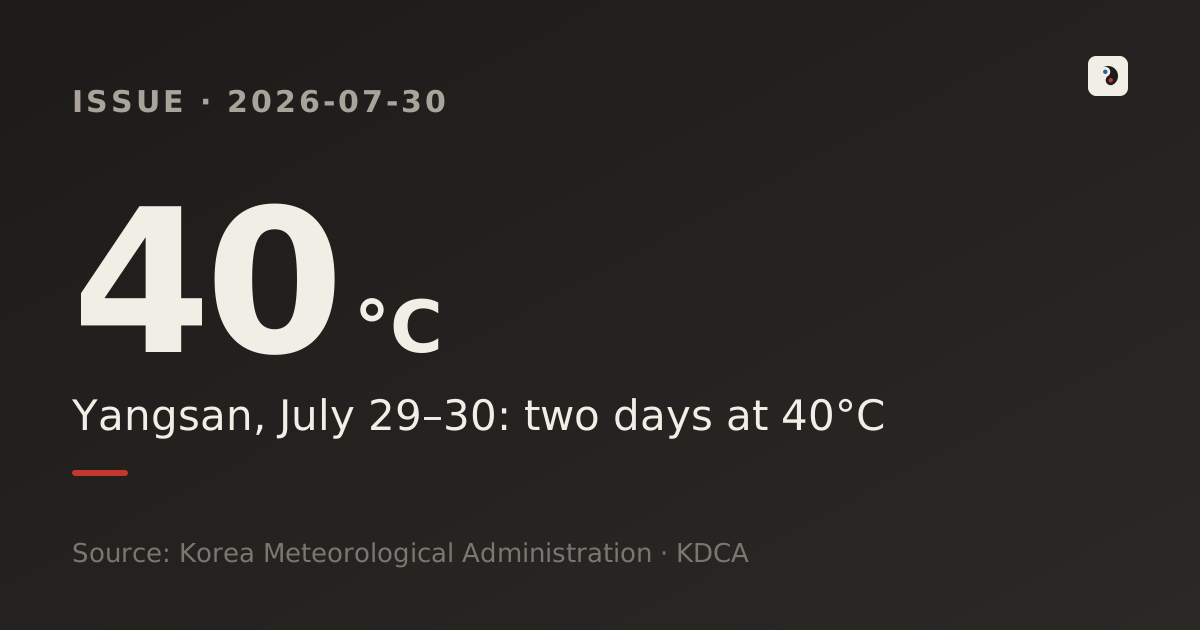
Yangsan’s 40°C days, investigation powers and leveraged losses: July 30 briefing
Yangsan recorded 40.3°C on July 29, 2026 and 40.0°C at 13:10 on July 30. The consecutive-day record refers to Yangsan observations since 2008, not a first across all Korean stations.