Hyundai's 111-Day Wage Standoff Ends — 3 Numbers Behind the Deal
After 111 days of tug-of-war, Hyundai and its union shook hands. What was really at stake beneath the numbers?
- Hyundai Motor and its union reached a tentative wage agreement on August 25, 111 days after talks began in May — a package the union values at roughly 40 million won per worker.
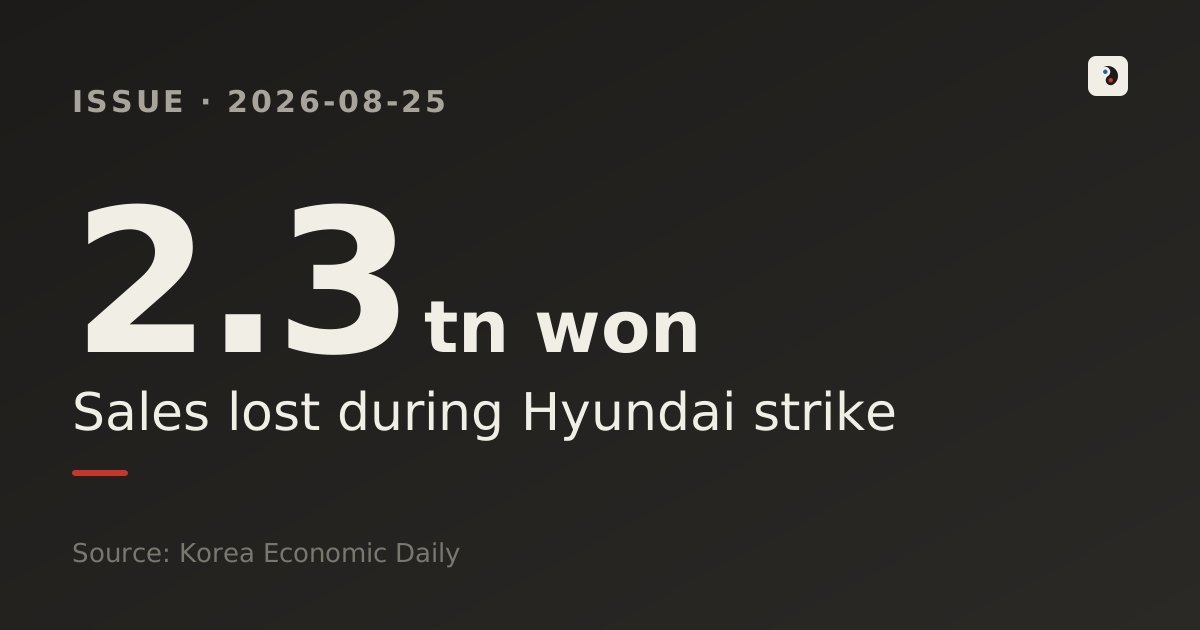
- The talks included Korea's first full-plant strike in a decade (about 39,000 workers, August 21), with an estimated 55,200 vehicles and over 2.3 trillion won in lost sales.
- The public fight was over bonuses and retirement age, but underneath sits a deeper anxiety: job security amid the EV transition and the rise of robotics and physical AI.
What happened
Hyundai Motor and its union reached a tentative wage agreement on August 25 at the 16th round of talks at the Ulsan plant — 111 days after negotiations began in May. The deal includes a monthly base-pay raise of 100,000 won, a bonus of 400% of base pay plus 12.7 million won, 15 company shares, 500,000 won in welfare points, and a 200,000 won increase to the summer vacation allowance. The union puts the total value of the package at roughly 40 million won per worker.
It isn't final yet. The agreement still needs to pass a ratification vote by union members on August 31.
Why it took a strike — the backdrop
What dragged the talks out wasn't pay alone — it was three non-wage demands: a 50% bonus increase, an extended retirement age, and the reinstatement of dismissed workers. Along the way, the union staged an 8-hour full-plant strike on August 21, with roughly 39,000 workers walking out nationwide — Korea's first full strike at Hyundai in a decade, since 2016.
Two anxieties are layered underneath. One is over profit-sharing: Hyundai posted record 2025 revenue of 186.25 trillion won (up 6.3% year on year), but tariff pressure from the US cut operating profit to 11.47 trillion won (a 6.2% margin) — down from the year before. That gap invites an obvious question: if results are record-breaking, why isn't the workers' share growing too? The other is job security, as the shift to EVs and the rollout of robotics and physical AI accelerate. Tellingly, the agreement includes a clause committing labor and management to share updates on new business and technology and jointly respond to industrial transition — the real negotiating table hiding beneath the pay table.
By the numbers
The strike's cost wasn't small. Using Hyundai's roughly 460-vehicles-per-hour production rate, the industry estimates cumulative lost output at about 55,200 vehicles and lost sales at more than 2.3 trillion won. This year's cumulative strike time reached 60 hours, with 120 hours of line-level shutdown.
What did labor and management gain — or protect — for absorbing that loss? Korea isn't alone in this story. After the 2023 UAW strike in the US, Hyundai and Kia's non-union plants in Alabama and Georgia preemptively announced they would raise hourly wages 25% by 2028 — matching what Ford, GM, and Stellantis gave the UAW. It was a move to head off unionization without ever facing a strike. Korea's union, by contrast, needed 111 days of talks and the first full strike in a decade to win a comparable-scale increase.
Where views diverge
For the union, this deal is a "package win" spanning pay, jobs, and future-proofing. The pledge to hire 500 new technical staff over two years (200 in the second half of 2027, 300 in 2028) reads as a trade-off for not fully winning an extended retirement age — protecting headcount instead.
From management and the industry's vantage point, the 111-day timeline and the roughly 2-trillion-won loss are themselves a warning sign. The robotics and physical-AI cooperation clause in particular could set a precedent that automation-rollout speed now needs to be negotiated with the union — a factor that may weigh on future automation investment decisions.
From a consumer and market view, getting production back to normal is what matters most. A backlog from the strike could push out delivery times for new models, and if labor costs stack on top of a margin already squeezed by tariffs, some of that could get passed through to sticker prices.
What to watch next
- The August 31 ratification vote — if members reject it, talks reset and another strike becomes possible again.
- Whether the 500-hire pledge turns into actual job postings — the first test of whether the retirement-age trade-off holds up in practice.
- Whether the physical-AI/robotics coordination body becomes a real, functioning mechanism — if it stays a paper clause, the same conflict could resurface at the next round of talks.
- Hyundai labor and management reach tentative wage deal, ending 111-day standoff — Global Economic (Aug. 25, 2026)
- Hyundai's tentative deal worth "40 million won": base pay +100,000 won, bonus 400% — Maeil Shinmun (Aug. 25, 2026)
- Hyundai union, after first full strike in a decade, returns to talks — over 2 trillion won in lost output already — Hankyung (Aug. 23, 2026)
- Demanding higher bonuses and a later retirement age, Hyundai union stages first full strike in a decade — Money Today (Aug. 21, 2026)
- Hyundai Motor announces 2025 annual results — Hankyung (Jan. 29, 2026)
- Toyota, Honda and Hyundai are raising wages in wake of big UAW wins — CNN Business (Nov. 14, 2023)
This article is nuloq's own analysis, written with the help of AI tools, based on the news reports and Hyundai Motor's public disclosures listed under Sources above. It is for information only, not investment or legal advice, and reflects the situation as of the time of writing. We correct the text if errors are found.
Related posts
Korea's 554 Trillion Won Pension Shift From Banks to Brokerages
South Korea's pension market hit 554 trillion won in Q2 2026, with banks' share falling to 50.8% as brokerages near 30%. The data behind the shift, and why now.
Korea Youth Employment Falls 26th Month — New Jobs Plan
South Korea's youth employment rate has fallen for 26 straight months to 43.9%. Here's why, and whether the government's new jobs plan can reverse it.
Seoul Jeonse Deposits Top ₩700 Million for the First Time as Supply Halves
Seoul's average apartment jeonse deposit hit ₩704.6 million in July, a record high. New housing supply just fell 48% — here's the data behind the crunch.
150 Troops, 70% of Oil: South Korea's Hormuz Dilemma by the Numbers
Squeezed between US pressure and Iran's war warning, South Korea is weighing sending 150 troops to the Strait of Hormuz — the route for 70% of its oil imports. Here's the dilemma in numbers.