Seoul Jeonse Deposits Top ₩700 Million for the First Time as Supply Halves
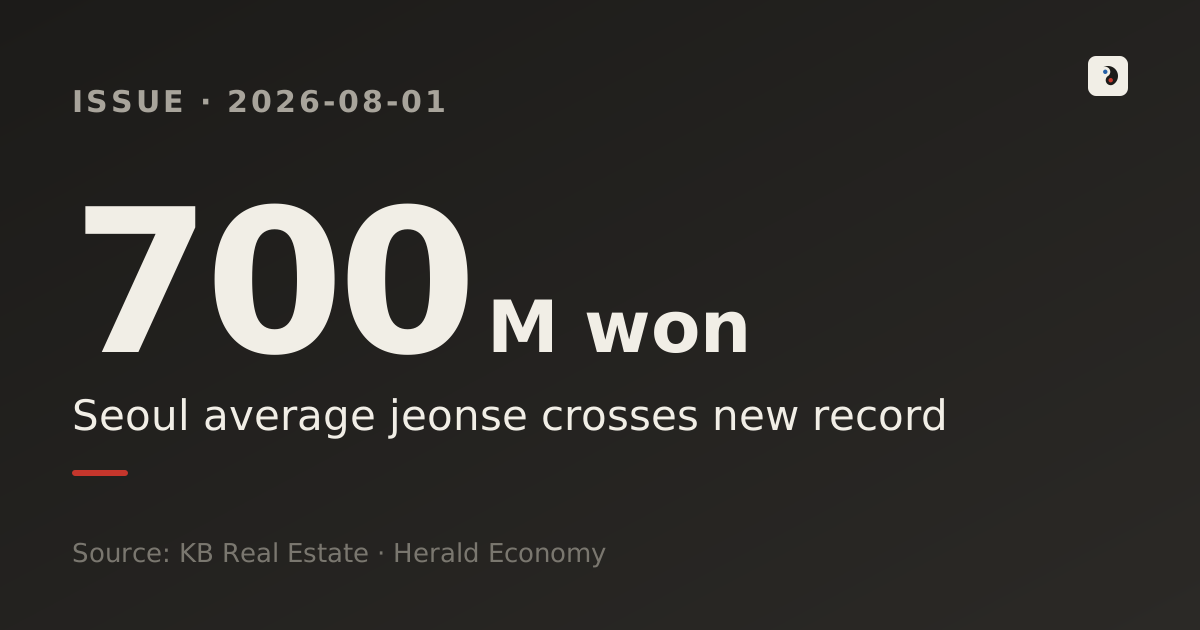
Breaking down Seoul's jeonse market by the numbers — why the ₩700 million line broke now.
- Seoul's average apartment jeonse deposit hit ₩704.58 million in July per KB Kookmin Bank, crossing ₩700 million for the first time — up 8.5% (₩55.14 million) year-on-year, the fastest annual rise since May 2022.
- The root cause is a supply crunch: new apartment move-ins in Seoul fell 48.4% to 10,690 units in Jan–May, the fallout from pre-sale price caps, soaring construction costs and rate hikes in 2020–2022 that delayed or cancelled redevelopment projects.
- The government has flagged a comprehensive housing package for late August, but it is still at odds with Seoul City over whether this is "policy failure" or simply "supply shortage" — leaving tenants exposed in the meantime.
What happened
According to KB Real Estate's monthly housing price trend report released July 27, Seoul's average apartment jeonse (a lump-sum deposit paid instead of monthly rent) price reached ₩704.58 million — the first time it has ever crossed ₩700 million in recorded statistics. That's up ₩8.39 million from the previous month (₩696.19 million) and ₩55.14 million (8.5%) from a year earlier (₩649.44 million) — the sharpest annual jump since May 2022 (10.2%).
Sale prices are climbing in tandem. As of July 13, Seoul's average apartment sale price stood at ₩1.5949 billion, up ₩73.28 million in six months from January's ₩1.5216 billion. The gap between north and south remains wide: the 11 southern Gangnam-area districts average ₩1.9779 billion versus ₩1.1688 billion for the 14 northern districts.
Why it matters — the structural supply crunch
It's hard to write this off as simple demand overheating, because supply itself has shrunk. New apartment move-ins in Seoul totaled just 10,690 units from January to May this year, down 48.4% from 20,702 units in the same period last year. Full-year move-ins are projected to fall 40–50% from last year to around 16,000 units.
This didn't happen overnight. Pre-sale price caps, surging construction costs, and rising interest rates collided in 2020–2022, forcing redevelopment projects and private pre-sales to be delayed or cancelled — and that pullback is now surfacing as today's supply cliff with a two-to-three-year lag. The Ministry of Land, Infrastructure and Transport has made a similar case in a public back-and-forth with Seoul City, arguing that rental-market instability reflects "a compounding of reduced construction starts in 2022–2024, a project-financing (PF) crisis, and a construction-cost surge — not policy failure."
By the numbers
Put rising jeonse prices and falling move-in supply side by side, and it's immediately clear why the market is reacting the way it is.
Displacement demand from redevelopment and reconstruction projects is another pressure point — in districts with heavy redevelopment activity, households relocating all at once flood the jeonse market and drive up local prices.
What stands out most is that the rally has spread to the outskirts. Average June jeonse prices in nine outer Seoul districts — Gangbuk, Gangseo, Gwanak, Guro, Geumcheon, Nowon, Dobong, Eunpyeong and Jungnang — all surpassed their peaks under the previous Moon Jae-in administration. Gangseo District hit ₩504.75 million, crossing ₩500 million for the first time since January 2011 and 16.8% above its late-Moon-era peak of ₩432.17 million (January 2022). Gwanak District reached ₩511.38 million, about ₩50 million above its own peak of ₩465.52 million (June 2021). June's 1.37% monthly rise in Seoul apartment jeonse prices was the fastest since October 2013.
The debate — policy failure or supply shortage?
Here the government and Seoul City diverge. The Ministry of Land, Infrastructure and Transport insists the root cause is a structural supply shortage that can't be reversed quickly. Tenant advocacy groups and some commentators counter that the government's response has been too slow — a comprehensive tax and housing package isn't expected until late August even as prices keep climbing, leaving tenants to absorb the burden in the meantime.
Presidential economic growth aide Ha Joon-kyung said the government "will announce jeonse and monthly-rent measures soon, alongside plans to expand supply and support young renters." Seoul City has emphasized localized fixes — such as bringing forward jeonse supply freed up by redevelopment relocations — while the central government leans more toward tax and financing tools, a modest but real divergence in where each side wants to put the emphasis.
What's next — what this means for tenants
With another move-in cliff looming once August passes, a quick cooldown in jeonse prices looks unlikely. If the government's package leans heavily on tax and financing support, upward pressure could persist until new supply materializes in 2027–2028. On the other hand, if the late-August package includes real supply levers — faster redevelopment approvals, earlier public rental supply — the pace of increases could ease.
For tenants, that means growing pressure to renew leases early (part of why early renewals have been rising) and to rebudget for prices that have climbed even in outer districts. Households heavily reliant on jeonse loans should also watch how rate moves affect their interest burden.
- Seoul apartment prices near ₩1.6 billion... jeonse tops ₩700 million for the first time — Herald Corp (2026.07.28)
- Move-in supply shortage pushes Seoul average jeonse past ₩700 million — Hankyung (2026.07.27)
- Seoul enters the ₩1.6 billion housing era... jeonse also tops ₩700 million for the first time — Aju News (2026.07.28)
- "Bleeding every day"... jeonse in 9 outer Seoul districts surpasses Moon-era peak — Herald Corp (2026.07.24)
- Presidential economic growth aide: "Jeonse and rent measures coming soon, alongside supply and youth rent support" — Financial News (2026.07.27)
- Land Ministry rebuts Seoul City: "Rental instability is about supply shortage, not policy failure" — Newspim (2026.06.11)
- Jeonse — Namu Wiki (accessed 2026.08.01)
This is nuloq's own analysis, written with the help of AI tools, based on the public reporting and official data listed under Sources. It is for information only — not investment, legal, or medical advice — and reflects the situation as of the time of writing (August 1, 2026). We will correct this piece if any factual errors are found.
Related posts
Korea Doubles Housing Loans, Adds 230,000 Homes — Will It Work?
Korea unveiled a housing plan on Aug. 13 adding 230,000+ homes and doubling household loan quotas, as Seoul's jeonse prices rose six times faster than a year ago. Here's whether it can actually cool the market.
Loans Got Tighter, Yet Only 20-Somethings Borrowed More: Korea's ₩200M Mortgage Line
South Korean borrowers in their 20s now carry an average mortgage balance of ₩203.94 million, crossing ₩200 million for the first time even as lending tightened everywhere else. Here's what the Bank of Korea data reveals — and the statistical trap behind it.
Hyundai's 111-Day Wage Standoff Ends — 3 Numbers Behind the Deal
After 111 days and Korea's first full strike in a decade, Hyundai's union got a wage deal. Here's what the 2.3 trillion won in losses actually bought.
Korea's Property Tax Reform: 1.4bn Won Exemption for Residents, 900m for Absentees
Korea's 2026 tax reform raises the property-tax exemption to 1.4bn won for owner-occupiers, cuts it to 900m won for absentee owners. The data, history and fight behind the split.