150 Troops, 70% of Oil: South Korea's Hormuz Dilemma by the Numbers
Caught between US pressure and Iran's warning, why is South Korea weighing sending 150 troops to the Strait of Hormuz?
- Under US pressure, the Lee Jae-myung government is weighing a roughly 150-strong deployment — a naval support ship and a maritime patrol aircraft — to the Strait of Hormuz, and Iran has warned it would treat any such move as joining the war.
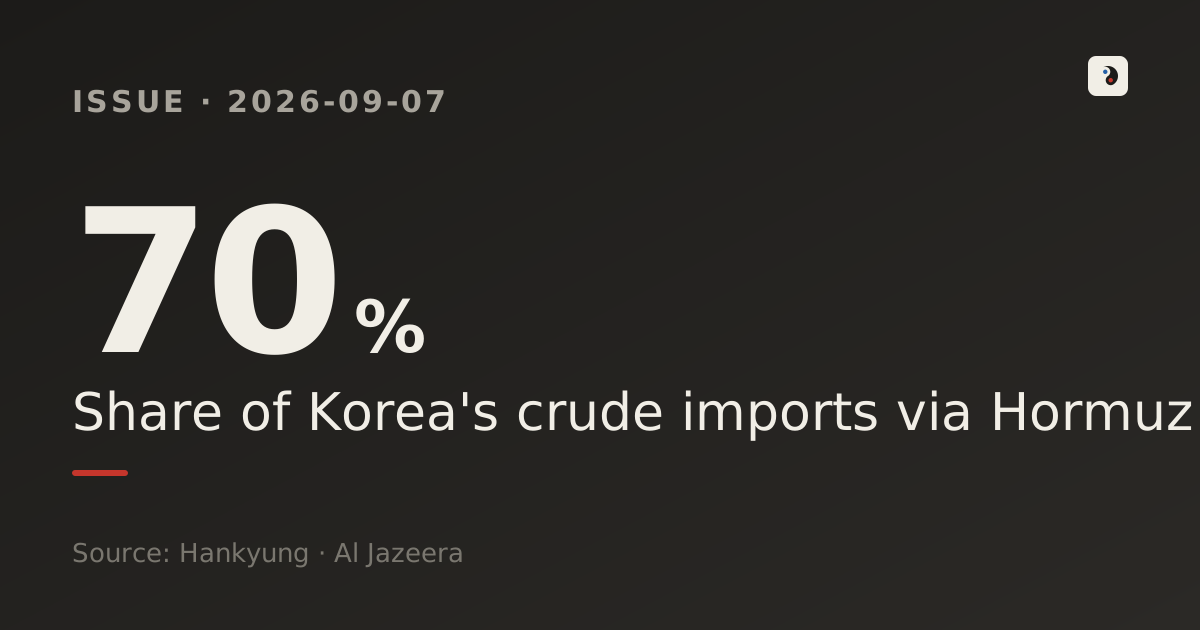
- Seventy percent of South Korea's crude oil imports and 20% of its LNG pass through the strait; analysts warn a prolonged blockade could push Brent crude to $150-200 a barrel.
- Unlike Japan, which has ruled out combat-zone deployment under its pacifist constitution, Seoul cannot easily sit this out — Monday's summit with France and a National Assembly vote are the next flashpoints.
What happened
On September 6, while President Lee Jae-myung was on a state visit to France, his office left open the possibility of deploying forces to the Strait of Hormuz — a response that came after roughly three weeks of public pressure from US President Donald Trump. The government is reportedly weighing a non-combat mission centered on a naval support ship, a maritime patrol aircraft, and an explosive ordnance disposal (EOD) unit, with the personnel needed to operate the ship and aircraft estimated at around 150.
Iran reacted immediately. A senior Iranian official warned that any deployment of Korean forces to the strait, in any form, would be treated as "entering the war." Lee struck a cautious tone on September 7, saying "nothing has been decided" and that "the deliberation runs deep." The issue is expected to be a central topic at his summit with French President Emmanuel Macron, scheduled for September 8.
Why now — the background
The crisis traces back to a military clash between the United States and Iran on February 28. About a month later the two sides appeared to defuse tensions with a memorandum of understanding to lift the strait blockade, but the ceasefire effectively collapsed in mid-August, reigniting the standoff. In this new phase, the Trump administration has pushed allies to "share the burden," pressuring not only South Korea but Japan as well.
What makes the demand weigh so heavily on Korea isn't military capacity — it's energy structure. The United States has relatively low dependence on Middle Eastern crude, so a blockade would hit it far less directly. Korea's position is entirely different.
By the numbers
The numbers explain why Korea can neither easily step back nor readily comply.
According to trade-association and press data, South Korea sources 70% of its crude oil and 20% of its LNG imports from the Middle East, and most of that volume transits the Strait of Hormuz — crude from Saudi Arabia, the UAE, Iraq, Kuwait, and Qatar among it. If this narrow waterway closes, the shock travels straight to oil prices.
Banks including JPMorgan have floated an extreme scenario in which a months-long blockade sends Brent crude to $150-200 a barrel — more than double the $80-range seen in early 2026. Goldman Sachs, however, projects that expanding detour routes could mean 75% of Gulf crude bypasses Hormuz entirely by the end of 2028, suggesting the strait's chokehold could loosen over the long run.
The debate — divided views
Supporters argue that as one of the biggest beneficiaries of the strait's oil traffic, Korea owes the international community a fair share in securing safe passage — and that without a concrete contribution to the US alliance, Seoul risks losing leverage on defense-cost and security issues down the road.
Opponents make three arguments. First, dissent persists even inside Lee's own Democratic Party. Second, the main opposition People Power Party charges that "half-committing to deployment is only rattling Korea's diplomatic standing." Third, under the constitution, sending troops abroad requires National Assembly consent, leaving a procedural legitimacy question unresolved.
Japan's choice adds weight to the debate. Prime Minister Takaichi has flatly ruled out deploying forces to a combat zone, citing the pacifist constitution, and is considering at most mine-clearance work in non-combat areas. In Japanese polling, only 18% favored deployment versus 74% opposed. Major European allies have likewise declined to join, making Korea's more open posture stand out by comparison.
What's next — implications
The September 8 summit with France is the next inflection point. France faces a similar bind, so the question is whether the two leaders move beyond a general pledge to "cooperate on reopening the strait" toward a concrete plan. If deployment goes ahead, it will require National Assembly approval — a process likely to reignite political tug-of-war.
The decision isn't abstract for ordinary consumers, either. A prolonged blockade could push oil-driven inflation beyond fuel and heating costs into broader logistics expenses. Conversely, if deployment triggers a diplomatic rupture, it could raise safety concerns for Korean businesses and expatriates across the Middle East. Whichever path Korea takes, it is hard to escape the number that frames the whole dilemma: 70% oil dependence.
- South Korea mulls 'contributions' in Strait of Hormuz — Al Jazeera (2026.09.04)
- South Korea caught between Iran's warning and US pressure over Strait of Hormuz — Korea JoongAng Daily (2026.09.05)
- Hormuz Deployment Splits Korea's Ruling Bloc Again — Seoul Economic Daily (2026.09.05)
- Seoul leaves door open for Hormuz deployment as Lee, Macron prepare to discuss the strait — Financial News 파이낸셜뉴스 (2026.09.06)
- Japan on edge over Korea's possible Hormuz deployment — Asia Economy 아시아경제 (2026.09.04)
- Even Japan says 'no deployment' — none of the allies willing to join the fight — MBC News (2026.09.05)
- 70% of oil, 20% of LNG: Korea's Middle East dependence — Hankyung 한국경제 (2026.03.02)
- Oil prices could spike on a Hormuz blockade — '3 times more dangerous than the 1979 oil shock' — Global Economic 글로벌이코노믹 (2026.03.15)
- Oil prices surge as markets prepare for a new era of routing around Hormuz — Hankook Ilbo 한국일보 (2026.07.14)
- Republic of Korea Iraq Peace and Reconstruction Division (Zaytun Unit) — Wikipedia (Korean) (accessed 2026.09.07)
This is nuloq's own analysis based on the public reporting and data listed under Sources, written with the help of AI tools. It is for information only — not investment, legal, or military advice — and reflects the situation as it stood at the time of writing, which remains fluid. We correct the text if errors are found.
Related posts
2026-07-18 Choe Son-hui in Moscow, 61% Back Prosecutors, Galaxy Unpacked — Today's 3 Issues in Numbers
North Korea's foreign minister made her first official visit to Russia in 9 months, and a Gallup Korea poll found 61% want prosecutors to keep supplementary investigation powers. Plus Samsung's first AI glasses due July 22 — three issues unpacked with data the original reports left out.
Welfare ₩148.8tn, National Debt ₩1,519.8tn — What Is the 48.3% Ratio Divided By?
We separate the two ways of counting the welfare ministry's budget, and correct the denominator of the national debt ratio to nominal GDP. We hold back judgment on why the ratio falls until the official GDP assumption can be checked, and we found no confirmed evidence that the future response fund caused the ₩106 trillion rise in debt.

A 5-Year-Old Text Threatens Korea's Justice Minister Pick
Justice minister nominee Kim Seung-won sent a text in 2021 asking regulators to speed up a drug trial approval. Five years on, that message is the flashpoint of his September 15 confirmation hearing.
Supreme Court re-nomination dispute — what Article 104 actually sets out
We confirmed the presidential office's request for a re-nomination, and the August 18 nomination of Son Bong-gi, from the presidential office briefing. In plain words, provision by provision: which law covers candidate recommendation, nomination, the National Assembly's consent and the confirmation hearing.