· Updated 2026-09-10
Loans Got Tighter, Yet Only 20-Somethings Borrowed More: Korea's ₩200M Mortgage Line
Correction (2026-09-10): The scope, comparisons and interpretation of key figures have been reviewed and corrected below. The original publication date is retained.
In the very quarter regulators squeezed lending across the board, borrowers in their 20s were the one group whose mortgages kept growing.
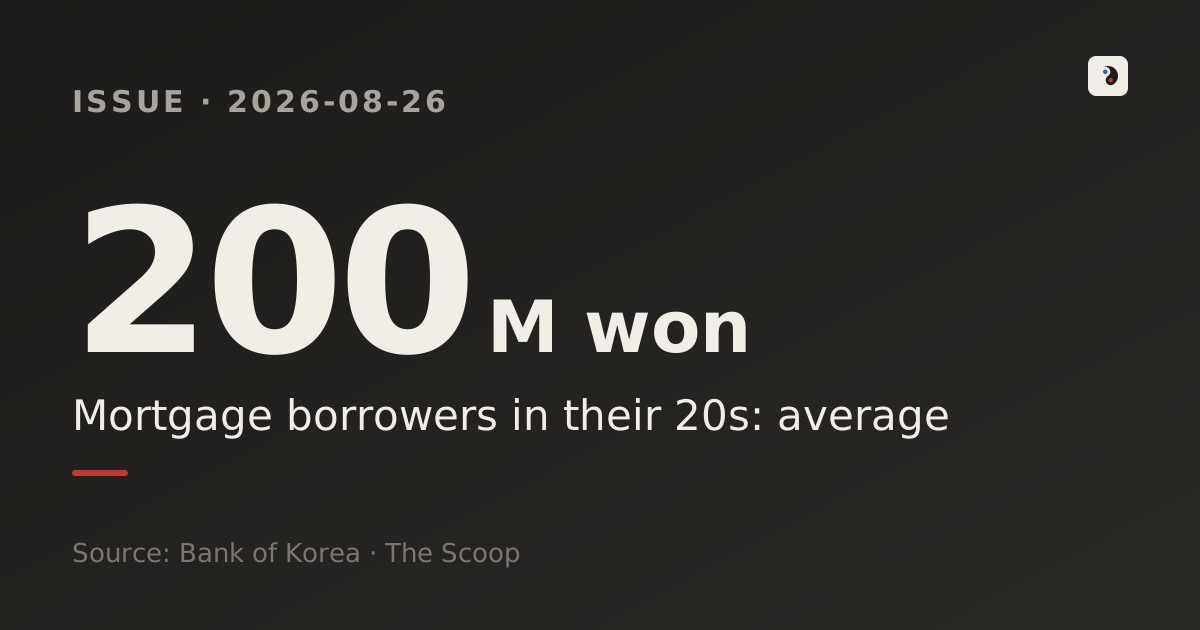
- South Korean borrowers in their 20s carried an average mortgage balance of ₩203.94 million in Q2 2026 — the first time that figure has topped ₩200 million since the data series began.
- Over the same quarter, the average new mortgage size across all ages fell by a record 9.2%, and 30s and 40s borrowers both saw sharp declines — but new mortgages for people in their 20s rose.
- The average covers borrowers in their twenties, not all people in that age group. Borrower composition can affect an average, but these data do not prove composition caused the increase.
What happened
According to the Bank of Korea's Q2 2026 household loan statistics by borrower, released on August 25, the average new mortgage taken out by a borrower in their 20s was ₩232.17 million in the second quarter, up ₩3.92 million from ₩228.25 million in the first quarter. More striking is the balance: the average outstanding mortgage balance for borrowers in their 20s reached ₩203.94 million, up ₩5.75 million (2.9%) from ₩198.19 million in Q1 — the first time it has crossed ₩200 million since the Bank of Korea began compiling this data.
Across all age groups, the average new mortgage fell to ₩208.29 million in Q2 from ₩229.39 million in Q1, a drop of ₩21.1 million (9.2%) — the largest quarterly decline on record. New mortgages for borrowers in their 30s fell from ₩289.90 million to ₩263.58 million (-₩26.32 million), and for those in their 40s from ₩245.14 million to ₩209.77 million (-₩35.37 million). As lending tightened across the board, borrowers in their 20s were the sole group moving in the opposite direction.
Why this is happening now
The broad decline traces back to a string of government measures. The "June 27 real estate package," announced on June 27, 2025, capped mortgage loans in the greater Seoul area at ₩600 million, limited loan terms to 30 years, and tightened requirements for first-time buyer loans as well. Then, from July 2025, the third phase of Korea's "stress DSR" rule took effect, adding a 1.5 percentage-point buffer rate on top of the actual interest rate when calculating repayment capacity. The result: borrowing limits fell by roughly 15-20% for the same income (non-metro regions had the phase-in deferred until the end of 2025).
Borrowers in their 20s, however, sit relatively outside that regulatory net. They are more likely than other age groups to be non-homeowners or first-time buyers, and first-time buyer loans were designed with lighter restrictions. In other words, this isn't a story of 20-somethings gaining more borrowing power overall — it's that only the ones who still meet the conditions to qualify (stable, provable income, among others) remain in the market at all.
The numbers
In absolute terms, borrowers in their 30s still take out the largest new mortgages, and reporting indicates their share and balance both hit record highs too. But the signal from 20-somethings is different — they're the only group moving up at all.
Lined up side by side, the contrast is stark. As regulation narrowed the lending door for every age group, the loans of the 20-somethings who could still walk through it actually grew larger.
The debate — how to read "crossing ₩200 million"
Some read this simply as reckless over-leveraging by young borrowers, but the counterargument carries real weight. New mortgages to people in their 20s make up only about 6% of all new mortgage originations, critics note. The vast majority of 20-somethings never show up in this statistic at all, because they can't meet income-verification or equity requirements in the first place. In this view, "an average of ₩200 million for the 20s" doesn't represent their generation — it represents the small slice of them with the means to qualify, whether stable income or family financial support.
That reading fits with other data. South Korea's homeownership rate for adults under 40 stood at 27.7%, down 2.4 percentage points from a year earlier — fewer young people own homes, even as the debt loads of the ones who do keep climbing. At the same time, borrowers in their 30s made up 56.1% of first-time Seoul homebuyers this year through May, a record high above last year's 49.8% average — a shift some analysts link to soaring jeonse deposits pushing renters toward buying instead. International comparisons are tricky. The average first-time buyer loan in the US in the first half of 2026 was $339,695 (at a 5.93% rate, 91% LTV, 40.1% DTI), and in the UK it was £229,214 as of Q1 2025 (with a 31-year average term) — both far larger in absolute terms than Korea's 20s figure. But those come from markets with entirely different price and income structures, and most analysts agree the more useful question isn't the raw amount, but how stretched that debt is relative to income.
What to watch next
One statistic isn't enough to declare an entire generation at risk. Still, it's worth noting that margin-loan balances (credit used to buy stocks) among 20-somethings also grew 2.24-fold in a year — from ₩188.8 billion in April 2025 to ₩423.9 billion in April 2026, outpacing the 1.96-fold average growth across all ages — a sign that leverage is expanding for young people outside real estate too.
- How much family financial support (gifted funds) actually underwrites this borrowing capacity isn't confirmed by this data alone — figures like tax-authority gift-tax filings would need to be checked alongside it.
- Once stress DSR phase 3 is fully applied outside the greater Seoul area, whether the 20s trend holds in next quarter's data will show whether this is structural or just a temporary side effect of regulatory timing.
- New mortgage lending drops ₩21.1 million, the largest decline on record — Seoul Economic Daily (Aug 25, 2026)
- New mortgages decline as lending tightens; 30s' share and balance hit record highs — Seoul Economic Daily (Aug 25, 2026)
- 20s' average mortgage tops ₩200 million — but "that's not really about me," here's why — The Scoop (Aug 25, 2026)
- [Issue Check] As mortgage thresholds rise, 30s and 40s pull back — only 20s keep growing — Tax & Finance News (Aug 25, 2026)
- Seoul-area mortgage capped at ₩600M, 30-year loan term limit: the June 27 household-debt package — Korea Finance Times (Jun 27, 2025)
- Margin loans near ₩35 trillion as 20s surge — concerns grow over youth "debt-fueled investing" — Polinews (Aug 2026)
- Less than 30% of young Koreans are homeowners, lowest ever — The Korea Herald (2026)
- Young Koreans' 1st-home buying hits 5-year high as Seoul rents soar — The Korea Times (Aug 19, 2026)
- First-Time Homebuyers in 2026: 60% of Agency Purchase Loans and What Comes Next — Polygon Research (2026)
- First-time buyer statistics UK: 2026 — Finder (2026)
This is nuloq's own analysis, built by re-examining the Bank of Korea data and reporting listed under Sources, with the help of AI tools. It's for information only, not investment or legal advice, and reflects the situation as of publication — we'll correct the text if a data revision or factual error comes to light.
Related posts
Korea's Household Debt Passes ₩2,019.8 Trillion, Biggest Jump in 19 Quarters
South Korea's household debt hit a record ₩2,019.8 trillion in Q2 2026, its biggest quarterly jump in 19 quarters. The data behind the debt-fueled stock bets and the central bank's rate dilemma.
Analysis before the July 16 rate decision: the case for an expected hike
Analysis before the July 16 rate decision: the case for an expected hike
Korea's Property Tax Reform: 1.4bn Won Exemption for Residents, 900m for Absentees
Korea's 2026 tax reform raises the property-tax exemption to 1.4bn won for owner-occupiers, cuts it to 900m won for absentee owners. The data, history and fight behind the split.
Korea Doubles Housing Loans, Adds 230,000 Homes — Will It Work?
Korea unveiled a housing plan on Aug. 13 adding 230,000+ homes and doubling household loan quotas, as Seoul's jeonse prices rose six times faster than a year ago. Here's whether it can actually cool the market.