· Updated 2026-09-10
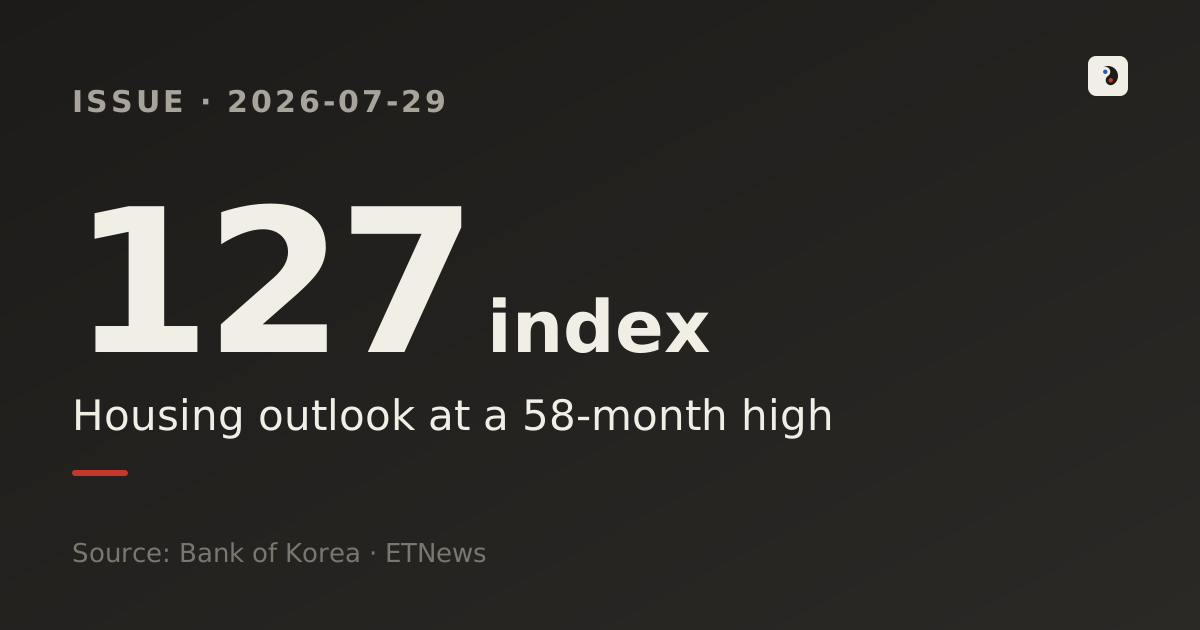
Korea Housing Price Outlook Hits 127, Highest Since the 2021 Boom
Correction (2026-09-10): The scope, comparisons and interpretation of key figures have been reviewed and corrected below. The original publication date is retained.
South Korea raised its policy rate for the first time in three and a half years — yet expectations for house prices swung right back to 2021-boom levels.
- The Bank of Korea's July 28 consumer survey put the housing price outlook index at 127, up 7 points from June — its highest level since September 2021 (128), the peak of Korea's last property boom.
- The Bank of Korea raised its rate to 2.75% on July 16, its first hike in three and a half years since January 2023. High price expectations alone do not prove supply constraints outweighed the rate effect.
- The government plans an August package on tax, supply and financing, but with the Moon Jae-in administration's 26 failed measures as precedent, markets are likely to wait for construction data, not announcements.
What happened
The Bank of Korea's July 28 consumer survey showed the housing price outlook index rising 7 points from June's 120 to 127. The index has now climbed for four straight months — 104 in April, 112 in May, 120 in June, 127 in July — its highest reading since September 2021 (128), the height of Korea's pandemic-era property boom. The same survey put the broader Consumer Sentiment Index at 106.8, improving for a third straight month, while apartment sale and jeonse (long-term deposit lease) prices in Seoul and the wider capital region rose in tandem.
The timing stands out. The reading came just ten days after the Bank of Korea raised its policy rate from 2.50% to 2.75% on July 16 — its first hike in six and a half years.
Why it matters now — a rate hike that didn't cool expectations
By the textbook, a rate hike should raise borrowing costs, dampen demand and lower price expectations. Instead, the index jumped. Most housing researchers read this as a sign the current pressure comes not from cheap money but from a shortage of homes.
Behind it lies a three-year supply cliff: strained project financing, soaring construction costs and prolonged high rates have driven housing starts sharply down, and that shortfall is now showing up as fewer new move-ins. Layered on top, owner-occupancy-focused regulations have slowed the turnover of jeonse listings, and wider use of the tenant's contract-renewal right has pushed jeonse prices up too — creating a "double squeeze" across both sale and rental markets.
By the numbers
The pace itself is unusual — a 23-point jump (104 to 127) in three months is hard to match anywhere in the last five years of data.
This divergence — rates rising while housing starts halve — is the core of the policy dilemma. Starts typically take two to three years to become move-ins. Just as the 2021 supply shortfall fed into 2023-2024 prices, today's shortfall points toward 2027-2028 prices. In other words, any measure announced now won't show results for years.
The debate — squeeze demand harder, or speed up supply
The government has flagged an early-August package spanning taxation, supply and financing. The likely direction: shift property-tax bases from the number of homes owned to their value, curbing multi-home speculative demand while preserving tax relief for owner-occupiers. Financial regulators are weighing a "targeted" approach — easing final-payment mortgages while tightening jeonse loans for non-resident single-homeowners, aiming to keep credit flowing only to genuine end users.
Skeptics argue demand curbs alone won't work. The Moon Jae-in government rolled out 26 separate real estate measures between 2017 and 2021 and still failed to tame prices; each announcement brought brief calm before renewed market anxiety fed speculative sentiment all over again, analysts note.
International approaches diverge too. Canada and New Zealand restrict foreign buyers outright — a demand-side fix. But Korea's current surge is being driven by domestic end-users and jeonse renters, not foreign buyers, so it's unclear the same prescription would work here.
What comes next
The August package's success will hinge on the "speed of supply." Tax and financing curbs alone can't fill a supply gap that has already opened up — what matters is how far the government actually accelerates redevelopment and reconstruction approvals.
- If the package stops at easing approvals → starts will still take another two to three years, so the outlook index is likely to keep climbing for a while.
- If it includes concrete volume targets covering non-apartment and inner-city supply → it could preemptively cool market expectations.
- Given the lesson of 26 prior rounds of measures, the market is likely to trust actual construction data over another announcement.
For prospective buyers, the practical move is to watch the timing of easier final-payment mortgages and any changes to jeonse-loan conditions around the August package.
- July Consumer Sentiment Index 106.8, Housing Price Outlook Highest in 4 Years 10 Months — Etnews (2026.07.28)
- Housing Price Outlook Highest in 4 Years 10 Months, Consumer Sentiment Improves for 3rd Month — Financial News (2026.07.28)
- "Will Prices Keep Rising?" — July Housing Outlook Up 7pts, Sentiment Improves for 3rd Month — Newspim (2026.07.27)
- Bank of Korea Raises Policy Rate From 2.50% to 2.75%, Unanimous Vote — ZDNet Korea (2026.07.16)
- Why Experts Agree "Housing Prices Won't Cool" — Rental Market Also on Alert — Money Today (2026.07.06)
- Housing Starts Cut in Half — Supply Trapped by Five Headwinds — Hankyung (2026.07.19)
- Government Reworks Three-Pillar Housing Policy: Supply, Targeted Financing, Differentiated Taxes — News1 (2026.07.27)
- Easier Final-Payment Loans, Tighter Jeonse Loans — Financial Authorities Finalize Housing Finance Measures — Financial News (2026.07.29)
- 17th Anniversary Special: A Full Review of the Moon Jae-in Government's 26 Real Estate Measures — Housing Herald (2021.05.18)
This is nuloq's own analysis, written with the help of AI tools, based on the public reporting and official data listed under Sources. It is for information only — not investment or policy advice — and reflects the situation as of July 29, 2026. We correct the text if errors are found.
Related posts
Korea's Property Tax Reform: 1.4bn Won Exemption for Residents, 900m for Absentees
Korea's 2026 tax reform raises the property-tax exemption to 1.4bn won for owner-occupiers, cuts it to 900m won for absentee owners. The data, history and fight behind the split.
Korea's Household Debt Passes ₩2,019.8 Trillion, Biggest Jump in 19 Quarters
South Korea's household debt hit a record ₩2,019.8 trillion in Q2 2026, its biggest quarterly jump in 19 quarters. The data behind the debt-fueled stock bets and the central bank's rate dilemma.
Seoul Home Prices Rise 75 Straight Weeks Despite Rate Hike — Korea's August Tax Overhaul
Seoul apartment prices have risen for 75 straight weeks, closing in on the 85-week record under the Moon administration — even after a rate hike. Here's why Korea's coming tax overhaul could be different, in numbers.
Analysis before the July 16 rate decision: the case for an expected hike
Analysis before the July 16 rate decision: the case for an expected hike