Seoul Home Prices Rise 75 Straight Weeks Despite Rate Hike — Korea's August Tax Overhaul
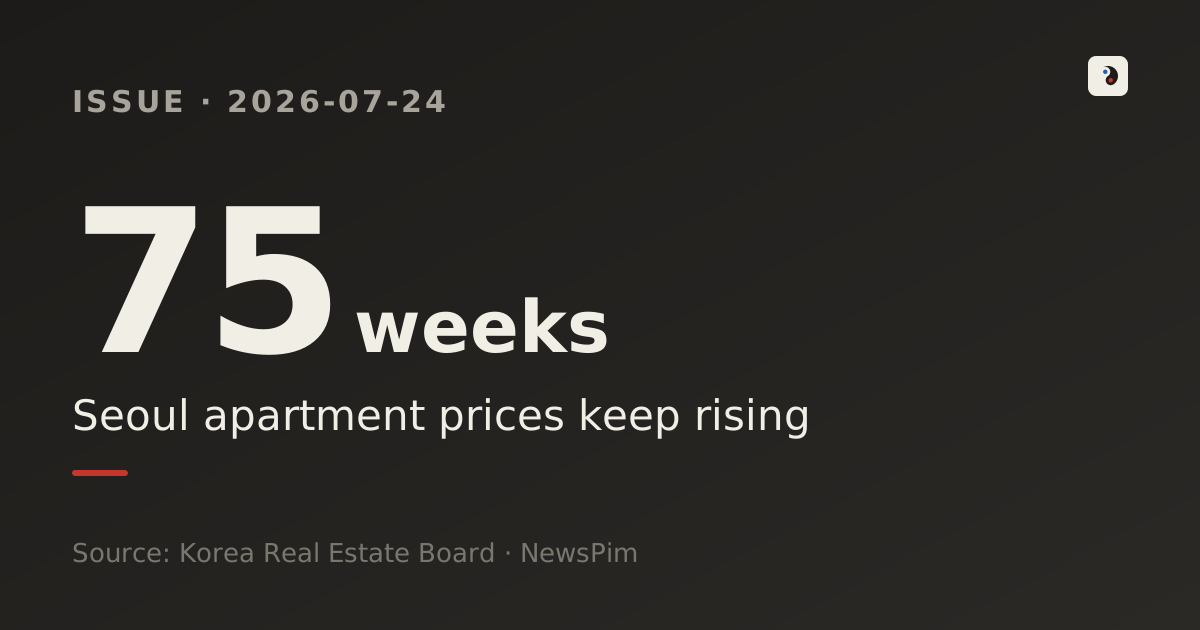
Even a rate hike hasn't cooled Korea's housing market — so the government is playing its last card: a full rewrite of the property tax code.
- Korea's government will unveil a comprehensive real estate plan in late July/early August that rewrites acquisition, holding, and transfer taxes around owner-occupancy.
- The Bank of Korea raised its policy rate to 2.75%, yet Seoul apartment prices have risen for 75 straight weeks, closing in on the 85-week record set under the Moon Jae-in administration.
- The core fight is over higher holding taxes and fewer perks for pricey single-home owners — and how far Korea pushes multi-home purchase costs toward levels seen in Singapore and the UK.
What happened
The government is preparing to announce a "comprehensive real estate plan" in late July or early August that rewrites the entire tax chain — acquisition, holding, and transfer — around owner-occupancy. The Ministry of Land and the Ministry of Economy and Finance are holding another public debate on the 27th to settle last-minute disputes. The core trade is raising holding taxes (the comprehensive real estate tax and property tax) while expanding the long-term holding capital-gains deduction for people who actually live in their one home.
The plan is a response to a housing market that simply won't cool. According to the Korea Real Estate Board's weekly report released July 23, Seoul apartment sale prices rose 0.27% from the prior week, marking 75 consecutive weeks of gains. A "balloon effect" is also spreading the increases into regulated satellite areas like Dongtan, Guri, and Yongin.
Why this is a turning point — a rate hike that didn't work
What makes this round unusual is its timing. The Bank of Korea's Monetary Policy Board raised the base rate from 2.50% to 2.75% on July 16 — a 0.25-point hike, the first increase in three and a half years since January 2023, ending 14 months of holds that followed a rate cut last May. All seven board members voted for the hike, and the bank explicitly cited financial-stability risk from surging home prices as one reason.
Tax overhauls themselves are nothing new. The Moon Jae-in administration issued more than 26 real estate measures over its five-year term, during which Seoul apartment prices notched an all-time record of 85 consecutive weeks of gains, from June 2020 to January 2022. The current 75-week streak is just 10 weeks shy of that record — which is exactly why a learned skepticism that "prices rise faster the more measures come out" is shadowing this plan too.
By the numbers
Still, the two eras prescribe different medicine. The Moon administration's measures mostly targeted mortgage limits and transaction curbs for multi-home owners. This overhaul instead aims to change the tax code's basic frame — holding versus actual residence. Until now, the long-term holding deduction that lowers capital-gains tax simply for holding a property long enough also benefited multi-home owners; the new idea is to redesign it around actual residence period instead.
By international standards, Korea's curbs on multi-home purchases sit in the middle of the pack. A second-home buyer in a regulated zone pays an 8% acquisition tax. Singapore, by contrast, charges even its own citizens a 20% Additional Buyer's Stamp Duty from the second home onward, which together with the base stamp duty comes to roughly 24% (about ₩240 million, or $180,000) in cash on a ₩1 billion (~$750,000) home. In London, added stamp duty for multiple homes pushes the effective rate to 12–13% (roughly ₩130 million). Korea's pivot toward higher holding taxes reads as an attempt to close this international gap at the holding stage rather than the acquisition stage.
The dispute — what's wrong with raising holding taxes
Supporters argue that higher holding taxes curb speculative demand and protect genuine homebuyers. The logic: scale back the tax perks that long flowed to pricey single-home owners — the so-called "one smart home" strategy — and redirect relief toward people who actually live in their homes.
Skeptics counter that raising holding taxes without an "exit ramp" backfires. If holding taxes rise while transfer (capital-gains) tax stays put, multi-home owners have less incentive to sell, which can lock up supply rather than free it — and the added tax burden can get passed through into jeonse and monthly rents. That's why real estate experts increasingly argue that "raising holding taxes requires opening an exit" — in other words, cutting transfer tax at the same time.
What's next — what to watch in the August plan
- Whether the holding-tax hike lands on the comprehensive real estate tax or the property tax, and how large the increase is
- How much the long-term holding deduction tightens its residency requirement — how closely the deduction rate tracks actual residence time rather than mere ownership time will determine how strong the incentive is for multi-home owners to sell
- Whether prices keep climbing after the August announcement — and whether they eventually surpass the Moon-era record of 85 weeks
If the plan clearly locks in a trade — higher holding taxes paired with a lighter transfer-tax path for owner-occupants — it could nudge multi-home owners to list properties and ease supply. If holding taxes rise alone without that exit ramp, locked-up inventory and rent pass-through could show up first instead. For renters and first-time buyers, an owner-occupancy-first overhaul is a favorable signal in principle, but if actual housing supply doesn't improve by the time they're ready to buy, the tax change alone may deliver only limited relief.
- Tax overhaul imminent: higher holding tax, fewer perks for the "one smart home" — Financial News (fnnews) (2026.07.24)
- Government to hold another public debate on the 27th, still finalizing real estate plan — Financial News (fnnews) (2026.07.24)
- Seoul apartment prices up 0.27%, 75 straight weeks of gains; Dongtan cools slightly — Newspim (2026.07.23)
- [Full text] Bank of Korea Monetary Policy Board July policy decision — Joseilbo (2026.07.16)
- Seoul apartment prices post 74 straight weeks of gains — a "dangerous overlap" with Moon's 85 weeks [Weekend Q&A] — The Scoop (2026.07.11)
- A record supply shortage fuels a second upswing — Seoul home prices rise for 67th straight week — Financial News (fnnews) (2026.05.25)
- A $75K-salary worker buying a second $750K home: Singapore taxes alone hit $180K, London nearly $100K — Daum News (2026.02.08)
- Buy a ₩1 billion home, pay ₩120 million in tax: everything about Korea's property taxes — Hankyung (2026.06.14)
This is nuloq's own analysis based on the public reporting and official data listed under Sources, written with the help of AI. It is for information only — not investment, legal, or medical advice — and reflects the situation at the time of writing. We correct the text if errors are found.
Related posts
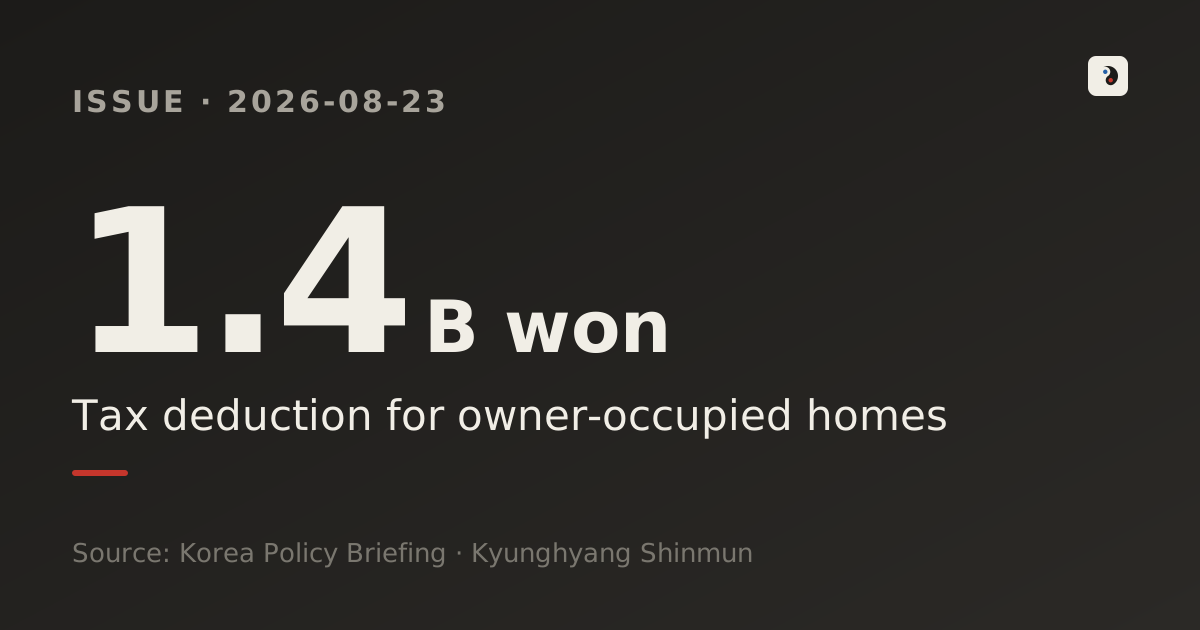
Korea's Property Tax Reform: 1.4bn Won Exemption for Residents, 900m for Absentees
Korea's 2026 tax reform raises the property-tax exemption to 1.4bn won for owner-occupiers, cuts it to 900m won for absentee owners. The data, history and fight behind the split.
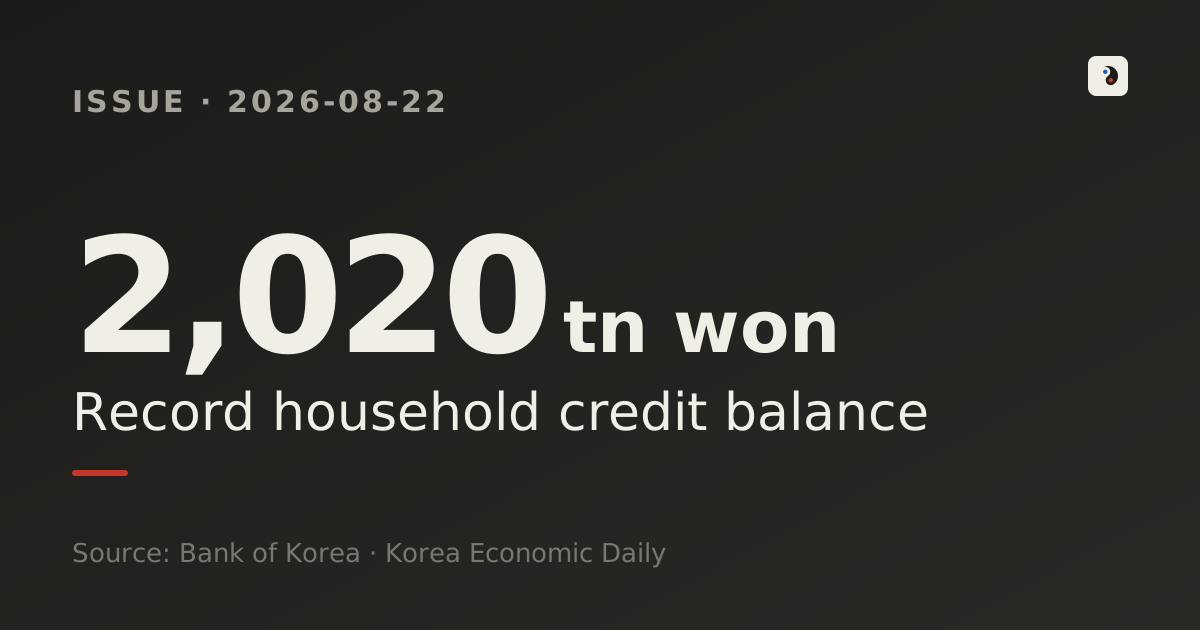
Korea's Household Debt Passes ₩2,019.8 Trillion, Biggest Jump in 19 Quarters
South Korea's household debt hit a record ₩2,019.8 trillion in Q2 2026, its biggest quarterly jump in 19 quarters. The data behind the debt-fueled stock bets and the central bank's rate dilemma.
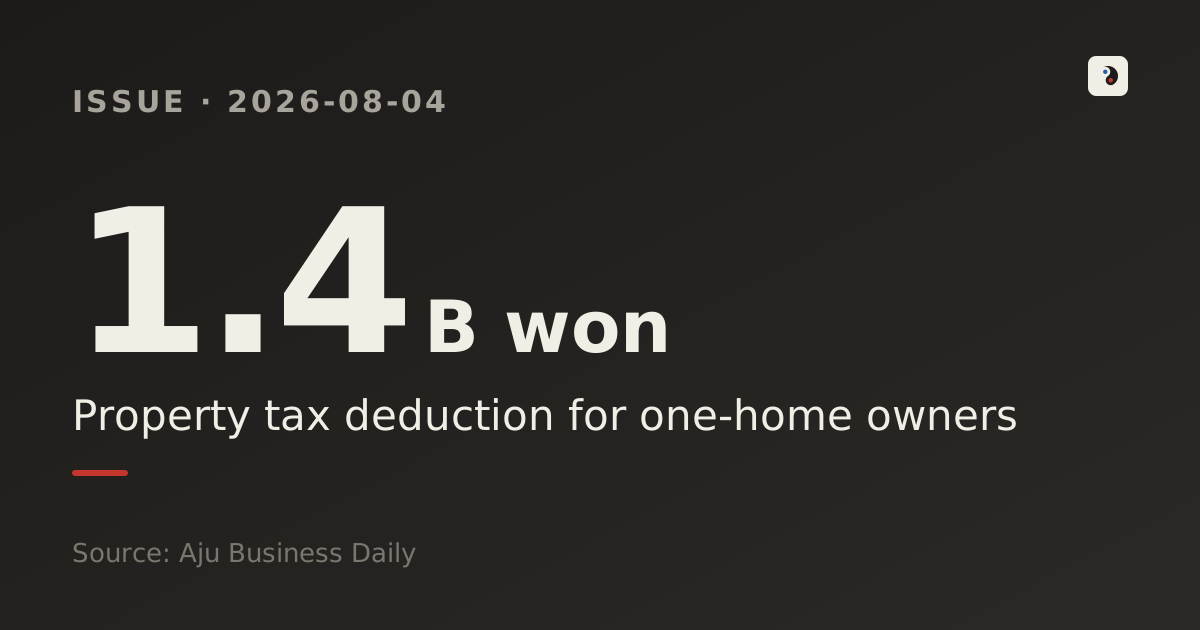
Korea Raises Property Tax Exemption to ₩1.4 Billion, Multi-Home Owners Face 80% Rate
South Korea raised its property tax exemption to 1.4 billion won and pushed multi-home owners' tax ratio to 80% — the 3.4 trillion won reform explained by the numbers.
Korea Housing Price Outlook Hits 127, Highest Since the 2021 Boom
Bank of Korea data show the housing price outlook index jumped to 127, a 4-year-10-month high, even after a rate hike. Here's why supply, not cheap money, is driving the surge.