· Updated 2026-09-11
Special counsel: up to 180 days of investigation — where does “690 days” come from?
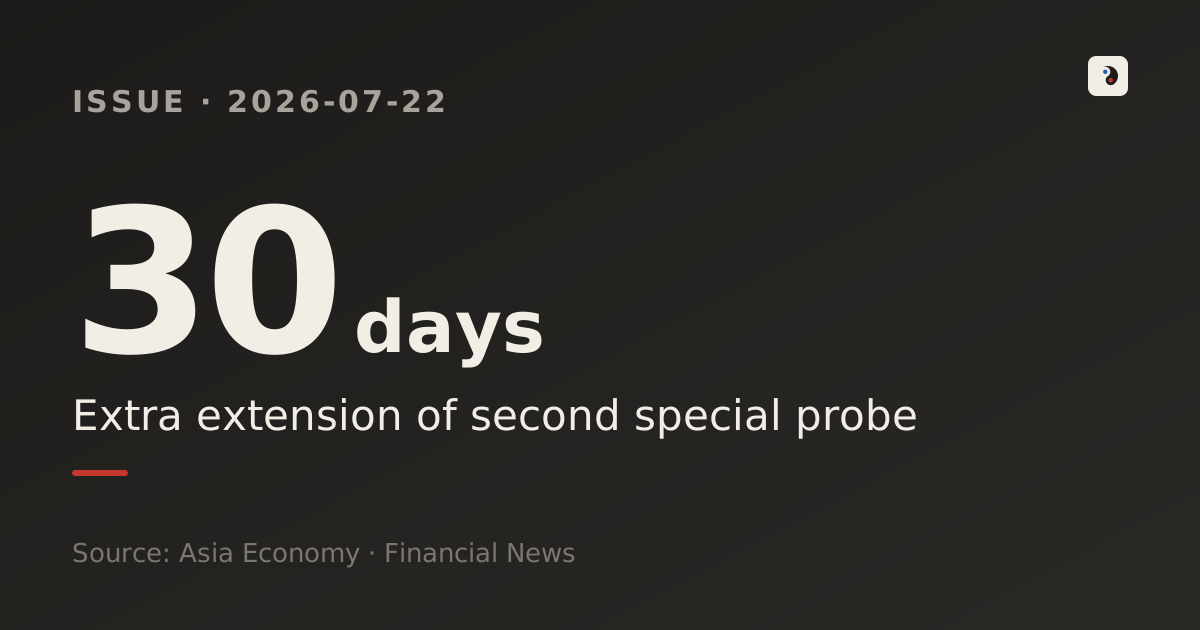
Correction (2026-09-11): (1) We read the text of the Special Counsel Act and now write the 20-day preparation period (the time for getting ready before the investigation starts) separately from the investigation period. (2) We fixed how the maximum investigation period of 180 days is built up: 90 + 30 + 30 + 30. (3) We deleted the sentence that gave one single cause for the gap between the 17 warrants and the 18 warrants counted on different dates. (4) We made clear that the 64.7% rejection rate in the summary is not a figure printed in the reporting, but a number this article worked out from the case counts that were reported. (5) Sources that were not used as evidence for this text are now marked as such. (6) We rewrote the sentences in plain words a middle-school student can read, and left every number, period and source unchanged. The 2026-09-10 correction items (a re-check of the counting scope of the key figures and of the comparison and interpretation wording) also still stand. The original publication date (2026-07-22) is retained.
The comprehensive special counsel act was changed, and the ceiling on how long the investigation can run went up. The People Power Party spoke of “690 days,” and the reporting gave a cost of 2.709 billion won. What is each of those numbers adding together? We checked by separating the preparation period and the investigation period that the law sets out.
- Look at Article 10 of the amended Special Counsel Act, in force since July 21, 2026. The preparation period is up to 20 days. The investigation period is 90 days to start with. On top of that, the special counsel can add 30 days once, on its own. If the President approves, 30 days can be added twice more. So the investigation period runs to a maximum of 180 days, and the 20-day preparation period is not counted inside it.
- The “690 days” is a number a People Power Party spokesperson said. It adds 510 days — the investigation periods of the first three special counsels added together — to the 180-day maximum investigation period of the second comprehensive special counsel. It does not mean one case is investigated for 690 days in a row.
- The 64.7% rejection rate is a number this article worked out itself, by dividing the case counts in a July 19 report (11 rejected out of 17 reviews finished). The 61.1% is copied straight from a figure given in remarks on July 22. We could not obtain court records compiled as of the same date, so we cannot settle why one count says 17 and the other says 18.
What the law actually says about the periods
Act No. 21856, which we checked on the Korea Law Information Center, took effect on July 21, 2026. Article 10(1) says the special counsel may take up to 20 days to get ready for work, counted from the day of appointment. Paragraphs (2) to (4) set the investigation period separately, counted from the day after that preparation period ends.
An earlier version of this article said “a base of 120 days, extended twice by 30 days.” The total of 180 days is the same, but the breakdown does not match what the law says. And there is no basis for mixing the “up to 170 days” figure from earlier reporting with the 180 days to argue that the 690 days could grow further.
The “690 days” is not time that ran off a calendar
On July 22, ThePublic reported remarks by Choi Bo-yun, chief spokesperson of the People Power Party. The remark was: “Add the 510 days of investigation for the first three special counsels and the 180 days for the second comprehensive special counsel, and you get 690 days.” This number is a total that the speaker added up in their own way.
The 2.709 billion won is “money calculated in advance as extra cost”
Financial News reported a calculation by the National Assembly Budget Office. It says that if the investigation period is extended by 30 days and 20 more officials are seconded, the cost goes up by 2.709 billion won. In this check we could not obtain the original estimate document. So the figures below are written down as values that this report passed on.
With warrant numbers, look at the cut-off date first
Etoday reported that, as of July 19, there had been 18 warrant requests, 17 finished reviews, 6 warrants granted and 11 rejected. If you work out the rejection rate using only the finished reviews, 11 ÷ 17 ≈ 64.7%. This article did that calculation. On July 22, ThePublic reported remarks by a People Power Party spokesperson saying that 11 out of 18 finished reviews were rejected, which is 61.1%.
What we checked, and what is still open
In this correction we read the text of the law and fixed what the periods mean. For the political remark and the cost report, we set out who said each figure. In short: the 690 days is a sum of investigation periods from several special counsels, the 2.709 billion won is a cost calculated in advance under stated assumptions, and the two rejection rates are values from two different points in time.
Some things we could not check. We could not obtain the court’s own record of warrant decisions compiled as of the same date, or the original cost estimate from the National Assembly Budget Office. On the Korea Law Information Center, the full text of Article 10 did not show up on screen in this check either, so the breakdown of the periods follows an earlier verification record. Who faces which allegation, and how the investigation turns out, are left out of this article’s calculations. An allegation is not yet a fact settled by a court ruling.
- Comprehensive Special Counsel Act — enactment and amendment text and current wording — Korea Law Information Center (in force 2026.07.21) · structure of the periods in Article 10 · in this check the act number and the effective date were confirmed on screen, but the full text of Article 10 did not appear
- “Comprehensive special counsel extension act” clears the Cabinet — Asiae (2026.07.21) · not used as evidence for this corrected text
- Bill extending the second special counsel clears the plenary session — Financial News (2026.07.21) · not used as evidence for this corrected text
- Report on the cost estimate for a one-month extension and 20 added staff — Financial News (2026.07.20)
- Report on the People Power Party’s 690-day and warrant-statistics remarks — ThePublic (2026.07.22)
- Report on the July 19 warrant count — Etoday (2026.07.19)
- Report on the comprehensive special counsel’s investigation schedule — Ajunews (2026.07.20) · not used as evidence for this corrected text
- Report on ruling and opposition party reactions — Sedaily (2026.07.21) · not used as evidence for this corrected text
- Report on the Comprehensive Special Counsel Act before the amendment — OhmyNews (2026.01.16) · not used as evidence for this corrected text
- Report on questioning by the special counsel — Financial News (2026.07.23) · not used as evidence for this corrected text
This article was put together by nuloq. The act number of Act No. 21856 and the fact that it took effect on July 21, 2026 were confirmed directly on the Korea Law Information Center screen. The full text of Article 10, however, did not show up on screen in this check either, so the breakdown of the periods follows an earlier verification record, and we leave it as an item for a human editor to check against the statute again. Figures taken from news reports are accepted only as far as what those reports passed on, and are not treated like official records issued by an institution itself. AI helped in writing this article.
Related posts
Approval at 45%, Housing Anger at 28%: What South Korea's Cabinet Reshuffle Really Signals
President Lee Jae-myung replaced six ministers as his approval rating sank to 45%. The data and disputes behind South Korea's biggest reshuffle yet.
Korea's Property Tax U-Turn: Gangbuk Prices Jump, Not Gangnam
Seoul walked back a property-tax hike on non-resident owners — but Gangbuk apartments, not Gangnam's, are the ones rising. Here's why.
Han Hak-ja Gets 2 Years, Not 13: Inside Korea's Church-Politics Scandal
The reported two-year sentence is a first-instance ruling and was appealed. It is not described as final. Defendants, charges and stages of separate proceedings must be distinguished.
Korea's Property Tax Reform: 1.4bn Won Exemption for Residents, 900m for Absentees
Korea's 2026 tax reform raises the property-tax exemption to 1.4bn won for owner-occupiers, cuts it to 900m won for absentee owners. The data, history and fight behind the split.