Approval at 45%, Housing Anger at 28%: What South Korea's Cabinet Reshuffle Really Signals
The finance chief was replaced after just eight months. The reason, in two words: real estate and approval ratings.
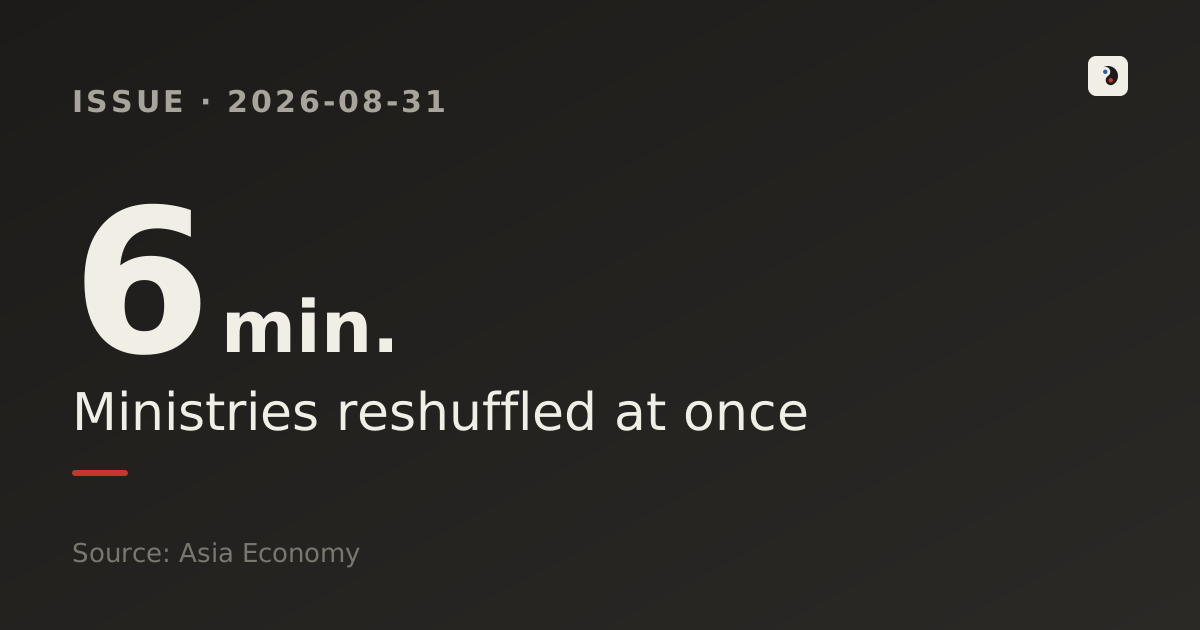
- On August 30, President Lee Jae-myung replaced six Cabinet ministers at once, including the deputy prime minister for the economy (Lee Hyung-il), the justice minister (Kim Seung-won), and the defense minister (Kang Shin-chul).
- The shake-up follows a slide in Lee's approval rating — from 59.9% in April to 45.7% in August by one tracking poll, and to a 45%-45% "dead cross" in Gallup Korea's August 18-20 survey, with housing policy the top reason for disapproval (28%).
- The opposition blasted the pick of Justice Minister nominee Kim Seung-won as a "bulletproof reshuffle" meant to shield the president's own legal cases, setting up confirmation hearings as the next flashpoint.
What happened
On August 30, President Lee Jae-myung nominated new ministers for six ministries at once: Economy and Finance, Justice, Defense, Land, Infrastructure and Transport, SMEs and Startups, and Gender Equality and Family. Lee Hyung-il, currently the finance ministry's first vice minister, was tapped as deputy prime minister for the economy. Kim Seung-won, the ruling Democratic Party's floor spokesperson on the parliamentary Legislation and Judiciary Committee, was named justice minister. Kang Shin-chul, South Korea's ambassador to Saudi Arabia and a former deputy commander of the Combined Forces Command, was picked for defense.
Hong Ji-seon (the land ministry's vice minister), Lee So-young (a Democratic Party lawmaker) and Yong Hye-in (Basic Income Party lawmaker) round out the list. Billed as the second reshuffle of Lee's term, this one touches six ministries at once — a mid-sized shake-up the presidential office called a "merit-first" personnel move.
Why it matters
Officially, the reshuffle is about "policy continuity and execution." The timing suggests more. In Gallup Korea's August 18-20 survey of 1,004 adults, approval and disapproval of Lee's job performance were tied at 45% each — a first-time "dead cross." Housing policy was the single biggest reason cited for disapproval, at 28%. A separate tracking poll shows an even sharper decline: from 59.9% in April to 45.7% in August, a 14.2 percentage-point drop. That the ministries reshuffled happen to be housing (Land), the economy (Finance) and security (Defense) is not a coincidence.
The economic reshuffle is also a sequel to a bigger reorganization. When the Lee government took office, the old Ministry of Economy and Finance was split — for the first time in 18 years — into a new Ministry of Economy and Finance (handling policy, taxation and the treasury) and an Office of Budget Planning (handling the budget). Gu Yun-chul, the inaugural head of the new finance ministry, is now leaving after roughly eight months. The presidential office insists this isn't about holding him accountable, but it's unusual for a newly created ministry's first chief to be replaced before completing even a year.
By the numbers
The generational gap is stark. Koreans in their 40s (55%) and 50s (50%) still rate Lee's performance positively, while those in their 20s (33%) and 30s (37%) lean negative. Filling the Cabinet with hands-on, younger figures — three sitting lawmakers among them — reads as an attempt to close that gap.
Incoming deputy prime minister Lee Hyung-il inherits a scorecard already spelled out in numbers. Under the government's mid-year economic strategy released in July, the "3-4-5 Leap" plan calls for lifting potential growth to 3%, ranking exports among the world's top four, and pushing per-capita income to $50,000. His track record — notably running a temporary price cap on oil during a Middle East-driven spike while serving as vice minister — is cited as the reason he got the nod.
The dispute
The ruling party frames the picks as "pragmatic and reform-minded" — installing a technocrat like Lee Hyung-il, who has held senior macroeconomic posts under both liberal and conservative governments, at a moment that calls for policy fluency.
The opposition People Power Party zeroes in on Justice Minister nominee Kim Seung-won. Party leader Jang Dong-hyuk argues that Kim — who sponsored a bill to remove the breach-of-trust charge the president himself faces, led the push to strip prosecutors of supplementary investigative powers as the ruling party's floor spokesperson on the Legislation and Judiciary Committee, and championed a special-counsel bill to cancel an indictment — is being installed as "the minister who will take the fall for canceling the president's own trial." The ruling camp counters that Kim never defended anyone in the Daejang-dong development scandal, disputing the opposition's characterization directly. Which account holds up is a question for the parliamentary confirmation hearing, not one this dispute alone can settle.
What comes next
The most immediate test is that hearing. Kim Seung-won is likely to face the sharpest opposition scrutiny, and a drawn-out confirmation fight would leave the other five ministries running without confirmed leadership for longer. Lee Hyung-il faces immediate pressure to finish a tax-code overhaul and stabilize housing prices and the stock market — without visible results there, both his approval numbers and the reshuffle's "merit-first" rationale could unravel. If housing and prices cool and the early indicators of the 3-4-5 strategy improve instead, this reshuffle could be remembered as the turning point that revived momentum in Lee's second year.
- Cabinet reshuffle roundup: Lee Hyung-il, Kim Seung-won, Kang Shin-chul named — Asia Economy (Asiae) (2026.08.30)
- Opposition blasts Kim Seung-won pick as a "bulletproof" reshuffle — Hankook Ilbo (2026.08.30)
- Housing and defense ministers swapped amid falling approval — Kyunghyang Shinmun (2026.08.30)
- Lee Hyung-il inherits tax reform and growth challenges — Herald Corp (2026.08.30)
- Finance ministry split in two for first time in 18 years — Kyunghyang Shinmun (2025.09.07)
- "Reform reshuffle" amid falling approval — Newstomato (2026.08.30)
- President's approval rebounds slightly to 45%, positive and negative tied (citing Gallup Korea) — Seoul Economic Daily (2026.08.21)
This is nuloq's own analysis based on the public reporting and polling data listed under Sources, written with the help of AI tools. It does not represent any political position and is for information only — not investment or legal advice — reflecting the situation at the time of writing; we will correct it if errors are found.
Related posts
Special counsel: up to 180 days of investigation — where does “690 days” come from?
We split the amended act's 20-day preparation period from its 180-day maximum investigation period. Then, in plain words: what the 690-day total, the 2.709 billion won cost estimate and two warrant rejection rates from different dates each mean.
Korea's Property Tax Reform: 1.4bn Won Exemption for Residents, 900m for Absentees
Korea's 2026 tax reform raises the property-tax exemption to 1.4bn won for owner-occupiers, cuts it to 900m won for absentee owners. The data, history and fight behind the split.
Korea's Growth Forecast Hits 3.2% — So Why Are New Jobs Falling?
KDI raised South Korea's 2026 growth forecast to 3.2% in 3 months on a chip boom — but new-jobs forecast fell from 170,000 to 110,000. The numbers, explained.
South Korea's Birth Rate Rebound: 0.72 to Near 0.9 — Real or a Mirage?
South Korea's fertility rate jumped from a record-low 0.72 in 2023 toward 0.9 in 2026. Is this birth rate rebound a real turnaround — or a demographic mirage?