· Updated 2026-09-11
Supreme Court re-nomination dispute — what Article 104 actually sets out
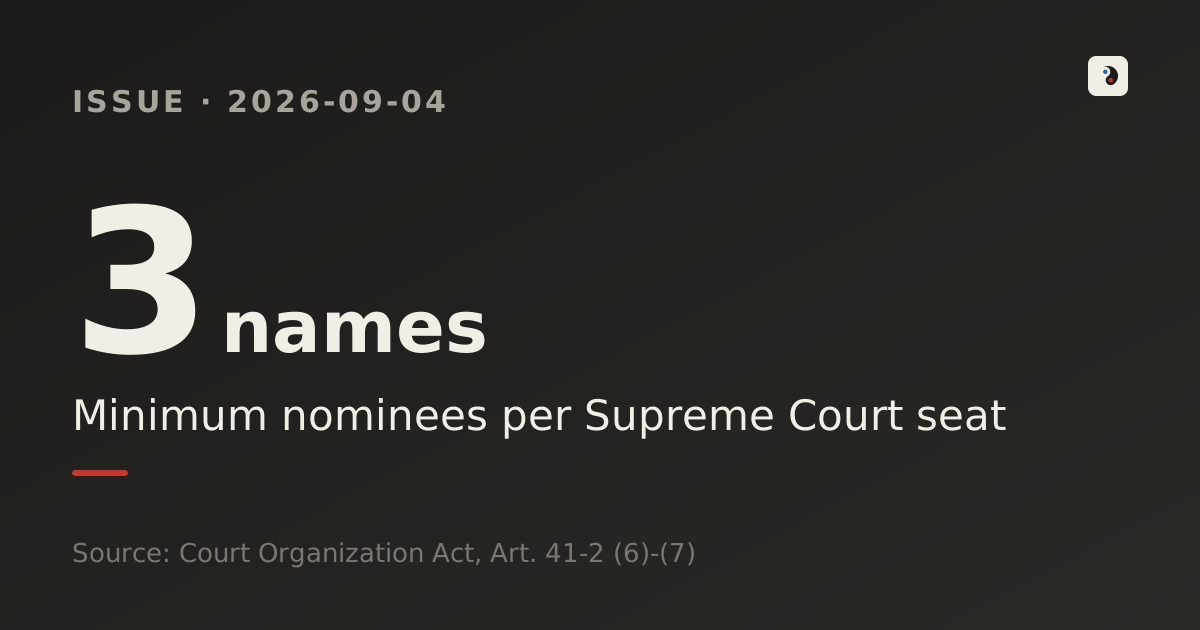
Correction (2026-09-11): (1) We removed the phrase “the first in 39 years,” which we could not check against the full record, from the title, the summary, the body and the chart notes. (2) Article 104 of the Constitution covers only the Chief Justice’s nomination, the National Assembly’s consent and the President’s appointment, so the procedure for submitting the appointment consent motion and the confirmation-hearing procedure are now written separately, under the National Assembly Act and the Personnel Hearing Act. (3) We state in the chart that the basis for recommending candidates is Article 41-2(6) and (7) of the Court Organization Act, and we changed the source link to an address where that provision is actually visible. (4) A ratio made by dividing the number of signatories of one statement by the other is hard to give any meaning to, so we deleted it from the chart note. (5) We explain once why former Justice Noh Tae-ak and Justice Lee Heung-gu are written differently, and we also say what we used to confirm the date of August 18. (6) We rewrote the sentences in plain words a middle-school student can read, and left every number, date and source unchanged. The original publication date (2026-09-04) is retained.
The presidential office did not send the appointment consent motion (the document submitted to the National Assembly to ask for its consent) for Supreme Court justice nominee Son Bong-gi. Instead, it asked the Chief Justice to put forward a candidate again. We checked, one at a time, which law applies to this and how far, using the official announcements and the text of the statutes.
- On August 18 the Chief Justice nominated Son Bong-gi, and Kim Seong-su was reported to have been nominated on the same day. On August 28 the presidential office said it would not send Son’s appointment consent motion to the National Assembly and asked for a fresh nomination instead, and said it would send Kim’s appointment consent motion to the Assembly.
- Article 104(2) of the Constitution sets out three things: the Chief Justice puts a candidate forward, the National Assembly consents, and the President appoints. The committee that recommends candidates is written into the Court Organization Act, and the review and confirmation hearing that follow once the document reaches the Assembly are written into the National Assembly Act and the Personnel Hearing Act.
- Judgments such as “the first since 1987” or “the first in 39 years” could not be checked this time by going through the whole record. So this article explains only the procedure and the legal issues, and does not nail that number down as a fact.
The order of events that the official announcements confirm
On August 18, 2026, Chief Justice Cho Hee-dae nominated Son Bong-gi in writing. Kim Seong-su was reported to have been nominated on the same day. Son Bong-gi, a presiding judge at the Daegu District Court, was put forward to succeed former Justice Noh Tae-ak, and Kim Seong-su, a presiding judge at the Seoul High Court, to succeed Justice Lee Heung-gu. This step, in which the Chief Justice puts a candidate forward to the President, is called a nomination. The date confirmed in the briefing is August 18, when Son Bong-gi was nominated in writing. We could not confirm the date of Kim Seong-su’s nomination from official material this time, so we record the value that appeared in reporting. Writing one of them as “former Justice” and the other as “Justice” follows the briefing the presidential office released on August 28. The Supreme Court notice page did not open in this check either. When the two of them left the bench is not something this article checked separately.
In its August 28 briefing, the presidential office said it would not send Son’s appointment consent motion to the National Assembly. Instead, it asked the Chief Justice to put forward a candidate again. It gave two reasons: that more than seven months had gone by after the candidate recommendation committee made its recommendation in January without a nomination, and that the nomination was made only in writing, without real consultation. For Kim, it said views had come together through consultation, and that it would send the appointment consent motion to the Assembly. This is the explanation the presidential office gave. It is not a ruling handed down by a court.
The procedure is not all inside one provision
So bundling it as “steps 2 to 4 are the Constitution,” the way an earlier version of this article did, does not match the sources. The Constitution sets out only how power is shared among three institutions. Recommending candidates, and the handling procedure inside the National Assembly, are set separately by other laws.
What is written in the law, and what is not
Article 104(2) of the Constitution says nothing about the President and the Chief Justice having to consult in advance. The other way round, this provision also does not say when or in what form the President has to send the appointment consent motion to the National Assembly. The presidential office explained that consulting in advance is a practice of mutual respect. Statements opposing the move, and news reports, criticised it as an infringement of the Chief Justice’s power of nomination.
The number of people who signed a statement is not an opinion poll
On September 2, Asia Economy reported a statement issued by 84 legal professionals from the 14th class of the Judicial Research and Training Institute. On September 3, the Law Times reported a statement issued by 27 alumni of Seoul National University’s law school who entered in 1976. Those two numbers are only the number of people who put their names on each statement. They are not a figure that shows how opinion is divided across the legal profession as a whole.
How this differs from the United States
The U.S. Congressional Research Service (CRS) counted 165 nominations to the federal Supreme Court from 1789 to 2022. Of those, 128 received the Senate’s consent and 37 did not. Of the 37 that did not, 11 were voted down in a Senate vote.
But in the United States the President picks the candidate and the Senate consents. In Korea, this case arose at the stage after the Chief Justice had put a candidate forward, when the President did not send the appointment consent motion to the National Assembly. Who picks the candidate is different, and so is the procedure. So the number of rejections in the United States cannot be used as a direct comparison for this request for a re-nomination.
What happened after publication, and what we could not confirm
On September 9, the Law Times reported that the Supreme Court appears set to form a new candidate recommendation committee in order to put forward another successor to former Justice Noh Tae-ak. In this check we could not obtain an official Supreme Court announcement to match it. So we record it only as a report with a date attached, not as a settled decision.
We could not check the full record of nominations from 1987 to 2026. So the phrase “the first in 39 years” has been taken out of the body and out of the article’s own details. Whether the two candidates are suitable as Supreme Court justices is also not a question for this article to judge.
- Briefing on the request to re-nominate a Supreme Court justice candidate — the presidential office (2026.08.28)
- Nomination for the appointment of Supreme Court justices — Supreme Court of Korea (2026.08.18) · could not be reached in this check because of a certificate problem
- Constitution of the Republic of Korea, Article 104 — Korea Law Information Center
- Court Organization Act, Article 41-2(6) and (7) — Korea Law Information Center · the screen where the wording on recommending at least three times the number of vacancies, and on respecting the recommendation, is actually visible
- National Assembly Act, Article 46-3 — Korea Law Information Center
- Personnel Hearing Act, Article 6 — Korea Law Information Center
- The existing article’s reference link for the Constitution and the Court Organization Act — Korea Law Information Center · kept to preserve the URL; the provisions relied on in this correction are the individual official links above
- Report on the request for a re-nomination — the Law Times (2026.08.28)
- Report on the presidential office’s announcement — Kyunghyang Shinmun (2026.08.28)
- Report carrying the judgment “a first in constitutional history” — Money Today (2026.08.28) · the historical judgment was not independently verified
- Report on the statement by 84 members of the 14th class of the Judicial Research and Training Institute — Asia Economy (2026.09.02)
- Report on the statement by 27 Seoul National University law alumni who entered in 1976 — the Law Times (2026.09.03)
- Report on the Chief Justice’s remarks on returning to work — Cheonji Ilbo (2026.09.03)
- Supreme Court Nominations, 1789 to 2022 — CRS
- Report on the prospect of reconstituting the candidate recommendation committee — the Law Times (2026.09.09)
This article was written by opening and checking the presidential office briefing and the text of the statutes on the Korea Law Information Center directly. The Supreme Court notice page again did not open because of a certificate problem, so the fact and the date of the August 18 nomination were confirmed from the presidential office briefing. The number of people who joined each statement, and what happened afterwards, are written down as values the respective reports passed on. Whether this is “a first in history,” and any final conclusion on how the Constitution should be read, are not treated as confirmed facts. AI helped in writing this article.
Related posts
150 Troops, 70% of Oil: South Korea's Hormuz Dilemma by the Numbers
Squeezed between US pressure and Iran's war warning, South Korea is weighing sending 150 troops to the Strait of Hormuz — the route for 70% of its oil imports. Here's the dilemma in numbers.
Welfare ₩148.8tn, National Debt ₩1,519.8tn — What Is the 48.3% Ratio Divided By?
We separate the two ways of counting the welfare ministry's budget, and correct the denominator of the national debt ratio to nominal GDP. We hold back judgment on why the ratio falls until the official GDP assumption can be checked, and we found no confirmed evidence that the future response fund caused the ₩106 trillion rise in debt.

A 5-Year-Old Text Threatens Korea's Justice Minister Pick
Justice minister nominee Kim Seung-won sent a text in 2021 asking regulators to speed up a drug trial approval. Five years on, that message is the flashpoint of his September 15 confirmation hearing.
Korea's Property Tax U-Turn: Gangbuk Prices Jump, Not Gangnam
Seoul walked back a property-tax hike on non-resident owners — but Gangbuk apartments, not Gangnam's, are the ones rising. Here's why.