A 5-Year-Old Text Threatens Korea's Justice Minister Pick
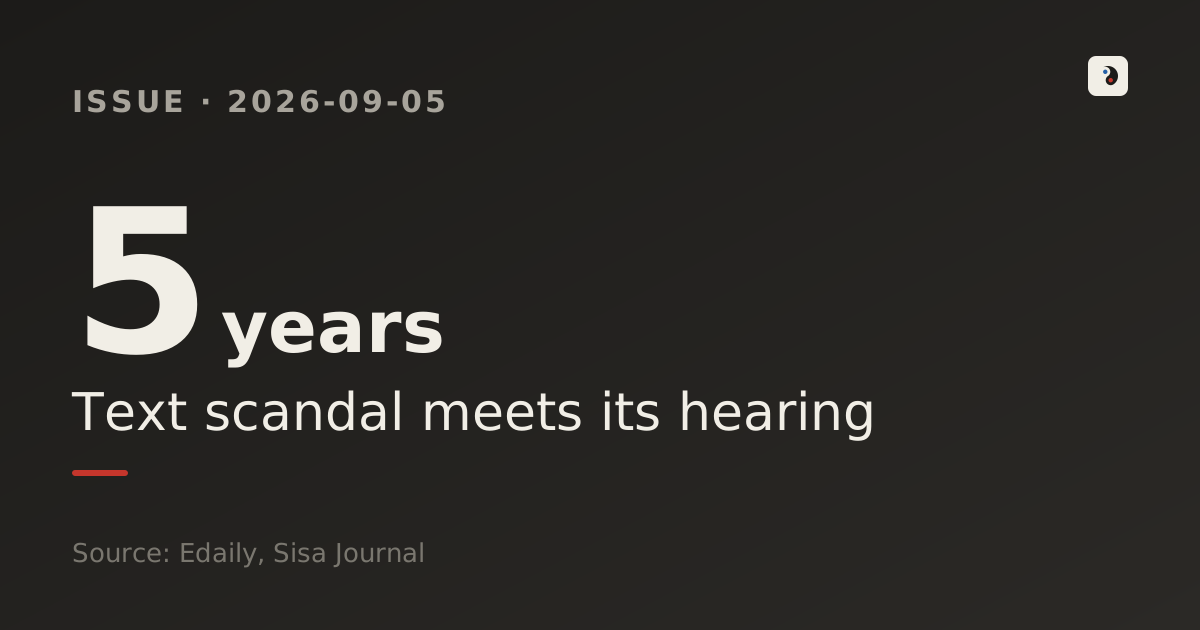
Favor or forwarded complaint? A single text message from five years ago has become the biggest landmine in a cabinet confirmation hearing.
- Justice minister nominee Kim Seung-won, then a first-term lawmaker, sent Korea's drug regulator a text in 2021 asking it to speed up approval of a COVID-19 treatment's clinical trial.
- Prosecutors closed the case with a suspended indictment in December 2024, but the opposition has revived it as a conflict-of-interest issue ahead of the September 15 hearing.
- The controversy is compounded by Kim's past push to cancel President Lee Jae-myung's criminal indictment and an old drunk-driving record, raising broader fitness-for-office questions.
What happened
When Rep. Kim Seung-won of the Democratic Party was nominated as justice minister, a text message he sent back in 2021 resurfaced. As a first-term lawmaker that year, Kim relayed a request from an acquaintance, Mr. Yang, to then-Ministry of Food and Drug Safety (MFDS) Commissioner Kim Kang-lip, asking that the clinical-trial approval process for Genencell, a company developing a COVID-19 treatment, be handled quickly.
Prosecutors investigated and closed the case with a suspended indictment against Kim in December 2024. But after he was nominated justice minister in August 2026 and the National Assembly's Legislation and Judiciary Committee set the confirmation hearing for September 15, the five-year-old text became the hearing's central issue.
Why it matters
The justice minister sits atop Korea's law-enforcement apparatus, wielding personnel authority over prosecutors and influence over investigations. A candidate who once passed a specific company's request directly to a regulator's chief cannot easily escape conflict-of-interest scrutiny. Kim is also co-chair of a lawmakers' group pushing to cancel the criminal indictment against President Lee Jae-myung and to launch a parliamentary probe into how it was filed. Given how much sway a justice minister has over prosecution's investigative and charging decisions, that record risks being read as more than personal political conviction — it goes to the nominee's fitness for the post.
Confirmation-hearing casualties are nothing new under this administration either. Education minister nominee Lee Jin-sook, a former university president, saw her nomination withdrawn earlier over plagiarism and early-study-abroad allegations involving her children. This hearing is another test of whether the justice ministry — meant to lead prosecutorial reform — can command public trust amid that recurring pattern.
By the numbers
The text at the center of the controversy was sent in 2021, but prosecutors didn't close the case with a suspended indictment until three years later, in December 2024. Now, two more years on, in September 2026, the matter has resurfaced as the hearing's core issue — a single text message with five years of political staying power.
Opposition lawmakers are pressing on three fronts ahead of the hearing. Beyond the drug-trial lobbying allegation, Rep. Han Dong-hoon of the Reform Party has newly alleged that as head of the party's Gyeonggi chapter, Kim ran a "kickback" scheme in which staffers were paid inflated salaries and then returned the excess. His past drunk-driving record is also under scrutiny.
The dispute: two readings
Kim's camp draws a firm line: the text was "not lobbying but simply relaying a public-interest grievance." They point out prosecutors found no violation of MFDS review procedures, and that the outcome was a suspended indictment, not a clean exoneration.
The opposition People Power Party sees it differently — arguing it is inherently improper for a sitting lawmaker to hand a specific company's request directly to the head of the regulator overseeing that company, regardless of the outcome. Legal observers note that a suspended indictment isn't a denial of wrongdoing; it means the offense is acknowledged but prosecution is waived given mitigating circumstances — a distinction that undercuts any claim of a clean bill of health.
Views also diverge on Kim's push to cancel President Lee's indictment: the ruling camp calls it "a political conviction aimed at correcting judicial injustice," while the opposition warns that as justice minister, it "could compromise the neutrality of the entire prosecution and charging apparatus."
What's next
Except for a handful of posts like prime minister, National Assembly consent is not a legal requirement for Korean confirmation hearings — meaning the president can push through an appointment regardless of how hard the opposition objects. So this hearing alone has limited power to block Kim's appointment outright.
Still, if new statements or evidence surface during the hearing, public backlash could push him toward a voluntary withdrawal — as happened with the earlier education minister nominee. If he clears this hurdle instead, a conflict-of-interest case resting on a suspended indictment could become a precedent for pushing appointments through regardless. Either way, the hearing's outcome will test how much public trust the Lee administration's prosecutorial-reform drive can command.
- Is the justice minister nominee tied to a favoritism scandal? — Sisa Journal (2026.09.02)
- From the MFDS text to Lee's dropped indictment: what's at stake at the hearing — Edaily (2026.09.04)
- Kim's hearing set for the 15th, opposition vows tough scrutiny — Edaily (2026.09.05)
- PPP presses on MFDS lobbying claims; Kim says it was a public-interest referral — Joseilbo (2026.09.03)
- A hot-potato hearing from day one: indictment cancellation and drug-trial lobbying — Herald Corp (2026.09.02)
- Six ministerial nominees prep for hearings; Kim's "indictment cancellation" the biggest flashpoint — Digital Times (2026.09.01)
- Han Dong-hoon Releases Texts in Justice Nominee's Drug Agency Lobbying Case — Seoul Economic Daily (2026.09.02)
- Seo Young-kyo on the controversy over Justice nominee Kim Seung-won — The Kyunghyang Shinmun (2026.09.04)
- A "brutal history": education-minister nominees keep falling under every administration — University News Network (2025.08.20)
This is nuloq's own analysis, comparing and synthesizing the domestic and international reporting listed under Sources, written with the help of AI tools. It is provided for information only, not as a legal judgment about any individual or party, and reflects the situation at the time of writing. We correct the record promptly if errors are found.
Related posts
150 Troops, 70% of Oil: South Korea's Hormuz Dilemma by the Numbers
Squeezed between US pressure and Iran's war warning, South Korea is weighing sending 150 troops to the Strait of Hormuz — the route for 70% of its oil imports. Here's the dilemma in numbers.
Welfare ₩148.8tn, National Debt ₩1,519.8tn — What Is the 48.3% Ratio Divided By?
We separate the two ways of counting the welfare ministry's budget, and correct the denominator of the national debt ratio to nominal GDP. We hold back judgment on why the ratio falls until the official GDP assumption can be checked, and we found no confirmed evidence that the future response fund caused the ₩106 trillion rise in debt.
Supreme Court re-nomination dispute — what Article 104 actually sets out
We confirmed the presidential office's request for a re-nomination, and the August 18 nomination of Son Bong-gi, from the presidential office briefing. In plain words, provision by provision: which law covers candidate recommendation, nomination, the National Assembly's consent and the confirmation hearing.
Korea's Property Tax U-Turn: Gangbuk Prices Jump, Not Gangnam
Seoul walked back a property-tax hike on non-resident owners — but Gangbuk apartments, not Gangnam's, are the ones rising. Here's why.