· Updated 2026-09-11
Welfare ₩148.8tn, National Debt ₩1,519.8tn — What Is the 48.3% Ratio Divided By?
Correction (2026-09-11): ① We fixed an error that described national tax revenue as the denominator of the national debt ratio — the number you divide by. The denominator of the ratio is nominal GDP. ② We also deleted the claim that the future response fund was the cause of the ₩106 trillion rise in national debt. The government's fiscal management plan says the opposite: ₩12.5 trillion of the extra tax revenue goes to cutting new government bond issuance. ③ So that readers do not read the two years of nominal GDP, back-calculated from rounded figures, as one continuous series, we added an explanation of why they cannot be read that way, and we held back any judgment on why the ratio falls. ④ We noted that part of the ₩162.3 trillion has no stated use. ⑤ We removed a chart note about a ₩100 million difference that readers had no way to check. ⑥ We rewrote the sentences in plain language a middle-school student can read, and left the numbers, units and sources unchanged. The correction items from 2026-09-10 — a re-examination of the counting scope of the key figures and of the comparison and interpretation wording — are kept as well. The original publication date (2026-09-06) is retained.
The 2027 budget bill contains both ₩148.7697 trillion under the Ministry of Health and Welfare and national debt of ₩1,519.8 trillion. The debt amount rises while the share of GDP falls, so we read those two numbers through the definitions of the numerator (the number being divided) and the denominator (the number you divide by). We held back judgment on why the ratio falls until the official GDP assumption can be checked. Tax revenue, the fiscal balance and the future response fund are set out here as separate indicators.
- The official Ministry of Health and Welfare material puts the ministry's own 2027 budget at ₩148.7697 trillion. Add the three programs that went into the future response fund and the total is ₩152.4328 trillion. The two numbers count different things.
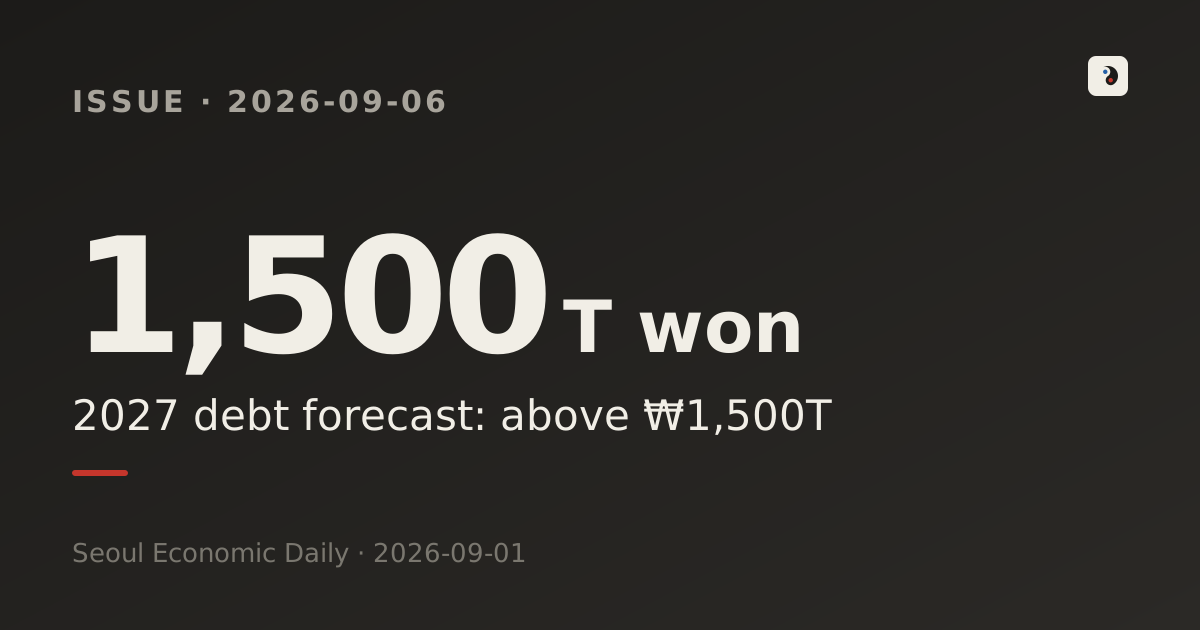
- In the government's plan, national debt rises from ₩1,413.8 trillion in the 2026 original budget to ₩1,519.8 trillion in 2027, an increase of ₩106 trillion. Yet the share of GDP falls from 51.6% to 48.3%. The number you divide by to get that ratio — the denominator — is nominal GDP, not national tax revenue.
- The government says it is creating the future response fund out of domestic tax collected above the trend of the last 10 years, investing ₩45.4 trillion and using ₩12.5 trillion to cut new government bond issuance. This material on its own cannot tell us that the fund is the cause of the ₩106 trillion rise in debt.
₩148.8 trillion and ₩152.4 trillion count different things
The Ministry of Health and Welfare's press release on the 2027 budget bill puts total spending under the ministry at ₩148.7697 trillion. It said separately that adding the child basic allowance, the child-welcome grant and the physical AI programs, which went into the future response fund, brings the figure to ₩152.4328 trillion.
The debt amount and the debt ratio move in different directions
Look at the government's National Fiscal Management Plan for 2026 to 2030. On a 2026 original budget basis, national debt is ₩1,413.8 trillion, or 51.6% of GDP. The 2027 projection is ₩1,519.8 trillion and 48.3%.
The national debt ratio is national debt divided by nominal GDP. Work backwards from the published rounded figures and nominal GDP comes out at about ₩2,740 trillion for 2026 (1,413.8 ÷ 0.516) and about ₩3,147 trillion for 2027 (1,519.8 ÷ 0.483). These are not from an official GDP table; they are approximate values back-calculated from a rounded debt amount and a rounded ratio. Join the two and nominal GDP would have to grow about 14.8% in a single year. So until it is confirmed that both ratios were produced from the same GDP series and the same base year, these back-calculated values cannot be strung together and compared as one time series. The material we read this time has no such assumption table.
That is why national tax revenue of ₩584.4 trillion cannot be called the denominator of the ratio. Tax revenue can affect the fiscal balance and how much borrowing is needed. But by the definition of the debt ratio, the number you divide by is nominal GDP. The government documents we read this time have no separate table of nominal GDP assumptions, so we do not break down any further why the ratio fell.
Tax revenue and the fiscal balance are numbers on different axes
The government projects total revenue of ₩880.8 trillion and total spending of ₩820.9 trillion for 2027. It put the consolidated fiscal balance at a surplus of ₩59.9 trillion, and the managed fiscal balance, which takes out the social security funds balance, at a deficit of ₩3.1 trillion. It expects national tax revenue to rise from ₩390.2 trillion in the 2026 original budget to ₩584.4 trillion.
We could not find the wording for a consolidated fiscal balance of ₩59.9 trillion, or for a managed fiscal balance deficit of ₩3.1 trillion, on the page we opened this time. That page shows only the managed fiscal balance as a share of GDP, at -0.1%. The two amounts can only be checked against the attachments to the budget bill.
There is no confirmed evidence that the future response fund increased the debt
The government press release and the National Fiscal Management Plan explain it like this. Of 2027 national tax revenue, the extra ₩162.3 trillion collected above the trend line for domestic taxes over the last 10 years is used to fund the future response fund. The government said it plans to invest ₩45.4 trillion of that money in young people, growth engines, regions, education and talent, and to use ₩12.5 trillion to cut the volume of new government bond issuance. The material we read this time does not set out item by item what the rest is used for, and there is no basis for linking that remainder to the ₩106 trillion rise in debt.
This explanation does not back up the earlier text, which said the fund created the ₩106 trillion rise in debt. If anything, the official explanation points the other way: part of the fund's money goes to reducing debt. To pin down exactly why debt rises by ₩106 trillion, you would need a financing table covering bond issuance and redemption, fund balances, loans and equity injections, and cash adjustments. We could not confirm that table in this material, so we do not state a cause.
What this piece can confirm
- ₩148.7697 trillion under the Ministry of Health and Welfare and ₩152.4328 trillion including the future response fund programs count different things.
- A rise of ₩106 trillion in the debt amount and a fall of 3.3 percentage points in the share of GDP can happen at the same time. The number you divide by in the ratio is nominal GDP.
- The tax revenue projection is only an assumption used in working out the fiscal balance. It is not the denominator of the debt ratio itself.
- How the future response fund and the ₩106 trillion rise in debt connect in accounting terms has not been confirmed.
All the 2027 figures are projections in the government's budget bill and mid-term plan. They can change in the National Assembly's review and in the settlement of accounts later on.
- 2027 budget bill and the 2026-2030 National Fiscal Management Plan — Ministry of Planning and Budget official budget site (2026.09.01) · press release and National Fiscal Management Plan attachments
- The ₩820.9 trillion 2027 budget bill and the future response fund explained — Policy Briefing (2026.09.01)
- 2027 Ministry of Health and Welfare budget bill — Ministry of Health and Welfare / Ministry of Planning and Budget official budget site (2026.09.04)
- Report on the national debt and tax revenue projections — Seoul Economic Daily (2026.09.01)
- Report on the welfare ministry's budget — ZDNet Korea (2026.09.01)
- Report on the counting scope of the welfare ministry's budget — Pax Medical News (2026.09.01)
- Report on basic livelihood benefits — Korea Social Welfare Journal (2026.09.01)
- Report re-citing OECD social spending — The Indigo (2025.04.09) · not used as evidence in this corrected text
- Report on the national tax revenue projection — Money Today (2026.09.02)
- Report on projections for the elderly population — Aju Business Daily (2026.09.04) · not used as evidence in this corrected text
- Report on the ruling and opposition reaction to the budget bill — Newswho Plus (2026.09.05) · not used as evidence in this corrected text
For this piece we opened and read the explanation of the 2027 budget bill posted on Policy Briefing. Total spending, total revenue, national tax revenue, the debt ratio and the future response fund amounts were confirmed on that page. However, ₩148.7697 trillion and ₩152.4328 trillion, ₩1,413.8 trillion and ₩1,519.8 trillion, and ₩390.2 trillion sit inside attachments posted by the Ministry of Planning and Budget and the Ministry of Health and Welfare, and we could not open those files this time. For the values we calculated, we wrote down the formula and the limits of rounding, and reports that are linked but were not used as evidence in the text are marked separately. AI tools helped in writing this piece, and it is not fiscal or investment advice.
Related posts
South Korea's Elderly Workers Top 10 Million — Retired at 53, Working Until 73
South Korea's employed 55-79 population just topped 10 million. Most left their career job at 53, not by choice, and a thin pension means many now say they'll need to work until 73.
KOSPI Crashes 10.84%, Worst Day Since 9/11 — Plus Korea's Record 6.7% Welfare Hike
The KOSPI plunged 10.84% to 6,023.66 — its steepest one-day fall since September 2001 — as China chip fears crushed Samsung and SK Hynix. We also unpack Korea's record 6.7% welfare benchmark increase and why the real heat-wave risk starts this week.
150 Troops, 70% of Oil: South Korea's Hormuz Dilemma by the Numbers
Squeezed between US pressure and Iran's war warning, South Korea is weighing sending 150 troops to the Strait of Hormuz — the route for 70% of its oil imports. Here's the dilemma in numbers.

A 5-Year-Old Text Threatens Korea's Justice Minister Pick
Justice minister nominee Kim Seung-won sent a text in 2021 asking regulators to speed up a drug trial approval. Five years on, that message is the flashpoint of his September 15 confirmation hearing.