· Updated 2026-09-11
Korea's National Pension Fund: domestic stock target raised, estimated domestic share 26.3% on July 8
Correction (2026-09-11): ① We had the wrong reference date for the 26.3% actual share. It is not "early August" but July 8 (Newsis, July 9, 2026, citing an estimate by Meritz Securities). Other dates were fixed to match that report. ② We had flatly written that the fall came "from prices, not from selling." That now reads "the estimated share came down while the KOSPI was falling." A securities firm's rough estimate and the "pension funds and others" trading line cannot prove that the National Pension Service caused it. ③ The band a fund may drift from its target (the tolerance range) is a figure the Ministry of Health and Welfare decided not to disclose. So each reported number now names the outlet that carried it, and we removed the sentence that stated a reason for the gap as settled fact. ④ The fund size in the headline (1,670 trillion won) carried no reference date, so we took it out. ⑤ We also fixed the number of times the target was raised, the % versus %p wording, the July net buying by pension funds, and the sources under the charts. ⑥ Added on 2026-09-11: we rewrote how the 28.8% tolerance figure is reached. It is the ±6%p of the long-term split (SAA) plus the ±2%p of the short-term adjustment (TAA) — ±8%p in all — laid on top of the 20.8% target. The earlier version left the TAA part out, so readers could not follow the math. ⑦ We also wrote inside the chart which period each headline figure (+5.9%p, -4.8%p) covers. The original publication date (2026-08-12) is unchanged.
The National Pension Service has a "target share" and an "actual share." The target is a number a committee sets. The actual share is what prices and trading leave behind. This year the target went up twice, and the actual share a securities firm estimated came down while the KOSPI was falling. The two often get read as one thing.
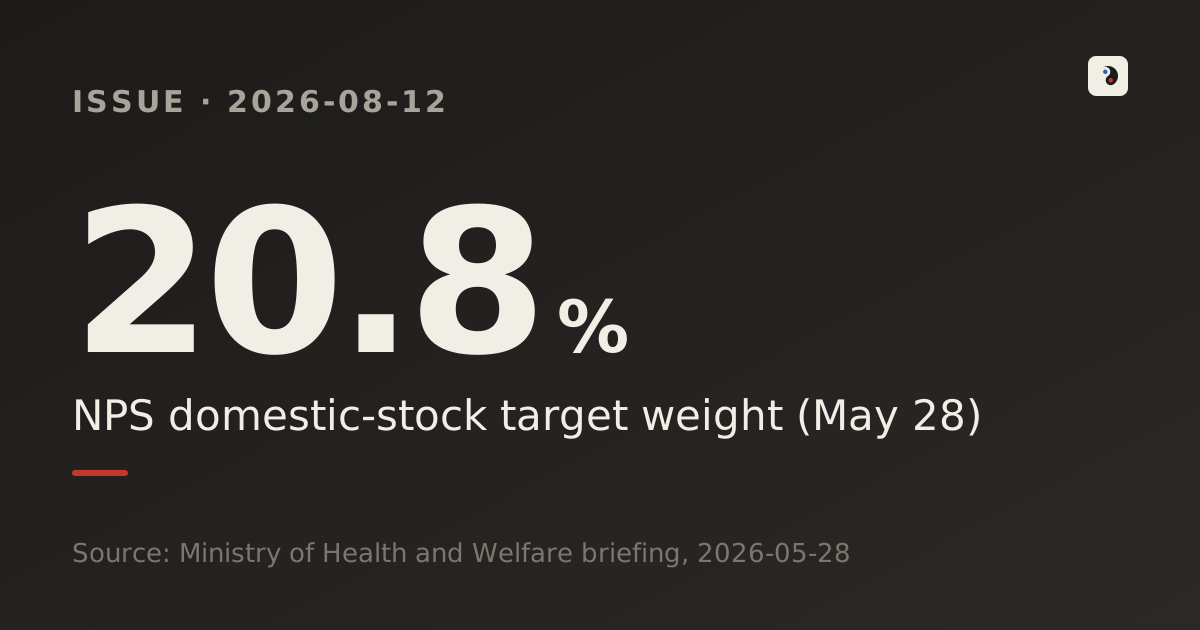
- The Fund Management Committee (the meeting that decides where and how much of the National Pension Service's money goes) raised this year's domestic stock target twice: from 14.4% to 14.9% in January, and from 14.9% to 20.8% on May 28. The May rise is 5.9%p. The new target applies from the end of June, when the pause on rule-based trading runs out.
- The actual share was 24.5% at the end of February. It climbed to 31.1% on June 22, then came down to 26.3% on July 8 (the May-to-July figures come from a Newsis report of July 9, 2026 that cites a Meritz Securities estimate). Set against June 22, that is 4.8%p lower. Read as a ratio, the same move is -15.4%.
- It is hard to read that fall as "the National Pension Service sold." From the start of the year to July 8, foreign investors were net sellers of 154.3085 trillion won on the KOSPI. Over the same stretch, net selling by pension funds as a whole came to 9.1599 trillion won. But "pension funds" is not a figure for the National Pension Service on its own. The comparison period does not line up exactly with the estimates above either.
What happened
At its January 26 meeting, the National Pension Fund Management Committee raised the domestic stock target from 14.4% to 14.9%. The same day it decided to pause rebalancing for a while. Rebalancing means buying or selling just enough to pull a holding back to the share you set in advance. The reason given was that markets were swinging hard.
At the May 28 meeting the target went up again, from 14.9% to 20.8%. The rise is 5.9%p. The new target applies from the end of June, when the pause runs out. The Ministry of Health and Welfare gave two reasons: a change in the Commercial Act that could reshape the domestic stock market, and the fact that the share it actually held had already grown. The same meeting also set the targets for the end of 2026: 20.8% domestic stocks, 34.7% overseas stocks, 23.1% domestic bonds, 7.4% overseas bonds and 14.0% alternative investments.
The reason for raising the target is simple. The share it actually held was far bigger than the target. At the end of February its domestic stocks were valued at 395.1 trillion won. That is 24.5% of the whole fund. The target then was 14.9%, so it was holding 9.6%p more than planned. By the rule, it should sell whatever is over. But the blow that selling would deal to the KOSPI was a burden.
After the pause lifted at the end of June, the KOSPI fell hard in July. From July 1 to the afternoon of July 28 it dropped 28.42% (2,408.81 points) to 6,067.67. Circuit breakers, which halt trading for a short while, were triggered along the way. Over the same period, "pension funds and others" were net buyers of 15 billion won on the KOSPI market. That is far from a "sell-off bomb worth trillions of won."
Now look at the Newsis report of July 9, 2026, which cites an estimate by Yoon Yeo-sam, an analyst at Meritz Securities. The actual share moved like this: 29.9% at the end of May, 31.1% on June 22, 29.5% at the end of June, and 26.3% on July 8. The estimated share came down while the KOSPI was going down. Still, these are numbers a securities firm worked out roughly. A share is not set by stock prices alone. How much was bought and sold, new money coming in, and changes in the value of other assets all play a part. So public material alone does not let us say flatly that "prices on their own pulled it down."
Three things people mix up
Stories on this subject often squeeze three different things into one sentence. Keeping just these three apart already makes the coverage read differently.
By the numbers
To sum up: what the committee changed is the target. The estimated actual share came down while the KOSPI was falling. From June 22 to July 8 it went down 4.8%p (-15.4% as a ratio). Over that stretch, the public trading data shows no record of heavy selling by pension funds. But "we do not see it" and "prices are the cause" are two different statements.
The 20.8% target is not an odd number by world standards. Japan's GPIF also puts 25% into domestic stocks. At the other end sits Norway's GPFG. True to the "Global" in its name, it was designed to invest only abroad, so its home-market stocks are 0%. Countries answer the question "how far into its own market should a pension fund go?" very differently.
The debate — did it hold the market up, or break the rule?
The side that says it defended the market: they argue the fall would have been deeper had the National Pension Service sold heavily. They point to "pension funds and others" staying a net buyer of 15 billion won even during July's plunge. But set against the KOSPI's total market value, 15 billion won only shows a direction. That one number cannot tell us it "kept the market from falling."
The side worried about national wealth leaving and about fairness: from the start of the year to July 8, foreign investors net sold 154.3085 trillion won on the KOSPI. Over the same period, net selling by pension funds as a whole, the National Pension Service included, came to 9.1599 trillion won. Their point is that "while other investors cut their risk, the public's retirement money stayed in and took it on." Still, the two numbers compare investors that differ in nature, in size and in the duties they carry.
Whether the system can be trusted: the worry is that once there is a precedent of changing the target twice in one year and even pausing the rebalancing rule, there will be a pull to tweak the rule the next time markets shake. Rebalancing has a point precisely because it is a rule meant to hold whatever the market is doing.
What comes next — what to watch
For 2027 the targets keep domestic stocks at 20.8% and set overseas stocks at 35.6%, domestic bonds at 21.8%, overseas bonds at 7.4% and alternative investments at 14.3%. The medium-term direction looking to the end of 2031 is around 55% stocks, around 30% bonds and around 15% alternative investments. Over the long run, the domestic stock share is being trimmed. So this year's increase is better read as an adjustment inside a shrinking trend.
The thing most worth watching is the upper end of the tolerance range. The tolerance range is the band that sets how far the actual share may drift from the target before anything is done. As the actual share nears that limit, the automatic selling that was put off comes back. One fact needs to be clear first. In its May 28 announcement, the Ministry of Health and Welfare said only that it had widened the tolerance range for the strategic asset allocation (SAA, the basic long-term split) of domestic stocks for a time. It wrote that it "decided not to disclose" the figure, because releasing it "could affect the fair conduct of fund management and the stability of financial markets." So the upper limit is a number that has not been made public. Reports carry that band in two parts. One is the ±6%p of the long-term split (SAA). The other is the ±2%p of the short-term adjustment (TAA). Add them and you get ±8%p. Lay 8%p on top of the 20.8% target and you get 28.8% (Businesspost 2026.07.19; Newsis 2026.07.09, citing a Meritz Securities estimate). Add only the 6%p SAA part and you get 26.8%. Businesspost reported that above 26.8% it is effectively hard to keep buying aggressively. Both numbers come from news reports, not from a government announcement. So it is safer not to pin the limit to a single figure.
If you invest, pension fund flows are worth noting as a short-term variable. But they do not change a company's earnings or what its shares are actually worth. This article does not recommend buying or selling any particular stock at any particular time.
What this article could not verify
- The settled figure for the upper end of the tolerance range — the Ministry of Health and Welfare decided not to disclose it. The 28.8% carried in reports is a calculation that adds the SAA ±6%p and the TAA ±2%p. We did not see the original text of the Fund Management Committee's resolution.
- A settled path for the actual share — 29.9% (end of May), 31.1% (June 22), 29.5% (end of June) and 26.3% (July 8) are all figures Meritz Securities worked out roughly. We could not check them against the monthly official data published by the National Pension Service Investment Management.
- Net buying by the National Pension Service alone during July — what we confirmed is 15 billion won of net buying by the "pension funds and others" category between July 1 and 28. We could not confirm a monthly figure for the National Pension Service on its own.
- NPS raises this year's domestic stock target from 14.9% to 20.8% — Ministry of Health and Welfare / Korea Policy Briefing (2026.05.28)
- NPS fund management: cutting the overseas stock share, raising domestic stocks — Ministry of Health and Welfare / Korea Policy Briefing (Fund Management Committee decision of 2026.01.26)
- Has the NPS scare gone? "The market plunge has eased the selling pressure" — Newsis (citing an estimate by Meritz Securities analyst Yoon Yeo-sam) (2026.07.09)
- NPS raises domestic stock target to 20.8%, easing the "forced selling" burden — Invest Chosun (2026.05.28)
- Fund accumulation status — National Pension Service Investment Management (continuously updated)
- Status by asset class (domestic stocks) — National Pension Service Investment Management (continuously updated)
- The NPS domestic stock share and its tolerance range — Businesspost (2026.07.19)
- NPS rebalancing falters as the KOSPI corrects; criticism over national wealth leaving looks unavoidable — SisaJournal-e (2026.07.09)
- No NPS "sell-off bomb" — a net buyer even as the KOSPI plunged — Money Today (2026.07.28)
- Policy Asset Mix for the Fifth Medium-Term Objectives Period — GPIF
- About the fund — Norges Bank Investment Management (GPFG)
This article was put together by nuloq with the help of AI tools, based on the material listed under "Sources" above. For the correction of September 11, 2026, the documents we opened and read ourselves were the Ministry of Health and Welfare policy briefings of January 26 and May 28, the Newsis report of July 9, 2026, the Businesspost report of July 19, 2026, and the Invest Chosun report of May 28, 2026. We could not open the monthly official data from the National Pension Service Investment Management or the original text of the Fund Management Committee's resolution. In the further correction of September 11, 2026, we reopened the Newsis report of July 9 and the Businesspost report of July 19 and checked the "SAA ±6%p / TAA ±2%p" wording directly. A figure a securities firm works out roughly is not a settled statistic. The purpose is to inform, not to recommend investments. If you find something wrong, we will fix it.
Related posts
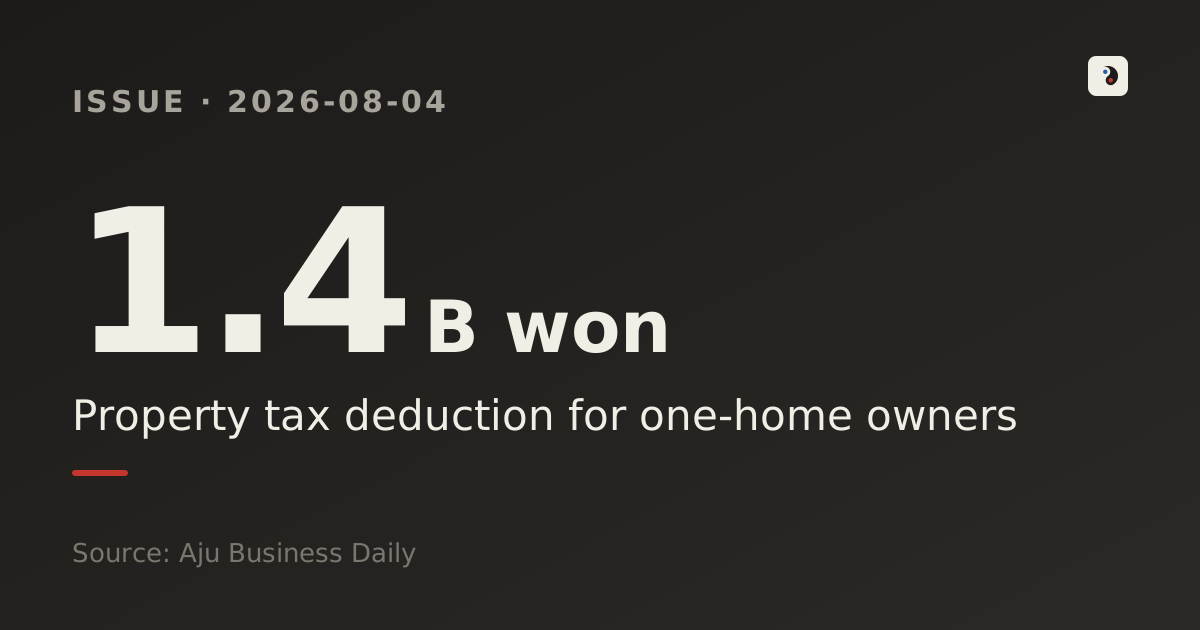
Korea Raises Property Tax Exemption to ₩1.4 Billion, Multi-Home Owners Face 80% Rate
South Korea raised its property tax exemption to 1.4 billion won and pushed multi-home owners' tax ratio to 80% — the 3.4 trillion won reform explained by the numbers.
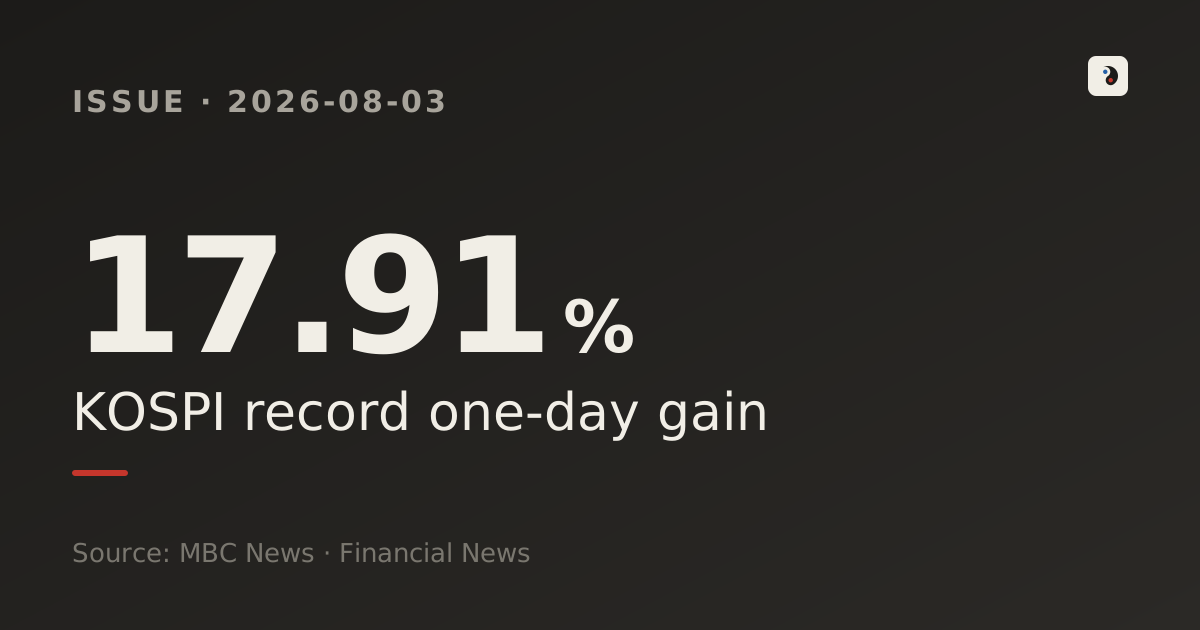
KOSPI Surged a Record 17.91% in One Day — What SK Hynix's Limit-Up Really Means
KOSPI jumped a record 17.91% in one day and SK Hynix hit its price limit for the first time in 17 years. Here's the data behind Korea's wild semiconductor rally.
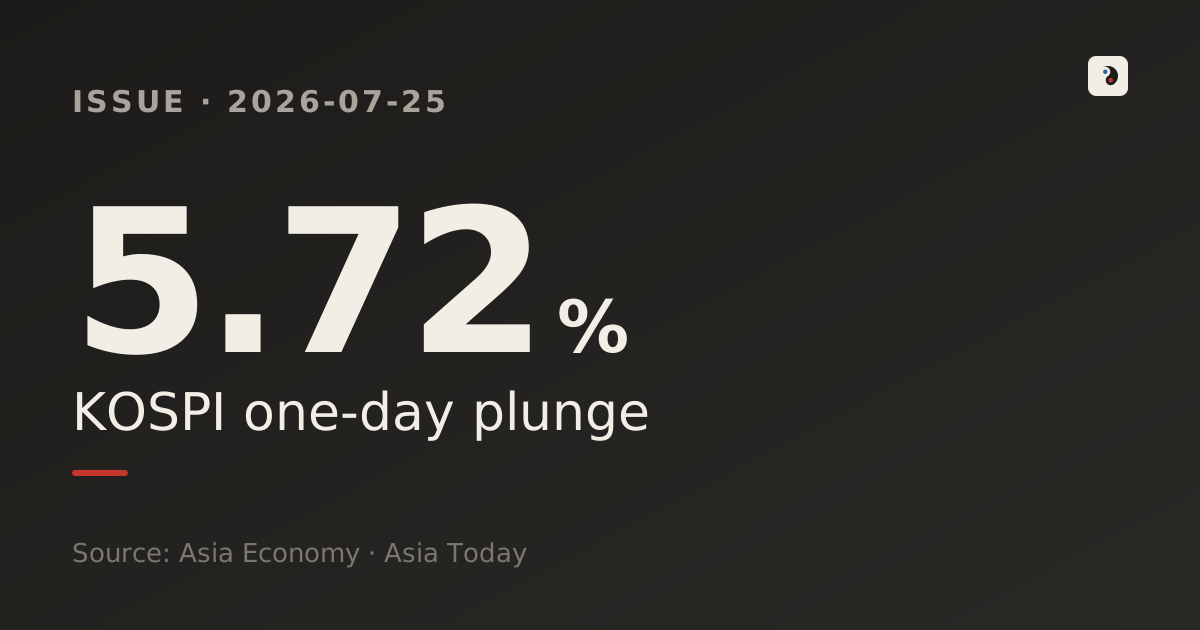
KOSPI Plunges 5.72% in a Day, Triggers Sell-Side Circuit Breaker
South Korea's KOSPI sank 5.72% in a day and triggered a sell-side circuit breaker. What a record 45 triggers this year reveal about the chip rally's future.
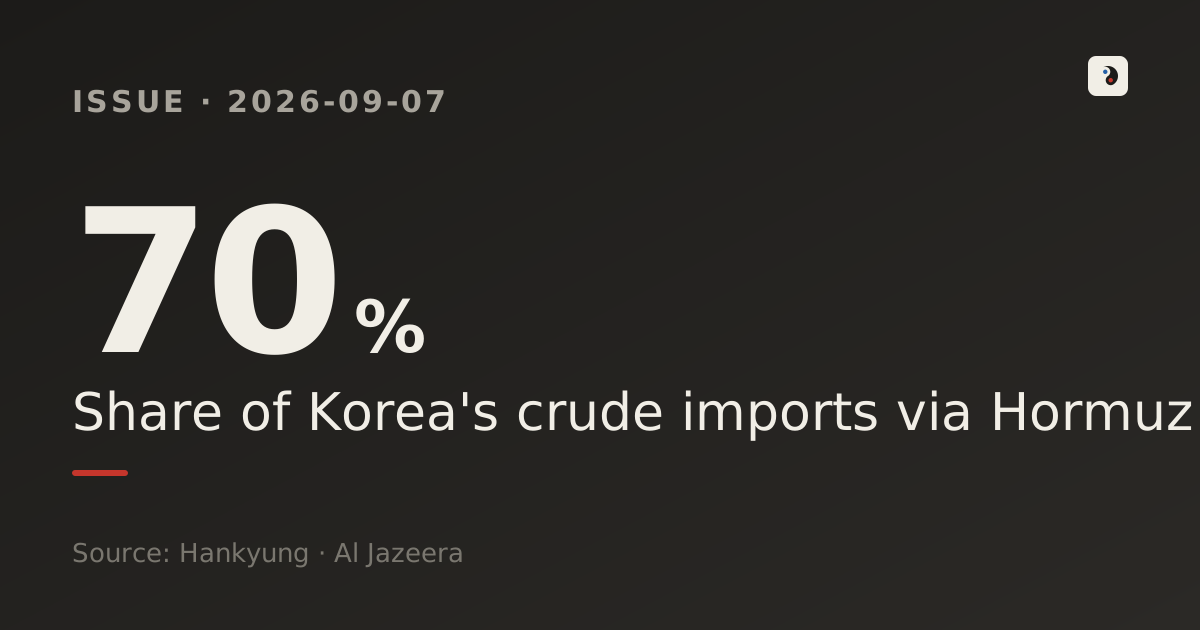
150 Troops, 70% of Oil: South Korea's Hormuz Dilemma by the Numbers
Squeezed between US pressure and Iran's war warning, South Korea is weighing sending 150 troops to the Strait of Hormuz — the route for 70% of its oil imports. Here's the dilemma in numbers.