North Korea Has 57 Nukes, Trump Says — But He Won't Say 'Denuclearization'
The moment a U.S. president put a number on North Korea's nuclear arsenal for the first time, what he didn't say mattered more than the number itself.
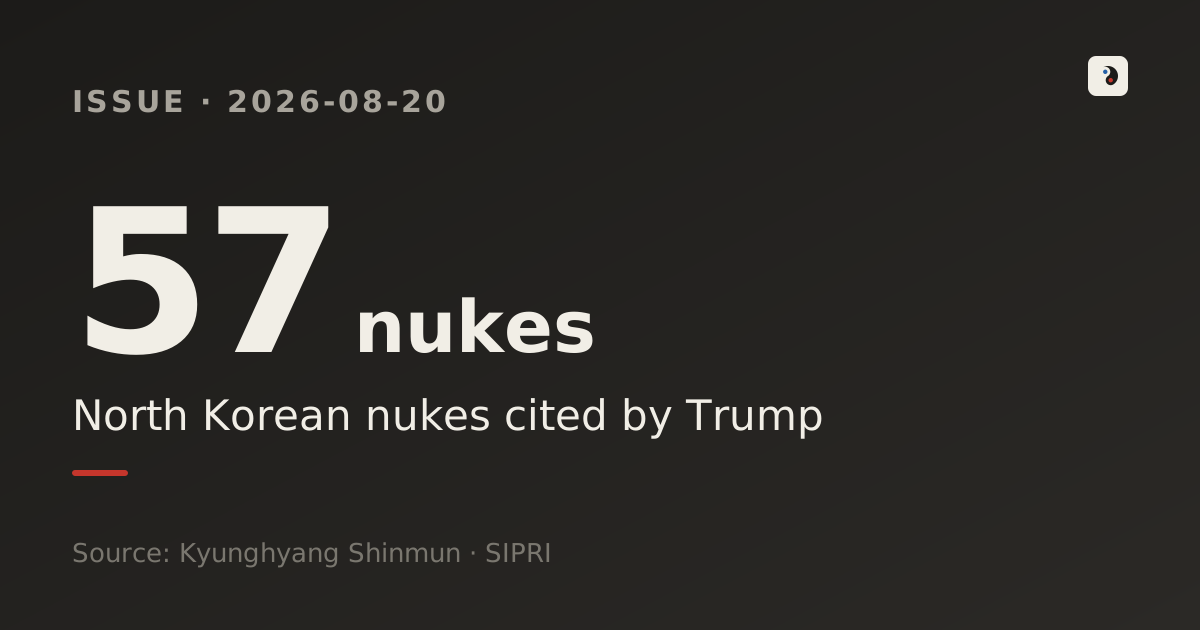
- On Aug. 19 (local time), President Trump said for the first time that North Korea has "57 very powerful nuclear weapons" — the first specific figure a U.S. president has ever given.
- In the same remarks, he said he expects to meet Kim Jong Un this year, but dodged a question on whether denuclearization is still the goal, saying "I don't want to talk about that."
- Analysts say the silence may signal a shift in U.S. posture toward treating North Korea as a de facto nuclear state.
What happened
President Trump told reporters at the White House on Aug. 19 (local time) that North Korea "already has 57 very powerful nuclear weapons." It marked the first time a U.S. president has cited a specific figure for North Korea's arsenal.
In the same appearance, he said he expects to meet North Korean leader Kim Jong Un "this year." The remark came a day after The Wall Street Journal reported that Trump was pushing aides to arrange a meeting with Kim, fueling speculation that the November 18–19 APEC summit in Shenzhen, China could provide the occasion.
What drew more attention was what he didn't say. Asked whether denuclearization is still the goal of renewed talks, Trump dodged, saying, "I don't want to talk about that."
Why it matters / background
There was a reason U.S. presidents avoided naming a specific figure for North Korea's arsenal: doing so risks being read as treating Pyongyang as a de facto nuclear power. From the Obama and Biden administrations to Trump's own first term, Washington's official goal has been "complete, verifiable, irreversible denuclearization" (CVID) — and officials steered clear of hard numbers.
That norm has been eroding since the 2019 Hanoi summit collapsed, leaving roughly seven years of stalled U.S.-North Korea diplomacy. Pyongyang kept expanding its nuclear and missile capabilities in that gap, hardening its position that its nuclear status is already a fact on the ground, while voices in Washington increasingly argue that talks premised on denuclearization are no longer realistic. Trump's avoidance of the word "denuclearization" sits on top of that shift — effectively unsettling a U.S. policy goal that has held for nearly two decades.
By the numbers
Where did Trump's figure of 57 come from? The White House hasn't confirmed a basis, but it lands close to the latest estimates from international think tanks. The Stockholm International Peace Research Institute (SIPRI) put North Korea's assembled warheads at 60 in its 2026 yearbook — double the 30 estimated in 2023. SIPRI also assessed that North Korea's fissile material stockpile alone could support up to 90 assembled warheads.
In other words, 57 isn't a made-up number — it sits close to several independent estimates of weapons already assembled. What matters more is the trajectory: a doubling in three years is feeding a growing view in Washington that the window for freezing or rolling back the arsenal through talks may already have closed.
The debate / different perspectives
Views on the remarks diverge.
- Risk of tacit recognition — Lim Eul-chul, a professor at Kyungnam University's Institute for Far Eastern Studies, said that if denuclearization drops off the agenda of U.S.-North Korea talks, "it could effectively move toward recognizing North Korea as a nuclear state," adding it's unclear whether Republicans, Democrats, and the bureaucracy beyond Trump himself would accept that.
- A pragmatic read — Park Won-gon, a professor at Ewha Womans University, said the remarks suggest Washington may be trying to save North Korea's face — without mentioning denuclearization — to draw it back to the table, and that Pyongyang could respond in kind.
- What Pyongyang might ask for — Emma Chanlett-Avery, director of political and security affairs at the Asia Society Policy Institute, said Kim could seek recognition as a nuclear state, a reduction or withdrawal of U.S. troops in South Korea, or eased sanctions as the price of returning to talks.
South Korea's own government has been notably cautious. Even a day after Trump's remarks, officials said only that they were "staying quiet" on the timing and substance of any meeting while trying to gauge Washington's intent.
What's next / implications
Two conditional paths stand out. If an actual summit materializes around the November APEC meeting, it would be the first U.S.-North Korea leader-level dialogue not premised on denuclearization — potentially the first time a "nuclear state to nuclear state" framing appears on the formal diplomatic stage. If the meeting falls through or is delayed, the remarks risk leaving behind only the criticism that Washington has effectively tolerated North Korea's arsenal, with nothing to show for it.
For South Korea, the debate spills directly into its own security politics: how the Ministry of National Defense's push for a nuclear-powered submarine (SSN), paired with its "no nuclear weapons" pledge, gets reaffirmed in this moment — and whether domestic calls for South Korea's own nuclear armament gain fresh traction. Three things to watch: ① whether the White House or Pyongyang formally confirms any of this; ② whether actual contact happens around the November APEC summit; ③ how Congress, across party lines, reacts. For now, only a president's remark exists — no policy has been finalized.
- Trump reveals North Korea has 57 nuclear weapons, dodges question on denuclearization goal — Kyunghyang Shinmun (경향신문) (2026.08.20)
- Trump signals meeting with Kim this year, cites 57 North Korean nuclear weapons — VOA Korean (2026.08.19)
- Trump says he will meet Kim Jong-un this year, puts North Korea's nukes at 57 — The Korea Herald (2026.08.19)
- Think tank raises estimate for North Korean nuclear arsenal to 60 warheads — NK News (2026.06.08)
- World nuclear forces — SIPRI Yearbook 2026 (2026.06)
- Government stays quiet on timing and substance of Trump-Kim meeting, tries to gauge intent — Kyunghyang Shinmun (경향신문) (2026.08.18)
- Why Kim can't simply smile at Trump's overture — he may still accept a summit without denuclearization — Hankook Ilbo (한국일보) (2026.08.17)
This is nuloq's own analysis, based on the reporting and SIPRI research cited under Sources and produced with the help of AI tools. It's for information only, not a basis for security or policy decisions, and reflects the situation as of publication — we correct errors as soon as they're confirmed.
Related posts
North Korea's two-thirds of H1 crypto hacking losses — reading two counts without mixing them
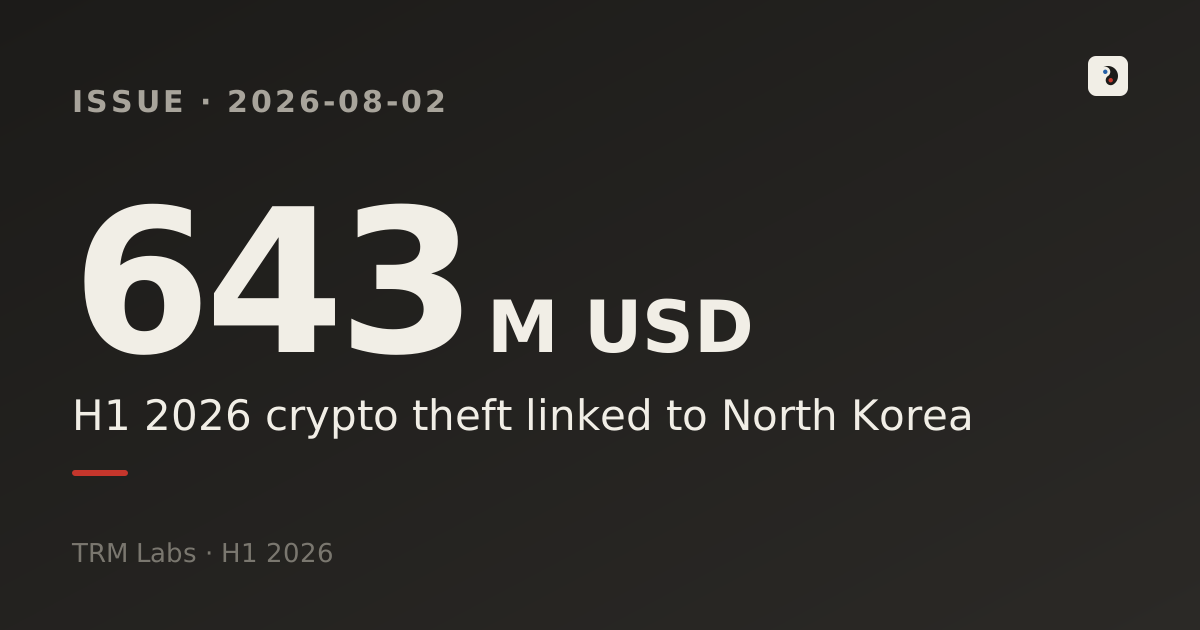
By TRM Labs' count, $643 million (66%) of the $972 million lost to hacks in the first half of 2026 was linked to North Korea. VOA's $609 million and 55%, citing Blockaid, is a separate count with a different base. The $789 million and 74% for private-key theft are that side's figures too.
150 Troops, 70% of Oil: South Korea's Hormuz Dilemma by the Numbers
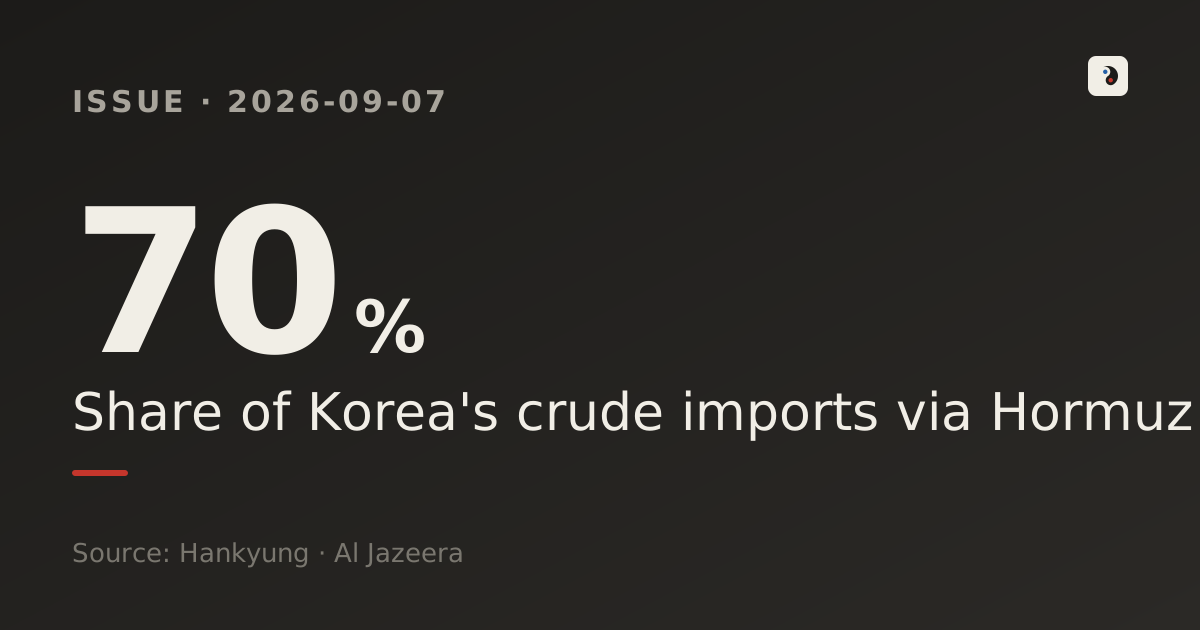
Squeezed between US pressure and Iran's war warning, South Korea is weighing sending 150 troops to the Strait of Hormuz — the route for 70% of its oil imports. Here's the dilemma in numbers.
Welfare ₩148.8tn, National Debt ₩1,519.8tn — What Is the 48.3% Ratio Divided By?
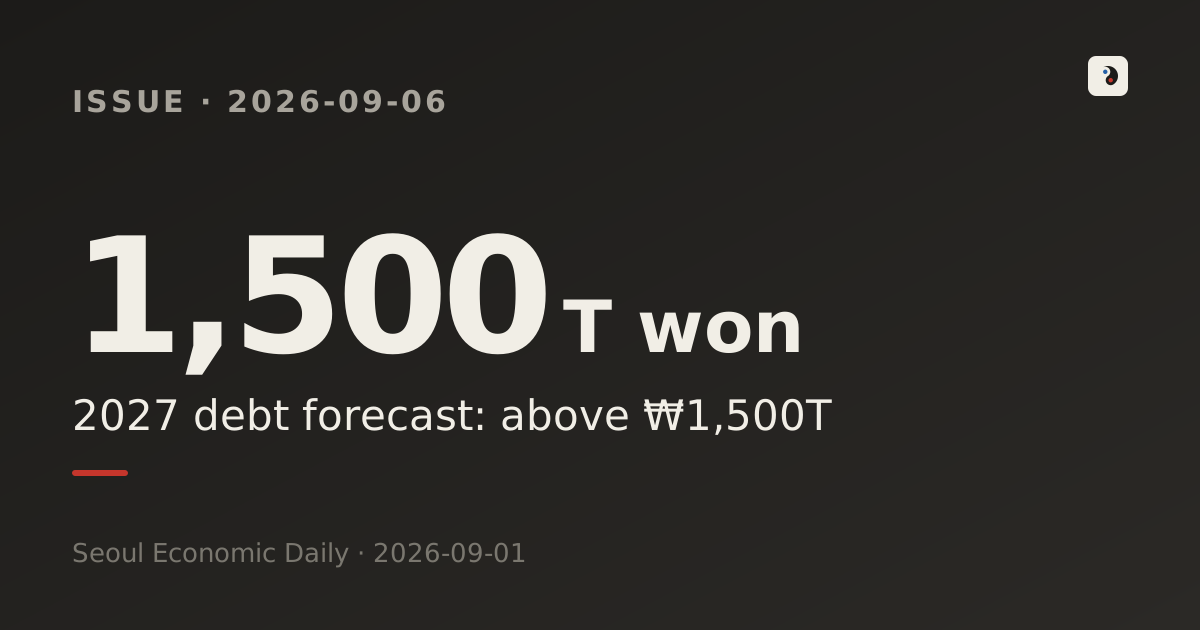
We separate the two ways of counting the welfare ministry's budget, and correct the denominator of the national debt ratio to nominal GDP. We hold back judgment on why the ratio falls until the official GDP assumption can be checked, and we found no confirmed evidence that the future response fund caused the ₩106 trillion rise in debt.
A 5-Year-Old Text Threatens Korea's Justice Minister Pick
Justice minister nominee Kim Seung-won sent a text in 2021 asking regulators to speed up a drug trial approval. Five years on, that message is the flashpoint of his September 15 confirmation hearing.