Rural Basic Income in Korea Expands to 7 Counties as Farm Population Falls Below 2 Million
Korea's rural basic income pilot just grew to 7 more counties. Here's what a monthly ~150,000 KRW payment can — and can't — change.
- Seven counties — Gurye, Boseong, Hwacheon, Boeun, Jinan, Muju and Cheongsong — joined Korea's rural basic income pilot, with residents starting to receive 150,000-200,000 KRW a month in local currency from August 28.
- The expansion lands just as Korea's farm population fell below 2 million for the first time ever, and the farm elderly-population ratio (56.6%) is running 2.5 times the national average.
- The first 10 pilot counties saw population rise 4.7% and local commerce revive within six months — but extending the program to all 69 declining counties nationwide would cost at least 4.9 trillion KRW a year, fueling a fiscal and fairness debate.
What happened
South Korea's Ministry of Agriculture, Food and Rural Affairs (MAFRA) added seven counties — Gurye, Boseong, Hwacheon, Boeun, Jinan, Muju and Cheongsong — to its rural basic income pilot. Five of them (Gurye, Boseong, Hwacheon, Boeun and Cheongsong) start payments on August 28. Jinan follows on the 31st, and Muju, which needed more time to migrate its local-currency system, starts on September 10.
The base payment is 150,000 KRW per person per month, but Gurye, Boseong and Cheongsong are topping it up to 200,000 KRW with their own county budgets, and Boeun is paying 160,000 KRW. Residents who lived in the area before the county was selected get July's payment retroactively — two months' worth in this first round — while new arrivals get three months backdated once a 90-day residency check confirms they actually live there. The total budget for the seven counties comes to 56.7 billion KRW.
Why now — the farm population drops below 2 million
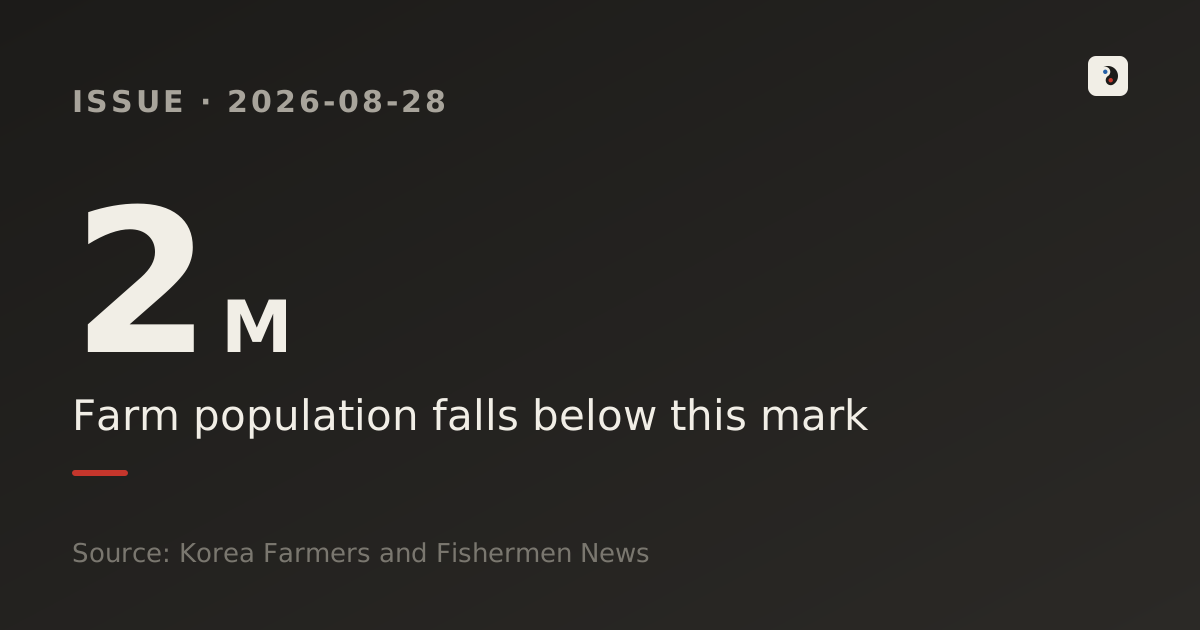
There's a number behind this expansion. Korea's farm population fell to 1,981,610 last year (2025) — the first time on record it has dropped below 2 million, and roughly three years earlier than officials had projected. This year (2026), it's forecast to shrink further, to 1,945,000.
The aging trend is even starker. The share of farm-household residents aged 65 or older crossed 50% for the first time in 2023, at 52.6%, and is projected to reach 56.6% by 2026. Compare that with the national elderly ratio of 21.2%, and rural Korea is already aging at more than 2.5 times the national pace. The number of people employed in agriculture, forestry and fisheries is also sliding, from 1.485 million in 2024 to a projected 1.38 million in 2026.
The numbers
That gap explains why this issue is no longer easy to ignore. Six months into the first 10-county rollout, the data shows the basic income has actually moved two things: local spending and population retention.
Did it work? The first 10 counties' six-month scorecard
Before these seven counties joined, ten others — selected in October and December 2025 — had already been paying out basic income since late February 2026. Six months in, the local-currency usage rate reached 91.0%, and 1,972 new merchants signed up to accept it, a 13.7% jump. Population in the pilot areas, which had been declining, rose 4.7% instead.
Okcheon County in North Chungcheong is a telling case: of the 20.44 billion KRW disbursed between February and April, 17.77 billion KRW (86.9%) was actually spent within the county. That's the evidence behind the government's description of the program as "seed money for the rural economy." Still, these are early observational numbers from a pilot with no control group — there's no way yet to know how these counties would have fared without the payments.
The debate — a fix for regional decline, or election-year populism?
President Lee Jae-myung pointed to Okcheon's population growth in June, saying: "If a two-year, time-limited program is already having this much effect, making it permanent and raising the amount would work even better." MAFRA says it's reviewing both a wider rollout and a higher payment, funded by surplus revenue from the special tax on agriculture and fisheries.
But the concerns are real. The program is funded 40% by the national government and 60% by local governments — and rural counties, many with weak fiscal bases, risk diverting money away from basic infrastructure like roads and bridges to keep covering their share. Extending the program to all 69 nationally designated population-declining counties would cost at least 4.9 trillion KRW every year, by one estimate.
- Supporters call it one of the few tested tools against regional decline, pointing to the real movement in spending and population figures.
- Critics call it election-year populism ahead of next year's local elections, noting that giveaway-style programs — local currency, consumption coupons, basic-income pilots — have all grown roughly 50% in tandem.
- Equity concerns note that because counties compete for selection, the areas at highest risk of disappearing could be the very ones left out, for lack of administrative capacity to apply.
An international comparison — what Finland's experiment showed
Korea isn't the first country to test basic income. Finland ran a national-level trial in 2017-2018, randomly giving 2,000 unemployed people 560 euros (about $636) a month, no strings attached. The results were clear: employment didn't rise significantly in the first year, but wellbeing measures — life satisfaction, stress, depression, loneliness — all improved markedly. The study's lead researcher summed it up: "No significant effects on employment, but important effects on well-being."
Korea's rural program is built differently. Because it pays out in local currency usable only within the county, it's aimed less at an individual's quality of life and more at "money that circulates through local shops." Where Finland measured effects on individuals, Korea is measuring effects on places — population and merchant sales. The two experiments aren't directly comparable, but Finland's lesson — that cash transfers don't dramatically change employment — is likely to hold in Korea too.
What's next — the conditions for making it permanent
MAFRA plans to use the data piling up across all 17 pilot counties, including these seven, to decide after 2027 whether to continue the program and how much to pay. That decision turns on three questions.
- Funding: without a stable revenue source — like surplus special-tax income — making the program permanent would strain local government budgets.
- Fairness: officials will need to rethink whether to keep the competitive-application model or prioritize the counties at greatest risk of disappearing.
- Verification: a proper evaluation with a control group is needed to determine how much of the population and spending gains are actually caused by the payments, versus other overlapping support programs.
One thing is certain: 150,000 KRW a month won't reverse the structural trend of rural depopulation on its own. The real question this experiment raises is smaller and more concrete — how much this amount of money can slow the pace at which people leave.
- Rural basic income adds 7 counties, starting Aug 28 — Asia Today (2026.08.25)
- Rural basic income's added 7 counties begin payments Aug 28 — Chuksan News (2026.08.25)
- Six months of rural basic income: 10 counties' commerce revives — OhmyNews (2026.08.05)
- Farm population falls below 2 million, three years ahead of forecast — Korea Agrinet News (2026.02.22)
- President calls for permanent rural basic income, cites special-tax funds — The Kyunghyang Shinmun (2026.06.10)
- "Fix for regional decline" vs. "welfare populism": the rural basic income debate heats up — The Kyunghyang Shinmun (2025.10.02)
- Ahead of local elections, rural basic income draws "populism" criticism — NewDaily (2025.11.10)
- Preliminary results of the basic income experiment — Finnish Government (2019.02.08)
This is nuloq's own analysis based on the public reporting and official data listed under Sources, written with the help of AI tools. It is for information only — not investment, policy, or legal advice — and reflects the situation at the time of writing; we correct the text if errors are found.
Related posts
150 Troops, 70% of Oil: South Korea's Hormuz Dilemma by the Numbers
Squeezed between US pressure and Iran's war warning, South Korea is weighing sending 150 troops to the Strait of Hormuz — the route for 70% of its oil imports. Here's the dilemma in numbers.
Welfare ₩148.8tn, National Debt ₩1,519.8tn — What Is the 48.3% Ratio Divided By?
We separate the two ways of counting the welfare ministry's budget, and correct the denominator of the national debt ratio to nominal GDP. We hold back judgment on why the ratio falls until the official GDP assumption can be checked, and we found no confirmed evidence that the future response fund caused the ₩106 trillion rise in debt.
A 5-Year-Old Text Threatens Korea's Justice Minister Pick
Justice minister nominee Kim Seung-won sent a text in 2021 asking regulators to speed up a drug trial approval. Five years on, that message is the flashpoint of his September 15 confirmation hearing.
Supreme Court re-nomination dispute — what Article 104 actually sets out
We confirmed the presidential office's request for a re-nomination, and the August 18 nomination of Son Bong-gi, from the presidential office briefing. In plain words, provision by provision: which law covers candidate recommendation, nomination, the National Assembly's consent and the confirmation hearing.