· Updated 2026-09-11
3.4% of Korea's Export Payments Were Settled in Won — What Is That a Share Of?
Correction (2026-09-10): We rechecked the export and import settlement currency shares in the original Bank of Korea table. We also wrote down what each number is divided by and how it was rounded. We removed the policy announcement date, the direct quotations and the claims that the plan was already in force, because we could not confirm them. The original publication date stays the same. We also rewrote the sentences so a middle-school reader can follow them easily. The content and the numbers are unchanged (2026-09-11).
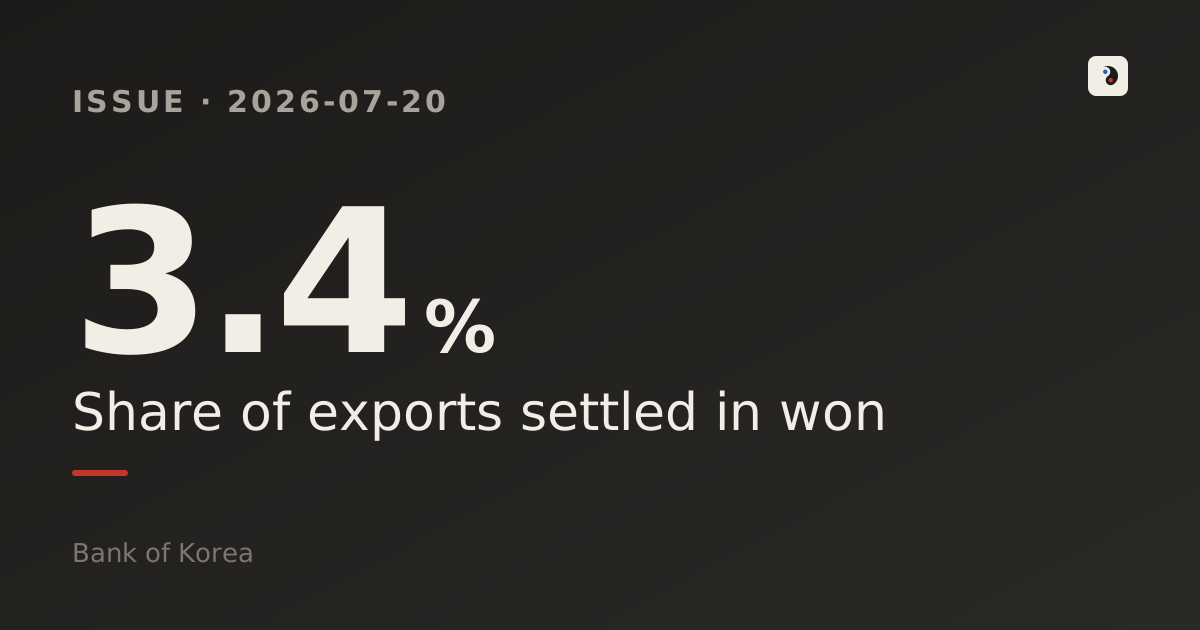
In 2025, 3.4% of the export payments Korea received were settled in won. What is that 3.4% a share of? And how should we read it alongside the plan to build a new won settlement network?
- These are the Bank of Korea's finalized 2025 statistics. Of export payments, 3.4% were settled in won and 84.2% in US dollars. Imports are counted separately: 6.6% of import payments were settled in won.
- The table lists the won share of exports as 2.7% in 2024 and 3.4% in 2025. Yet the change the Bank of Korea published is 0.8 percentage points. The values shown in the table are rounded, so the two have to be kept apart.
- The Bank of Korea's annual report sets out a schedule for an offshore won settlement system. The targets are a pilot run at the end of September 2026 and full operation in 2027. These are targets only, so the plan by itself tells us nothing about actual usage or any exchange-rate effect.
3.4% is a share of Korea's total export transaction value
Let's look at the export table in the Bank of Korea's “Exports and Imports by Settlement Currency, 2025 (final)”. It splits the value of goods that passed through customs (a customs-cleared basis) by the currency used for payment. For each currency, the transaction value is converted into US dollars first, and then the share is worked out. The 2025 column lists US dollars at 84.2%, euros at 5.9%, won at 3.4%, yen at 1.9% and yuan at 1.3%. If all export payments add up to 100, it means 3.4 of that 100 was settled in won.
So 3.4% must not be read as “3.4% of companies trade in won.” It is not the won's share of all payments worldwide either. It is not a statistic that counts companies one by one, whether their transaction values are large or small. You should not simply add the won share of exports to the won share of imports. Taking a plain average of the two and calling it “the won share of all Korean trade” is not right either. To combine them, you need the transaction values of exports and of imports separately.
The table goes from 2.7 to 3.4, so why is it 0.8 percentage points?
In the same table, the won share of exports is listed as 2.7% for 2024 and 3.4% for 2025. Subtracting one figure from the other gives 0.7 percentage points. Yet the change the Bank of Korea published is 0.8 percentage points.
Before treating that as a mistake, read the notes at the end of the release. The Bank of Korea states that it rounded the figures off at the second decimal place, so the shares appear with one decimal place. Because of that, the Bank of Korea explains, a figure worked out by subtracting the shares shown in the table can differ from the published change. This article uses the 0.8 percentage points from the original data as it is, and keeps it apart from the 0.7 percentage points you get by subtracting the displayed values.
The same care is needed when you work out “how many times bigger” or “up by what percent” from small shares. Suppose you calculate using values that are shown to only one decimal place. Adding several decimal places to the result does not make the original data any more precise.
A plan to build a settlement network and the share actually used are different records
The Bank of Korea's 2025 Annual Report has a passage titled “Promoting the establishment of an offshore won settlement system (working title).” It describes a system that helps won settlement even during the hours when overseas financial markets are open. The schedule written in that report is a target of a pilot run at the end of September 2026 and the start of full operation in 2027.
This is a description of a construction plan contained in a report. It does not let us say that the pilot run has already finished. Nor does it let us say that full operation has been fixed for a particular month. How much the participating institutions actually traded, and whether companies switched their settlement currency, also have to be checked in separate operating records.
On top of that, the 3.4% we saw earlier is a statistic counting transactions in 2025. It cannot be used as a result of infrastructure built in 2026 or later. Opening a road so that it can be used, and users actually choosing that road, are two things to check separately.
Which records should we compare from here?
- Whether it really started: announcing a plan and announcing that something is running are different things. Whether operation has begun is checked in the records the institution publishes later.
- How much it was used: the number of participating institutions, the number of transactions and the transaction value have different units. If they are published, note the period they cover and how far the count reaches.
- The trade settlement share: compare it with the next annual statistics released on the same customs-cleared basis. A plain difference between the earlier and later numbers may also contain a part that comes from a change in the mix of transactions, not just from policy.
- Judging the cause: the fact that a settlement share changed is not enough on its own. We do not conclude that the exchange rate moved less or that company costs improved. That question needs other data and analysis.
The two records we checked here answer two things: which currencies were used, and how much, in export and import settlement, and what the settlement network targets written in the report are. Every detailed step in the roadmap, whether the policy succeeds, and where the exchange rate goes next are not judged from these figures alone.
- Bank of Korea, Exports and Imports by Settlement Currency, 2025 (final) — 2026.04.16. We read the export and import tables on p.1 of the attached PDF and the notes on using the statistics on p.8. Accessed 2026.09.10.
- Bank of Korea, 2025 Annual Report — the passage “Promoting the establishment of an offshore won settlement system (working title).” Accessed 2026.09.10.
We put this together by comparing the scope of the statistical tables and the report published by the Bank of Korea, and we used AI while making it. The hypothetical example used to explain rounding is not real transaction data. If an error is confirmed, we correct it.
Related posts
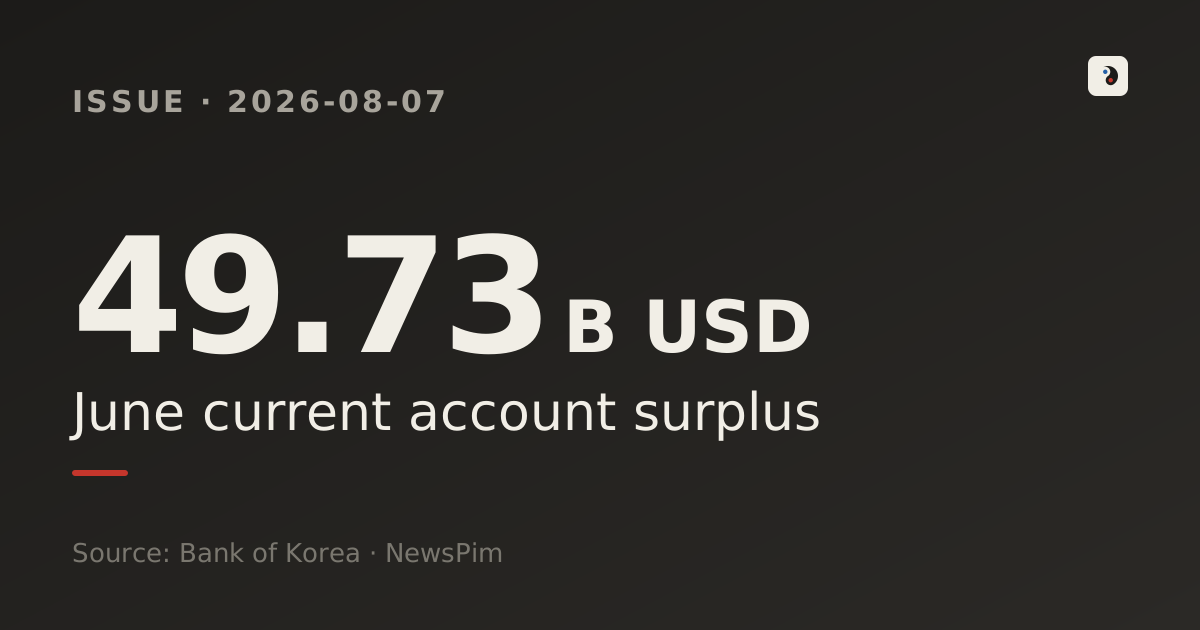
Korea's Current Account Hits Record $49.7B — Why the Chip Boom Isn't in Your Paycheck
South Korea's current account hit a record $49.7 billion in June, powered by a semiconductor export boom. Here's why the Bank of Korea itself is warning the windfall isn't reaching ordinary paychecks.
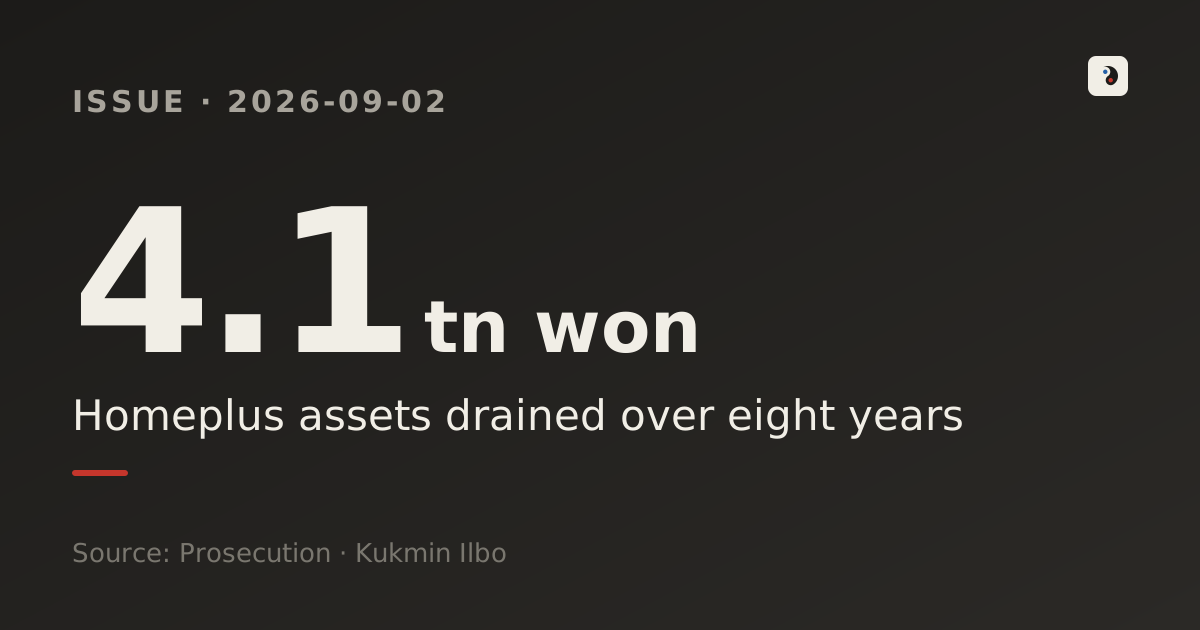
Homeplus Creditor Vote: MBK's ₩4.1 Trillion Exit, ₩1.9 Trillion Accounting Mystery
Creditors voted Sept. 2 on Homeplus's fate. Here's how MBK drained ₩4.1 trillion from the retailer over eight years, then turned ₩1.9 trillion of debt into equity six days before its rehabilitation filing.
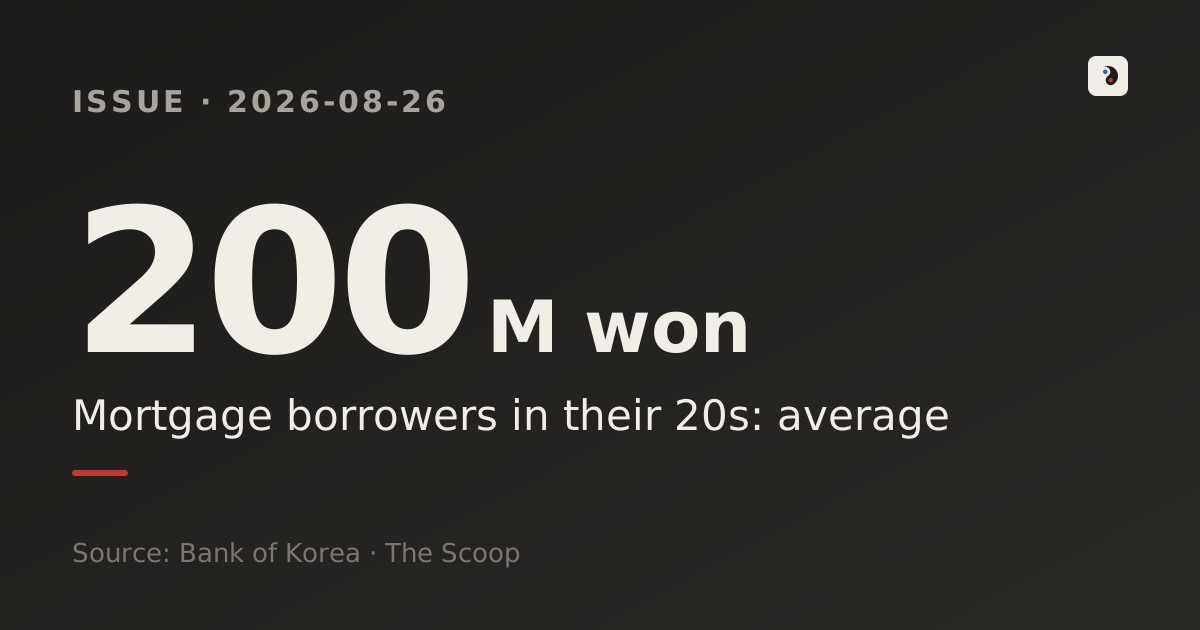
Loans Got Tighter, Yet Only 20-Somethings Borrowed More: Korea's ₩200M Mortgage Line
South Korean borrowers in their 20s now carry an average mortgage balance of ₩203.94 million, crossing ₩200 million for the first time even as lending tightened everywhere else. Here's what the Bank of Korea data reveals — and the statistical trap behind it.
Korea's Household Debt Passes ₩2,019.8 Trillion, Biggest Jump in 19 Quarters
South Korea's household debt hit a record ₩2,019.8 trillion in Q2 2026, its biggest quarterly jump in 19 quarters. The data behind the debt-fueled stock bets and the central bank's rate dilemma.