73 Years After the Armistice, Lee Jae-myung Proposes 'End-of-War' Talks With North Korea
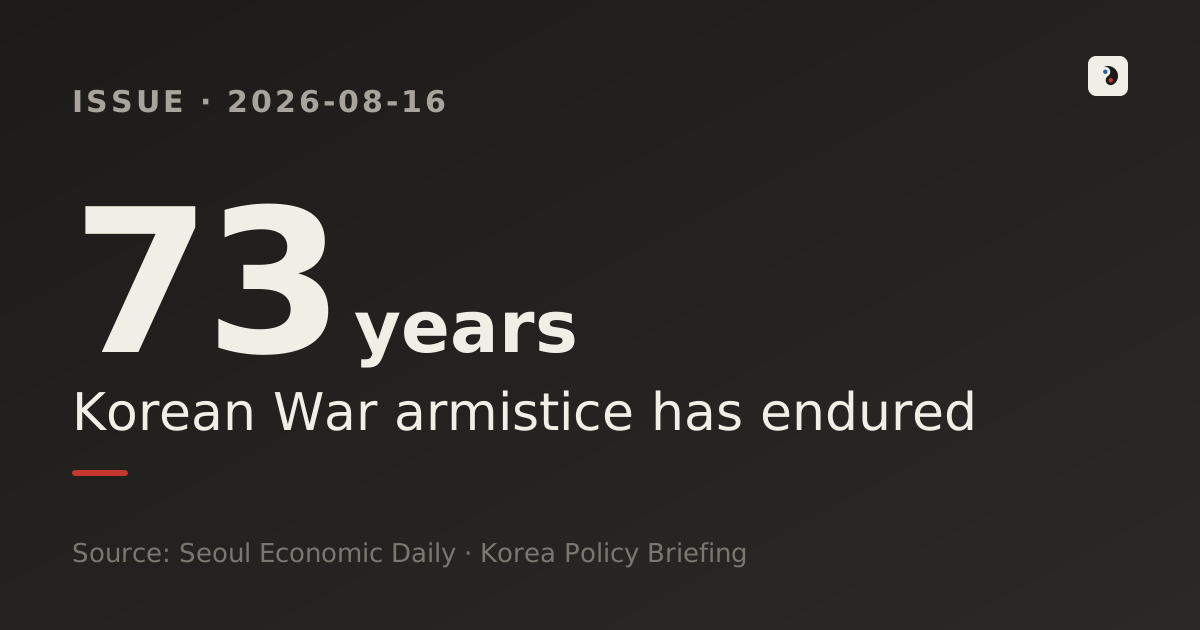
A look at why the "end-of-war talks" proposal in this year's Liberation Day address is drawing more attention than past ones — through numbers and context.
- On August 15, President Lee Jae-myung proposed that the parties to the Korean War begin talks to formally end it, addressing North Korea directly in his Liberation Day speech.
- Attempts to replace the armistice with a peace regime are not new — the 2005 September 19 Joint Statement and the 2018 Panmunjom Declaration both stalled before reaching a peace treaty.
- North Korea has already carried out its tenth missile provocation of 2026, and Lee's approval rating has fallen for four straight weeks — leaving it unclear whether the proposal will lead to real talks.
What happened
President Lee Jae-myung, speaking at the 81st Liberation Day ceremony at Sejong Center in Seoul on August 15, proposed that the parties involved "put down their mutual threats and begin talks to end this long war," addressing North Korea directly. He said South Korea would pursue a path from the current armistice to a peace regime, adding that "effective measures to halt the North's nuclear advancement could also be discussed" along the way.
The ceremony's theme was "An Irreplaceable Korea, With a Brighter Tomorrow." Lee reaffirmed his existing position of not pursuing unification by absorption, and stressed that the two Koreas "must stop unnecessary confrontation."
Why now — 73 years of a stalled armistice
The armistice signed on July 27, 1953, only stopped the fighting; it was never a peace treaty under international law. Since then, there have been several attempts to convert the armistice into a peace regime — and each time, the same obstacle got in the way: North Korea's nuclear program and the lack of trust surrounding it.
What sets this proposal apart is its language. Some outlets noted that Lee's speech did not explicitly reference the "September 19" agreements that past addresses often invoked, and that the word "denuclearization" carried less weight than in previous years' speeches. That reads as a deliberate shift — treating denuclearization not as a precondition for talks, but as an agenda item to be discussed once talks begin. It's an approach that lowers the threshold just to get both sides to the table.
By the numbers
Words carry weight best measured against numbers. Two figures explain the timing of this proposal.
Over the 73 years since the armistice, there have been at least three earlier attempts to shift toward a peace regime — all incomplete or stalled. Lee's proposal marks a fourth.
As it happens, Lee's approval rating had fallen for four straight weeks right before the speech. Unlike July, when diplomatic and security achievements lifted his numbers, August brought domestic controversies — including a dispute over real-estate taxation — that pulled the rating down. The message to North Korea landed without the tailwind of strong domestic political momentum.
The debate: divided reactions
Reactions split sharply.
- The government and ruling party argue that, having already ruled out unification by absorption and pledged to respect the North's system, opening the door to dialogue is itself a way to manage security risk.
- The opposition People Power Party called the speech "a declaration of abandonment on youth, security, livelihoods, and the future," with party leader Jang Dong-hyuk singling out the absence of any warning or deterrent message despite a North Korean ballistic missile launch just days earlier.
- Analysts cited by VOA Korea see little chance North Korea will respond, given its recently hardening hostility toward the South. Newspim and other outlets were similarly skeptical, describing the speech as offering "a blueprint" while conceding that "a repeat of the same cycle is hard to avoid."
All three views converge on one point: without a response from North Korea, this proposal risks remaining just a statement.
What to watch next
A few signals are worth tracking. The first test is whether North Korea responds through an official channel — a statement attributed to Kim Yo Jong, for instance. Silence or a snub would effectively read as a rejection. If North Korea answers with further provocations instead, the government's outreach itself could become a domestic political liability.
If North Korea leaves even a low-level channel open, though, talks on converting the armistice could move toward a working-level negotiating table. Even then, the fundamental disagreement over denuclearization remains — so the distance between "starting talks between the parties" and "signing an actual peace treaty" stays wide.
- Lee proposes talks between the parties to end the war — Fnnews (2026.08.15)
- [Full text] President Lee: "Let's start talks between the parties to end the war" — Seoul Economic Daily (2026.08.15)
- President Lee proposes talks to formally end the Korean War — VOA Korea (2026.08.15)
- PPP sharpens attacks on Lee's "end-of-war talks" speech — Hankook Ilbo (2026.08.15)
- Lee: "Korea needs a new liberation — toward an irreplaceable nation" — Korea Policy Briefing (2026.08.15)
- North Korea's 10th ballistic missile launch of 2026 — Busan Haps (2026.08.12)
- Lee's approval falls to 43.3%, fourth straight weekly decline [Realmeter] — Segye Ilbo (2026.08.10)
- North Korea's 2024 Military Trends and Its 2025 Choices — Asan Institute for Policy Studies (2025)
This article is nuloq's own analysis of the public reporting and official material listed under Sources, produced with the help of AI tools. It does not substitute for any political judgment and is intended for informational purposes only, reflecting the situation as of publication. We correct the piece if factual errors are found.
Related posts
Approval at 45%, Housing Anger at 28%: What South Korea's Cabinet Reshuffle Really Signals
President Lee Jae-myung replaced six ministers as his approval rating sank to 45%. The data and disputes behind South Korea's biggest reshuffle yet.
South Korea's AI Budget Jumps 211% to ₩10.1 Trillion — Can It Catch Up?
South Korea's 2026 AI budget jumped 211% to ₩10.1 trillion. As President Lee's Liberation Day speech leans into an 'AI top-3' vision, we checked the numbers.
150 Troops, 70% of Oil: South Korea's Hormuz Dilemma by the Numbers
Squeezed between US pressure and Iran's war warning, South Korea is weighing sending 150 troops to the Strait of Hormuz — the route for 70% of its oil imports. Here's the dilemma in numbers.
Welfare ₩148.8tn, National Debt ₩1,519.8tn — What Is the 48.3% Ratio Divided By?
We separate the two ways of counting the welfare ministry's budget, and correct the denominator of the national debt ratio to nominal GDP. We hold back judgment on why the ratio falls until the official GDP assumption can be checked, and we found no confirmed evidence that the future response fund caused the ₩106 trillion rise in debt.