South Korea's Birth Rate Rebound: 0.72 to Near 0.9 — Real or a Mirage?
Behind the headline of an eight-year low finally reversing lies a picture the raw numbers alone don't fully explain.
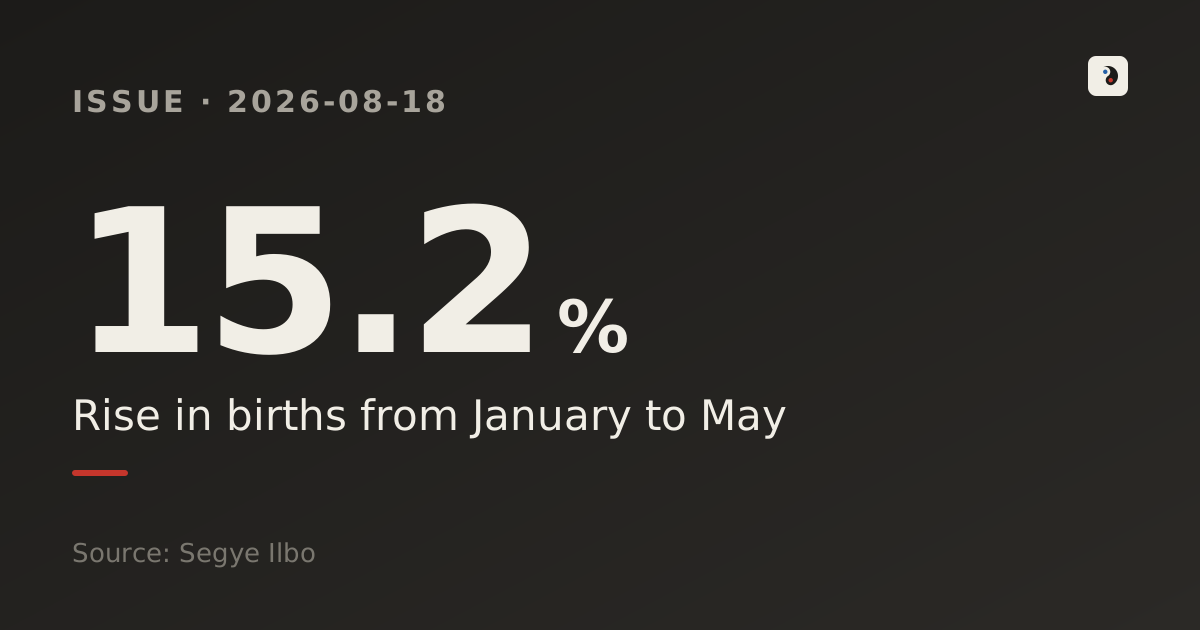
- Cumulative births in Korea rose 15.2% year-on-year from January to May 2026, the highest for that period since 2019.
- The rebound isn't just policy at work — it's also the echo-boom generation entering peak childbearing age and pandemic-delayed marriages finally converting into births.
- Korea's population of women aged 15-49 keeps shrinking, so whether this is a lasting trend reversal or a temporary cohort effect is still an open question.
What happened
South Korea's birth numbers have shown a clear rebound through 2026. According to the Presidential Committee on Ageing Society and Population Policy, January births came in at 26,916 — up 11.7% year-on-year — and February's growth rate widened to 13.6%. Cumulative births for January-May reached 122,694, up 15.2% from the same period a year earlier and the highest for that stretch since 2019 (134,433). The country's total fertility rate, which hit a record low of 0.72 in 2023, rose for two straight years to 0.75 in 2024 and into the 0.8 range in 2025, and some now expect it to cross 0.9 this year. Statistics Korea is due to release confirmed first-half figures on August 26.
Why it matters — background
Korea's annual births exceeded a million in the 1970s, fell by half by 2010, and shrank to roughly a quarter of that peak by 2023. That year's fertility rate of 0.72 was less than half the OECD average of 1.58 — the only OECD member below 1.0. The OECD has warned that, left unchecked, this trajectory could halve Korea's population within 60 years. That is why the first uptick in 2024, followed by a second straight year of gains through 2025-2026, is being read not as statistical noise but as a possible turning point in what's often called Korea's "demographic cliff."
The population policy committee points to three drivers behind the rebound: women from the "echo-boom" generation (born in the 1990s) entering their prime childbearing years, which mechanically expands the pool of women who could give birth; a wave of marriages once delayed by the pandemic finally taking place; and policy effects such as expanded parental-leave support and eased income requirements for newborn-household loans.
By the numbers
The debate — competing views
The government and its policy architects frame this as a structural turnaround backed by real policy impact. Joo Hyung-hwan, who served as vice-chair of the population policy committee from February 2024 to December 2025, argues in a recently published book that easing the burden of childrearing and shifting public attitudes toward marriage and childbirth — two structural levers — lifted the fertility rate from 0.72 to the 0.8 range, and laid the groundwork for a projected 0.87 in 2026 and a recovery toward 1.1 by 2030.
Demographers and statisticians are more cautious. The echo-boom cohort (born 1991-1995) driving the rebound simply represents a temporarily larger pool of people, they note, and the recent jump in marriages mixes a backlog of pandemic-delayed weddings with a base-effect rebound from an unusually low period. Reporting citing the Korea Institute for Health and Social Affairs notes that Korea's population of women aged 15-49 keeps shrinking, and that among women aged 25-44 the share who are married is falling even as the share of married-but-childless couples is rising — a structural headwind that could eventually offset the boost from more marriages.
In short, the question of whether policy drove the rebound, or whether demographic structure and marriage timing simply lined up by coincidence, doesn't yet have a clear answer.
What's next — implications
The confirmed first-half statistics Statistics Korea releases on August 26, 2026 will be the first real test of whether the rebound holds through the second half of the year. If growth continues into the late 2020s, as the echo-boom generation's peak childbearing years wind down, that would support the government's claim that policy effects have taken root. If the growth rate fades as the echo-boom cohort's share shrinks, that would strengthen the case that this was a temporary demographic tailwind rather than a lasting shift.
On the policy side, observers argue Korea needs to both sustain existing measures — parental leave, housing support — and design follow-up policies that address the rise in married-but-childless households, where marriage alone is no longer reliably converting into births. Either way, whether this rebound marks the end of Korea's "demographic cliff" is a question the next one to two years of data will answer.
- Korea's fertility rate hit a record-low 0.72 last year, less than half the OECD average — Newsis1 (2024.02.28)
- Fertility rate rebounds to 0.75 after 9 years, births up 3.6% — Kyeonggi Shinmun (2025.02.26)
- Key features and causes behind the recent birth rate rebound — Korea Policy Briefing (Population Policy Committee) (2026.01.28)
- How Korea's plunging fertility rate turned around — Hankyung (2026.03.25)
- 2025 marriage and divorce statistics: a full rundown — DataNow (2026.03)
- Fertility rebound unlikely to last, demographic and lifestyle shifts set limits — Herald Corporation (2026.06.19)
- Can Korea's fertility rate top 0.9 in 2026? Births up 15.2% through May — Segye Ilbo (2026.08.02)
This analysis was written by the nuloq editorial team using AI-assisted tools, based on the public reporting and official statistics listed above under Sources. It is intended for informational purposes only — not investment, legal, or medical advice — and reflects the situation as of the time of writing. If we find an error, we will correct it.
Related posts

Approval at 45%, Housing Anger at 28%: What South Korea's Cabinet Reshuffle Really Signals
President Lee Jae-myung replaced six ministers as his approval rating sank to 45%. The data and disputes behind South Korea's biggest reshuffle yet.
Korea's Property Tax Reform: 1.4bn Won Exemption for Residents, 900m for Absentees
Korea's 2026 tax reform raises the property-tax exemption to 1.4bn won for owner-occupiers, cuts it to 900m won for absentee owners. The data, history and fight behind the split.
Korea's Growth Forecast Hits 3.2% — So Why Are New Jobs Falling?
KDI raised South Korea's 2026 growth forecast to 3.2% in 3 months on a chip boom — but new-jobs forecast fell from 170,000 to 110,000. The numbers, explained.
Korea Raises Property Tax Exemption to ₩1.4 Billion, Multi-Home Owners Face 80% Rate
South Korea raised its property tax exemption to 1.4 billion won and pushed multi-home owners' tax ratio to 80% — the 3.4 trillion won reform explained by the numbers.