South Korea Ballot Shortage: 7,194 Missing Ballots, Now a Special Counsel Case
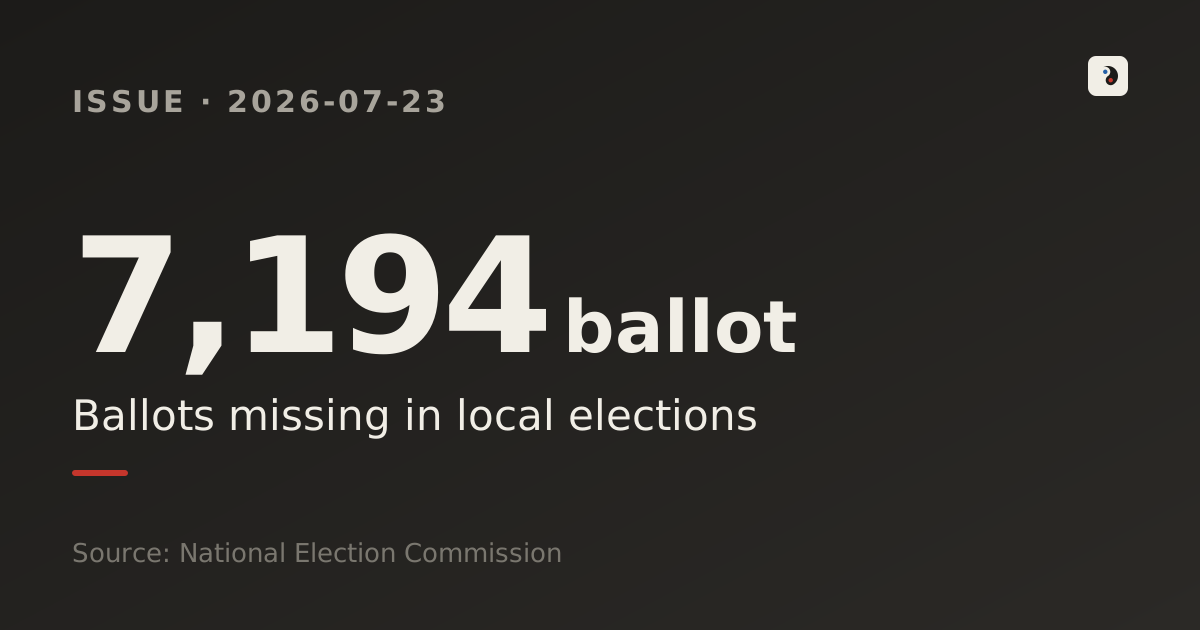
South Korea's ballot shortage from the June 3 local elections has, within two months, escalated into a bipartisan special counsel probe. What went wrong, and why did it grow this big?
- On June 3, 91 polling stations nationwide ran short by 7,194 ballots, halting voting at 26 sites for up to 105 minutes.
- Allegations that former NEC chair Noh Tae-ak took undisclosed spousal trips abroad compounded the crisis; investigators raided the National Election Commission (NEC) on July 20.
- Lawmakers from both parties agreed on a special counsel bill on July 21 and will pick a nominee at the National Assembly's plenary session on July 23.
What happened
In South Korea's June 3, 2026 nationwide local elections (the 9th synchronized local elections), 91 polling stations across the country ran short of ballots. According to data the National Election Commission (NEC) submitted to the National Assembly on June 9, the shortfall totaled 7,194 ballots nationwide, with Seoul alone accounting for 4,206 — well over half. Voting was suspended at 26 stations that ran completely out of ballots, for anywhere from 4 to 105 minutes.
As exit polls and early counts showed People Power Party Seoul mayoral candidate Oh Se-hoon narrowly trailing, some supporters at a polling station in Jamsil blocked ballot boxes from being moved to the counting center. The NEC only secured the boxes on June 5, after the blockade was cleared, and finished the count at Olympic Park. The NEC attributed the shortage to "a failure to predict turnout and poor regional allocation" — the problem, it said, wasn't an absolute shortage of ballots but a failure to get them where they were needed in time.
Why it escalated to a special counsel
The episode didn't end as a simple administrative error. Investigators found that former NEC chair Noh Tae-ak had taken three overseas trips during his tenure — to Germany, Sweden, and elsewhere — accompanied by his spouse, without disclosing that in the commission's post-trip reports. On July 20, a joint police-prosecution task force raided NEC offices over the "junket-style trip" allegations, seizing officials' phones and group-chat records.
The numbers
Breaking down where the 7,194-ballot shortfall was concentrated shows how lopsided the problem was.
What's more striking than the shortage itself is the speed of the political response. Tracking the timeline from the crisis to the special counsel nomination shows just how fast both parties moved.
How Germany handled a similar mess
Election-day chaos isn't unique to South Korea. In Germany's 2021 Berlin state and federal elections, held the same day, ballot shortages, long lines, and misdelivered ballots piled up. Berlin's state constitutional court voided the entire state assembly election and ordered a full re-run, while Germany's Federal Constitutional Court took a narrower approach for the Bundestag election — ordering a partial re-vote only in the 455 of 2,256 precincts where voters' right to an equal vote was found to have been violated. The remedy was scaled to the size of the problem.
South Korea's NEC wasn't entirely idle beforehand, either. From September to November of the prior year, it sent officials on 19 overseas trips — including to Lithuania and the United States — to study ballot inventory management, and its own trip reports recommended "properly producing and distributing necessary materials such as ballots and ballot boxes, and building a stable system for securing election resources." Those lessons, though, weren't applied in time for this election.
The dispute: administrative failure, or something more?
Both parties agree the NEC must be held accountable, but they diverge on remedies. Some in the People Power Party have called for a parliamentary inquiry, a special counsel, and even a re-run of the election. The Democratic Party backs the special counsel but places more weight on overhauling the election-management system itself through amendments to the Public Official Election Act and the NEC Act, rather than a re-vote.
Some supporters have cited the episode as evidence of "election fraud." But the special counsel bill's actual mandate targets the circumstances behind the ballot-allocation failure and the travel allegations against NEC officials — not whether vote results were manipulated. There's a clear gap between the special counsel's legal mandate and the fraud narratives circulating online.
What to watch next
At its July 23 plenary session, the National Assembly is set to appoint a special counsel from candidates put forward by a bipartisan nominating committee. Once appointed, the counsel is expected to dig into both the administrative causes of the ballot shortage and the travel allegations against Noh and other former officials. Meanwhile, the Democratic Party's promised election-reform task force is expected to propose amendments to election-related laws — a real test of whether ballot allocation actually changes before the next nationwide election. If the special counsel's findings are delayed or reform stalls, rebuilding trust in election administration will take that much longer.
- 2026 South Korea Local Elections Ballot Shortage — Wikipedia (Korean) (2026.07.23)
- Task force raids NEC chair’s office over "junket trip" allegations — Seoul Shinmun (서울신문) (2026.07.20)
- NEC took 19 overseas trips before the election — what did it learn? — MBC Newsdesk (MBC 뉴스데스크) (2026.06.11)
- Bipartisan nominating committee agrees on two special-counsel candidates — Kyunghyang Shinmun (경향신문) (2026.07.21)
- Parties agree to nominating committee, aim to pass bill within July — Hankook Ilbo (한국일보) (2026.07.21)
- What should Korea change after the ballot shortage? — OhmyNews (오마이뉴스, via Daum) (2026.06.07)
This is nuloq's own analysis based on the public reporting and official data listed under Sources, written with the help of AI. It is for information only — not investment, legal, or medical advice — and reflects the situation at the time of writing. We correct the text if errors are found.
Related posts
Han Hak-ja Gets 2 Years, Not 13: Inside Korea's Church-Politics Scandal
The reported two-year sentence is a first-instance ruling and was appealed. It is not described as final. Defendants, charges and stages of separate proceedings must be distinguished.
Special counsel: up to 180 days of investigation — where does “690 days” come from?
We split the amended act's 20-day preparation period from its 180-day maximum investigation period. Then, in plain words: what the 690-day total, the 2.709 billion won cost estimate and two warrant rejection rates from different dates each mean.
150 Troops, 70% of Oil: South Korea's Hormuz Dilemma by the Numbers
Squeezed between US pressure and Iran's war warning, South Korea is weighing sending 150 troops to the Strait of Hormuz — the route for 70% of its oil imports. Here's the dilemma in numbers.
Welfare ₩148.8tn, National Debt ₩1,519.8tn — What Is the 48.3% Ratio Divided By?
We separate the two ways of counting the welfare ministry's budget, and correct the denominator of the national debt ratio to nominal GDP. We hold back judgment on why the ratio falls until the official GDP assumption can be checked, and we found no confirmed evidence that the future response fund caused the ₩106 trillion rise in debt.