· Updated 2026-09-11
The Incheon Coupang Warehouse Fire — How Far Does the New Warehouse Safety Standard Reach?
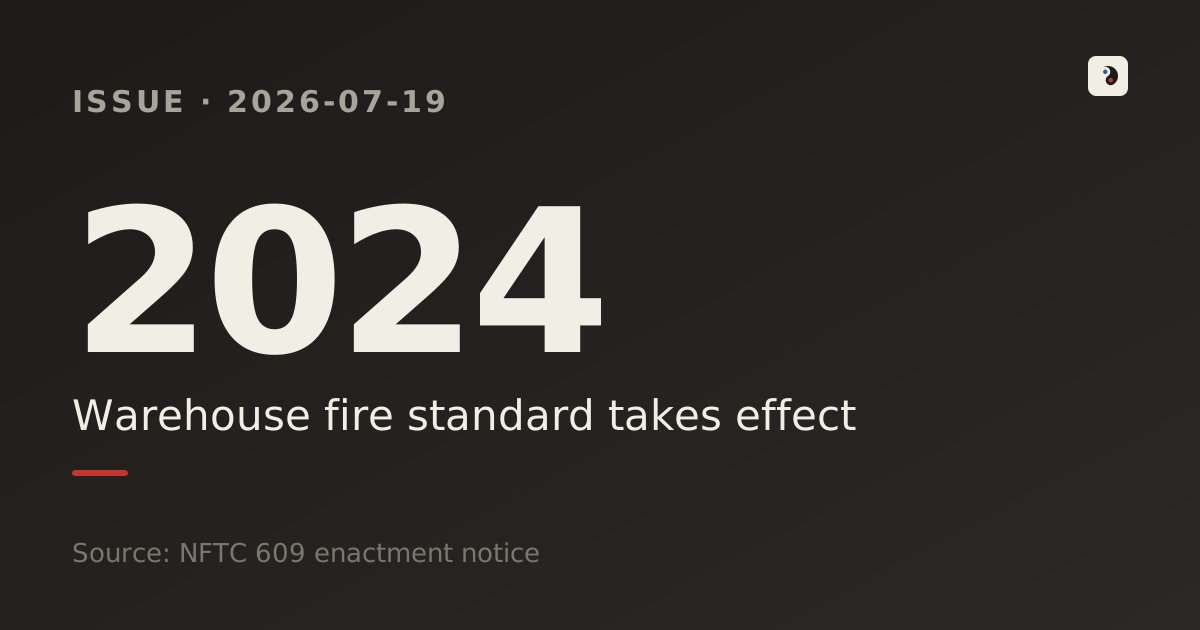
Does the fact that another fire broke out let us say “the safety standard did not work”? There are three things to check: what the standard requires, which standard applied to that building, and whether the equipment actually worked. These three are separate items.
- The Fire Safety Technical Standard for Warehouse Facilities (NFTC 609) took effect on January 1, 2024. It is the fire safety standard that applies to warehouses.
- There is a provision that applies the earlier standard to buildings whose permit was applied for before it took effect. That does not mean it is accurate to say every existing building sits outside the law.
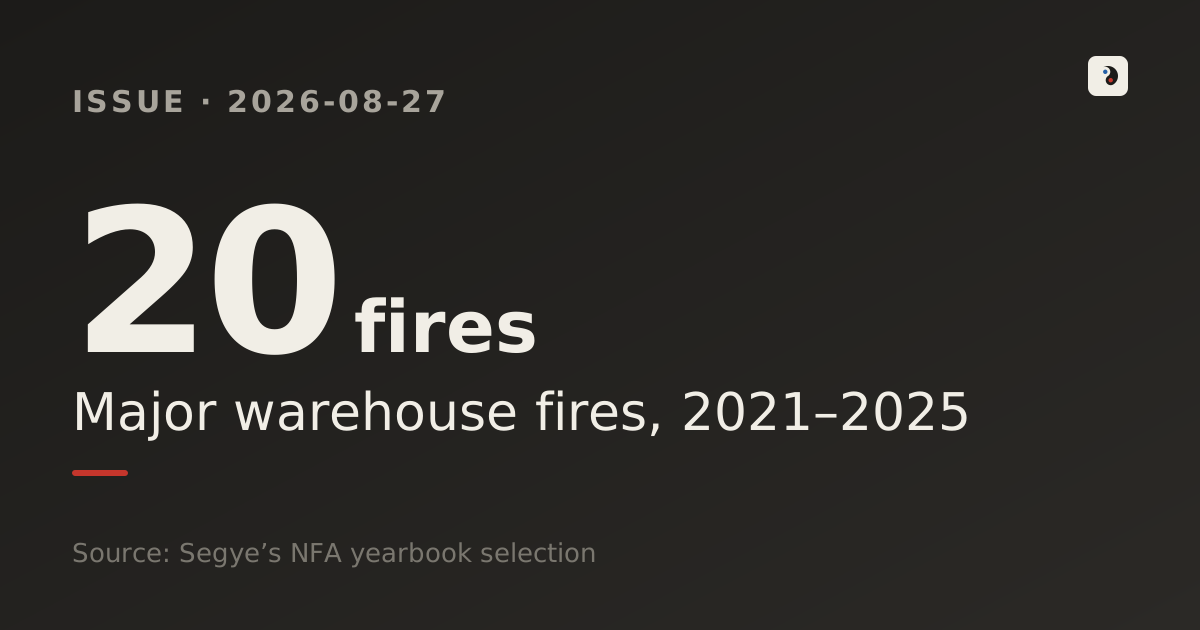
- Past nationwide warehouse fire counts are background data. They are not a number that shows Coupang's accident rate or the effect of policy in 2026.
What is confirmed, and what this article covers
YTN reported the fire at the Coupang logistics warehouse in Incheon in an article timed 15:55 on July 18, 2026. According to that article, the National Fire Agency issued a national fire mobilization order, which gathers the firefighting resources of five nearby cities and provinces in one place. [1] The fact that a mobilization order was issued tells us how wide the firefighting response was. It does not tell us whether the equipment worked or whether a standard was broken. This article is not an investigation that establishes the final cause of the accident or a legal violation by a particular site. It is an explainer on how to read published standards.
What does the figure of 7,388 count?
The National Fire Agency's page does not open now. We identified which release it was from the title of the post and from a record we had quoted earlier. There is a secondary source that reprinted the same release. It is not the original agency, but material that passed the release on. It gives 7,388 warehouse facility fires nationwide in 2017–2021, with 61 deaths and 226 injuries. The original agency's URL returned a 404 when we checked on September 10, 2026, which means the page is not there. So this figure is not one we rechecked directly in the National Fire Agency's own text. This time we checked the year-by-year values in an August 31, 2022 post by Logiket that quoted the same release. [2][4] The number adds up all the warehouse facilities covered; it is not a count of Coupang alone.
Three things to read in the standard introduced in 2024
- Effective date: section 1.3 of the enactment notice of December 29, 2023 states that it takes effect on January 1, 2024. Some detector provisions have a separate start date of their own.
- Equipment: section 2.3 requires large-drop sprinkler heads to be installed as a wet system (one in which the pipes are kept full of water). In two cases, though, a dry system (one in which the pipes are not kept filled with water) is allowed. The first is a freezer warehouse, or a chilled warehouse that stores goods below zero. The second is a warehouse with no permanent staff that is therefore not heated (2.3.1.1). A rack-type warehouse is one fitted with racks, the shelves that goods are placed on. There, heads must be installed at every 3 m or less of rack height (2.3.1.2). Under certain conditions, the standard also leaves room to apply a sprinkler system for early fire suppression instead (2.3.1.4). So the presence of sprinklers alone does not establish that the standard was met.
- Stored goods: section 2.3.5.1 sets the horizontal distance between heads differently depending on the goods. For warehouses storing designated combustible materials it is 1.7 m or less. For other warehouses it is 2.1 m or less, and 2.3 m or less where the structure is fire-resistant. So our earlier statement, that Korean rules make no distinction at all between types of goods, has to be corrected.
Which standard applies to an existing building?
Section 1.5 has transitional provisions, that is, rules that keep applying the earlier requirements. Some sites applied for or filed a building permit before the standard took effect. Others filed a notice to start fire-system construction work. The previous standard applies to those sites (1.5.1). The same section has an exception, though. Where applying the new standard is more favorable to the site, the new standard may be followed (1.5.2). So the transitional provisions do not work in one direction only. Section 1.4, meanwhile, covers extension, rebuilding, major repair and change of use in existing buildings. These are cases where a building is enlarged, heavily repaired or put to a different use. There are cases in which piping or wiring work is recognized as markedly difficult, that is, very hard to carry out. In those cases, some requirements may be left unapplied, as long as the function of the equipment is not impaired. [3]
So a building's completion year alone cannot settle which standard applies or how safe it is. When the permit or notification was filed, what was changed afterwards, and which provisions apply have to be checked together. Whether a rule exists and whether it was followed on site are also separate questions.
What more is needed to judge the cause
Weighing up the cause of the accident needs more records. Those are the building's permit, design and alteration records, the inspection and operating records of its fire systems, and the final fire investigation result. Without those records, we do not conclude that a regulatory gap caused this fire. To look at the effect of the policy, you would have to take the same group of warehouses and compare accidents and damage before and after the standard took effect. Changes in the number and size of the facilities would have to be reflected as well.
Further reading
Reading Coupang Fire Reports: What Does “20 in Five Years” Count? →
How to compare periods, units and baselines in a data explainer →
Sources
- YTN · 2026-07-18
- National Fire Agency post · 2022-08-21 · did not open when rechecked on 2026-09-10 (404)
- NFTC 609 · 2023-12-29 · §§1.3–1.5, 2.3
- Logiket, “Tighter warehouse fire safety standards and the industry's response” — 2022.08.31, the section “Warehouse safety accidents so far.” It is a secondary source quoting the National Fire Agency's release, and this article refers only to its 2017–2021 statistics.
Correction, 2026-09-10: we fixed the flat claim that every existing building sits outside the new standard. We also corrected the explanation that the rules make no distinction between stored goods. We removed a guess about the cause that we could not confirm, along with a passage comparing damage amounts from different counts. In their place we set out the original provisions and the scope of the statistics. The original publication date and URL are unchanged.
Update, 2026-09-10: we compared the text of the standard again. We wrote the horizontal distances (1.7 / 2.1 / 2.3 m) and the 3 m rack height rule into the article. We also set out the optional application under transitional provision 1.5.2. For the statistics, we added the year-by-year values so that the total and the annual average can be checked directly. The address of the National Fire Agency post at source [2] did not open when we checked on 2026-09-10. Other outlets quoting the same release give the same figures, but the address of the original post still needs to be rechecked. We also rewrote the sentences so a middle-school reader can follow them easily. The content and the numbers are unchanged (2026-09-11).
Written and revised by nuloq from public sources, with AI used in the research, the drafting and the translation. The statistics are values for the stated period, and they are not material for judging whether equipment on site meets the standard.
Related posts
Reading Coupang Fire Reports: What Does “20 in Five Years” Count?
Separate major warehouse fires across operators from one company’s incidents. A guide to matching populations, periods and denominators, with corrections to our earlier article.
2026-07-15 Jobs Rebound Hides a Youth Slump, 120mm Rains, Samsung Union Wave
Korea added 63,000 jobs in June while youth employment fell by 197,000. What the rebound hides, a 120mm monsoon-rain checklist, and Samsung's spreading unions.
150 Troops, 70% of Oil: South Korea's Hormuz Dilemma by the Numbers
Squeezed between US pressure and Iran's war warning, South Korea is weighing sending 150 troops to the Strait of Hormuz — the route for 70% of its oil imports. Here's the dilemma in numbers.
Welfare ₩148.8tn, National Debt ₩1,519.8tn — What Is the 48.3% Ratio Divided By?
We separate the two ways of counting the welfare ministry's budget, and correct the denominator of the national debt ratio to nominal GDP. We hold back judgment on why the ratio falls until the official GDP assumption can be checked, and we found no confirmed evidence that the future response fund caused the ₩106 trillion rise in debt.