Korea Strips Prosecutors' Investigation Power: 6 Crimes to Zero
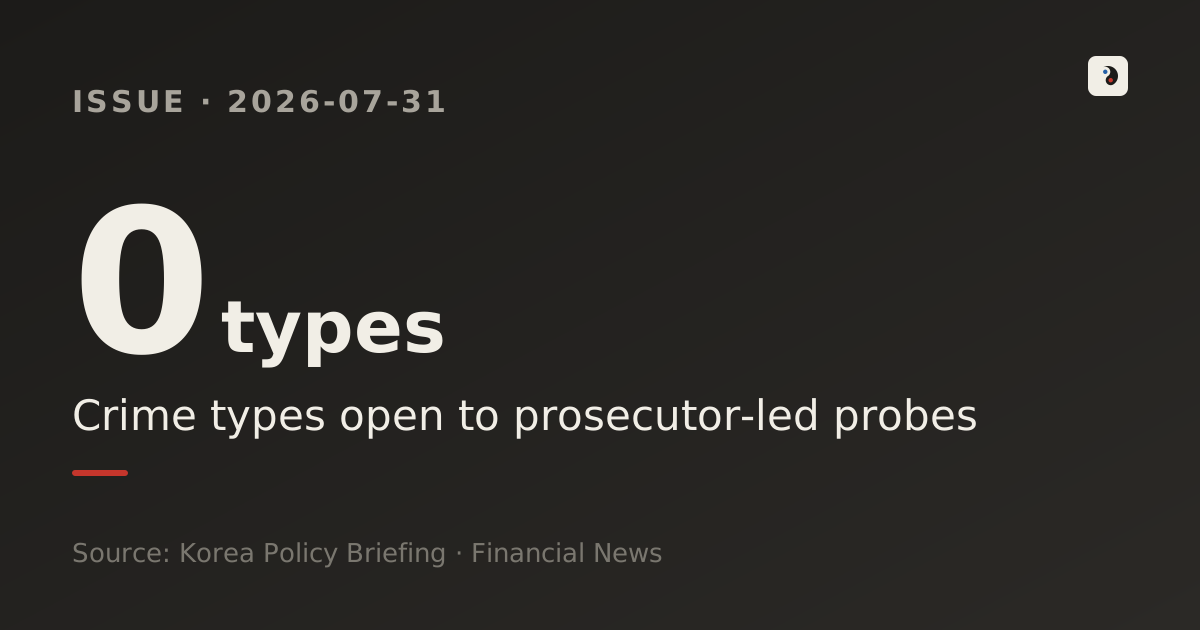
The last power prosecutors had to personally re-investigate a case after receiving it is about to clear its final hurdle in parliament — here's what this change actually does, and doesn't do, in numbers.
- On July 31, South Korea's National Assembly is voting to abolish prosecutors' "supplementary investigation power," leaving them only the right to "request" that police carry out further investigation.
- It's the final step of a 20-year power shift — 6 crime categories in 2020, down to 2 in 2022 — that culminates on October 2 with the 78-year-old Prosecutors' Office being abolished and replaced by a new Public Prosecution Office and Serious Crime Investigation Agency.
- Watch for whether President Lee Jae-myung vetoes the bill, and what checks lawmakers build into the new investigation agency, which inherits 9 crime categories.
What happened
A bill abolishing prosecutors' "supplementary investigation power" is clearing its final hurdle in South Korea's National Assembly. The ruling Democratic Party put the bill on the plenary floor on the afternoon of July 30, and the opposition People Power Party and the Reform Party immediately launched a filibuster. Under National Assembly rules, a filibuster can be forced to end 24 hours after it starts with the consent of three-fifths of sitting lawmakers — so a vote and passage were expected on the afternoon of July 31.
The core of the bill is simple. Until now, a prosecutor who received a case from police could personally carry out additional "supplementary" investigation. That power disappears; prosecutors keep only the right to "request" that police do it. Police must complete a requested supplementary investigation within one month, with a possible one-month extension. The bill also lets prosecutors seek disciplinary action, reassignment, or removal against officers who don't comply, and expands victims' right to object to police decisions.
Why it matters — the final chapter of a 20-year reform
This bill didn't come out of nowhere. Lined up in order, Korea's two-decade tug-of-war over investigative power between prosecutors and police shows exactly where this vote sits.
- 2020–2021: A criminal procedure law amendment gave police the power to close minor cases on their own (without forwarding them) and stripped prosecutors of their authority to command police investigations — the first break from a strictly hierarchical relationship.
- September 2022 ("prosecution reform"): An amendment to the Prosecutors' Office Act narrowed the crime categories prosecutors could directly investigate from 6 (corruption, economic crime, crimes by public officials, election crime, defense-industry crime, major disasters) down to 2 (corruption and economic crime).
- July 2026 (this bill): The one power prosecutors still had — personally carrying out supplementary investigation — is downgraded to a mere request. Prosecutors effectively lose any legal basis to keep investigating on their own.
- Set to take effect October 2, 2026: Under a government-reorganization law, the Prosecutors' Office itself — established in 1948 — is abolished after 78 years. In its place: a Public Prosecution Office (PPO) handling only indictment and trial, and a Serious Crime Investigation Agency (SCIA) taking over investigation of 9 major crime categories — corruption, economic crime, crimes by public officials, election crime, defense-industry crime, major disasters, drugs, insurrection/treason, and cybercrime.
In other words, this vote isn't a standalone event — it's the last piece of a much bigger overhaul that turns the prosecution service from an investigative body into a purely indicting one.
By the numbers
Putting numbers on how much ground prosecutors have lost — and where that authority actually went — makes the picture much clearer.
Set the shrinking side next to the growing side, and one thing becomes clear: the state's power to directly investigate crimes hasn't disappeared. It's simply moving from the hands of prosecutors into a newly created, separate agency.
Comparing Korea's prosecution system with other countries also shows just how unusual this move is.
Contrary to the ruling party's claim that "separating investigation from prosecution is the global trend," most European countries still leave prosecutors with some form of investigative authority — which is exactly why what "international standard" even means is itself contested in this debate.
Where views diverge — is a "request" enough?
Interpretations of the same bill split sharply along political lines.
- Government and ruling party: Justice Minister Jung Sung-ho said this bill "doesn't seem like something that calls for recommending a presidential veto," signaling the government isn't considering blocking it. The government's position: downgrading the power to a mere request is the last puzzle piece in truly separating investigation from prosecution.
- Opposition (People Power Party): Floor leader Jung Jum-sik argued the supplementary investigation power was "not prosecutorial power but a tool that protects victims," and demanded President Lee Jae-myung veto the bill if it passes. Conservative commentators added that a check on police investigations is disappearing.
- Legal community and civil society: According to Kyunghyang Shinmun, under the new "request" system, police who handle a supplementary investigation poorly may face only a reprimand or warning — raising doubts about whether the mechanism has real teeth. Within the Democratic Party itself, officials noted this was never formally adopted as party policy and promised public hearings with legal experts and civic groups.
The real fault line isn't "should prosecutors' power shrink or not" — it's narrowed down to whether a mere "request" can actually stop police from doing a sloppy job on supplementary investigation.
What's next
The most immediate variable is whether President Lee Jae-myung vetoes the bill. A veto invites criticism that prosecution reform has lost momentum; not vetoing means absorbing continued backlash from the opposition and parts of the legal community. Either way carries real political cost.
The more fundamental test comes on October 2. Whether the new Public Prosecution Office and Serious Crime Investigation Agency actually check each other in practice — not just on paper — can only be verified once both bodies start handling real cases. In particular, what oversight mechanisms lawmakers and civil society build around the Serious Crime Investigation Agency (how its head is appointed, who controls its budget and personnel) will determine whether this reform ultimately reads as "less power" or simply "relocated power."
- Ruling and opposition parties clash for a second day over filibuster; prosecution-reform bill expected to pass — Financial News (fnnews.com) (2026.07.31)
- "Supplementary investigation power" abolition nears; ruling party pushes again, opposition filibusters again — Money Today (2026.07.30)
- [Exclusive] A warning if a suspect gets away, a reprimand if an investigation is botched — is a "request" power really enough? — Kyunghyang Shinmun (2026.07.30)
- People Power Party condemns ruling party's push on abolishing supplementary investigation power, demands presidential veto — Ajunews (2026.07.30)
- Prosecutors' Office abolished after 78 years — bills creating Public Prosecution Office and Serious Crime Investigation Agency pass parliament — The Epoch Times Korea (2026.03)
- In the US, France, and Germany too, investigation falls under the prosecutor's purview — Sisa Journal (2022.04.16)
- Adjusting investigative power between prosecutors and police — Republic of Korea Policy Briefing (2021)
This is nuloq's own analysis based on the government and parliamentary records and news reporting listed under Sources, written with the help of AI tools. It is for information only — not legal or investment advice — and reflects the situation at the time of writing; we will check back and correct it if circumstances change.
Related posts
Approval at 45%, Housing Anger at 28%: What South Korea's Cabinet Reshuffle Really Signals
President Lee Jae-myung replaced six ministers as his approval rating sank to 45%. The data and disputes behind South Korea's biggest reshuffle yet.
Korea's Property Tax Reform: 1.4bn Won Exemption for Residents, 900m for Absentees
Korea's 2026 tax reform raises the property-tax exemption to 1.4bn won for owner-occupiers, cuts it to 900m won for absentee owners. The data, history and fight behind the split.
Korea's Growth Forecast Hits 3.2% — So Why Are New Jobs Falling?
KDI raised South Korea's 2026 growth forecast to 3.2% in 3 months on a chip boom — but new-jobs forecast fell from 170,000 to 110,000. The numbers, explained.
South Korea's Birth Rate Rebound: 0.72 to Near 0.9 — Real or a Mirage?
South Korea's fertility rate jumped from a record-low 0.72 in 2023 toward 0.9 in 2026. Is this birth rate rebound a real turnaround — or a demographic mirage?