Korea's Minimum Wage Hits 10,700 Won — Why Both Sides Are Furious
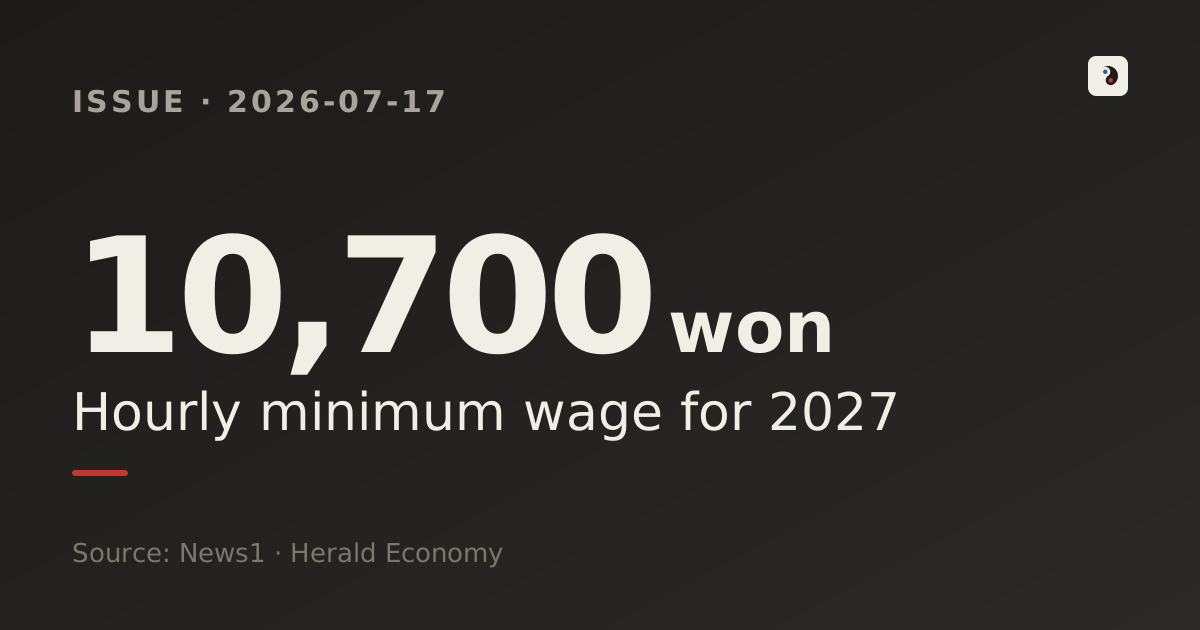
10,700 won an hour. The number went up, but neither small business owners nor workers are celebrating — here's what's behind the decision.
- Korea's 2027 minimum wage was set at 10,700 won an hour (2,236,300 won a month) — not by consensus, but by a 15-11 vote between business and labor representatives.
- Self-employed business debt hit a record 1,095 trillion won, and 68.5% of small businesses that closed last year did so while still carrying an average of 85.31 million won in debt.
- Yet labor unions call it "effectively a freeze" — because 12.4% of workers still aren't paid even the current minimum wage.
What happened
On the night of July 14, the Minimum Wage Commission's 14th plenary session set the 2027 minimum wage at 10,700 won an hour — up 380 won, or 3.7%, from this year's 10,320 won. Converted to a monthly wage for a 40-hour work week including paid weekly rest, that's 2,236,300 won — 79,420 won more per month than this year.
What stands out is how it was decided. Of 27 commission members, the business side's proposal of 10,700 won won 15 votes against the labor side's 10,730 won proposal, which got 11 (one vote was invalid) — a gap of just 30 won. Labor and management failed to reach agreement on their own, and the outcome was decided by the commission's public-interest members. The figure now goes through an objection process at the Ministry of Employment and Labor before final confirmation and public notice by August 5, taking effect uniformly across all industries from January 1 next year.
Why this is a turning point
The minimum wage rises every year, but this round is unusually loud because of the trajectory behind it. After the Moon Jae-in administration's push for a "10,000-won minimum wage" drove a 16.4% jump from 6,470 to 7,530 won in 2018, annual increases narrowed each year. They ticked back up slightly — 2.9% in 2026, 3.7% in 2027 — but over the full decade from 2015 to 2025, the minimum wage climbed a cumulative 79.7%. Over the same period, consumer prices rose just 22.9% and labor productivity only 12.4%, according to an analysis by the Korea Enterprises Federation (KEF), a business-side think tank.
KEF further points out that Korea's minimum wage, converted annually at purchasing-power parity, is 17.9% higher than the G7 average after tax, while hourly labor productivity — at $55.20 — is just 68.8% of the G7 average ($80.20), the lowest among G7 economies. Some academics caution, however, that comparing such indicators across countries with different industrial structures and samples calls for care.
By the numbers
Put the two figures side by side and you see two different curves. One is the minimum wage steadily climbing. The other is the share of workers not even getting that wage. Korea's below-minimum-wage rate was 4.3% in 2001 and had nearly tripled to 12.4% by 2024 — reaching 30–40% in some low-margin service sectors such as convenience stores and restaurants. Raising the wage floor, in other words, has coincided with a growing population living beneath it.
The fight — why both sides are angry
Small business owners' anger is backed by numbers. Self-employed loan balances hit 1,095.5 trillion won at the end of the first quarter — the highest since records began in 2012 — with delinquencies of at least one month reaching a record 22.3 trillion won. Of the 976,000 small businesses that closed last year, 68.5% were still carrying debt when they shut down, averaging 85.31 million won, and 70.9% cited weak sales as the reason. The Korea Federation of Micro Enterprises said the decision "ignored the desperate pleas of 7.9 million small business owners enduring record debt."
Labor isn't celebrating either. The Korean Confederation of Trade Unions said an increase of less than 80,000 won a month "falls far short of recovering accumulated real-wage losses," while the Federation of Korean Trade Unions called it "effectively a wage freeze that has lost its income-guarantee function" once recent inflation is factored in. Both umbrella unions also noted that platform and specially employed workers remain excluded from minimum-wage coverage. In the end, the decision satisfied no one — a compromise stitched together by vote within a shrinking room for negotiation.
How Korea compares abroad
Is Korea's minimum wage unusually high? Japan's 2026 national average minimum wage is 1,121 yen an hour — up 66 yen from the previous year, its largest-ever increase — which converts to roughly 9,460 won. Despite that record jump, Japan's minimum wage has now trailed Korea's for three straight years. Yet measured against median wages rather than absolute currency, Korea's minimum-to-median ratio of 60.5% ranks 9th among 30 OECD countries — a different picture from the raw-currency comparison. Whether Korea's minimum wage looks "high" or "low," in other words, depends entirely on which yardstick you use.
What's next — the variables before August 5
The 10,700-won figure isn't final yet — it's a pre-notice stage. Both labor and management can file objections with the Ministry of Employment and Labor, which will review them before issuing a final notice by August 5. Deeper questions remain, too. With more than 12% of workers already earning below the minimum wage, it's unclear whether simply raising the headline number will improve low-wage workers' lives, or whether an increase that doesn't account for small businesses' ability to pay will end up shrinking employment instead. Neither question will be settled by this decision alone, and the debate over these numbers is likely to continue well past August 5.
- 2027 Minimum Wage Set at 10,700 Won, Up 380 Won From This Year — News1 (2026.07.15)
- Small Businesses "Dismayed" by 10,700-Won Minimum Wage Decision — Herald Business (2026.07.15)
- KCTU Protests 10,700-Won Minimum Wage: "Nowhere Near Enough to Restore Real Wages" — Newspim (2026.07.15)
- Self-Employed Loans Near Record 1,100 Trillion Won, Delinquencies Climbing — Etoday (2026.06.30)
- 7 in 10 Closed Small Businesses Cite Weak Sales; Average Debt 85.31 Million Won — Newspim (2026.06.30)
- KEF: Korea's Minimum Wage Tops G7 Average, but Productivity Lags — Korea Daily (2026.06.21)
- Japan's Average Minimum Wage Converts to About 9,460 Won, Still Below Korea's for a 3rd Year — Korea International Trade Association (KITA) (2026)
- Korea's Minimum Wage by Year — superkts.com
This is nuloq's own analysis based on the public reporting and official data listed under Sources, written with the help of AI. It is for information only — not investment, legal, or medical advice — and reflects the situation at the time of writing. We correct the text if errors are found.
Related posts
2026-07-15 Jobs Rebound Hides a Youth Slump, 120mm Rains, Samsung Union Wave
Korea added 63,000 jobs in June while youth employment fell by 197,000. What the rebound hides, a 120mm monsoon-rain checklist, and Samsung's spreading unions.
Homeplus Creditor Vote: MBK's ₩4.1 Trillion Exit, ₩1.9 Trillion Accounting Mystery
Creditors voted Sept. 2 on Homeplus's fate. Here's how MBK drained ₩4.1 trillion from the retailer over eight years, then turned ₩1.9 trillion of debt into equity six days before its rehabilitation filing.
Korea's Growth Forecast Hits 3.2% — So Why Are New Jobs Falling?
KDI raised South Korea's 2026 growth forecast to 3.2% in 3 months on a chip boom — but new-jobs forecast fell from 170,000 to 110,000. The numbers, explained.
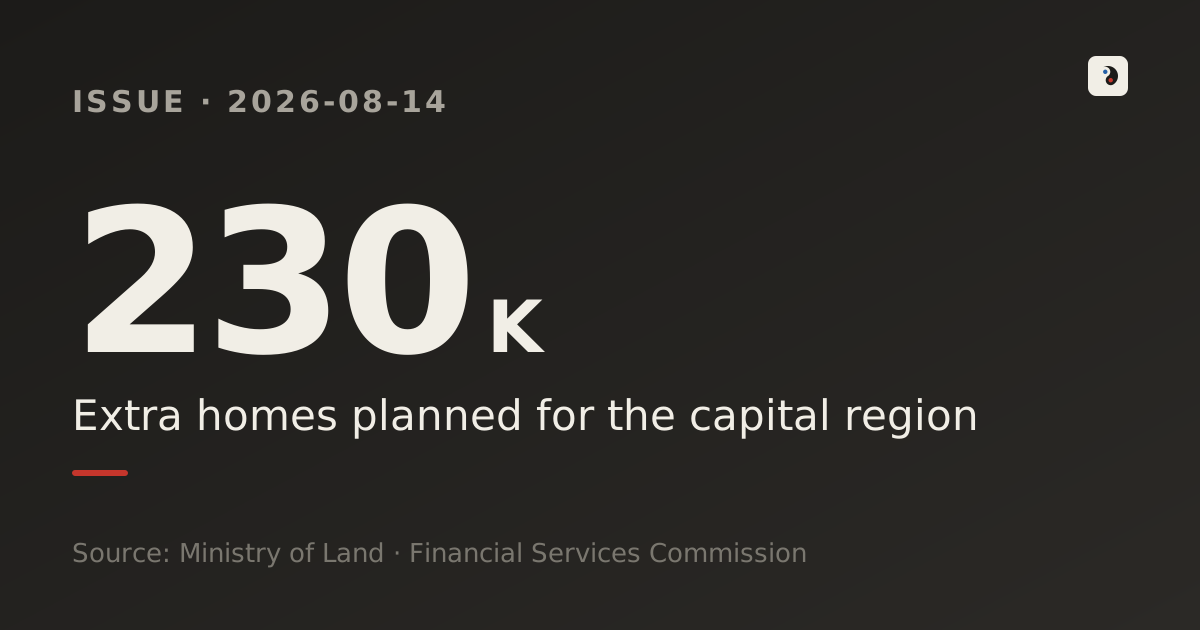
Korea Doubles Housing Loans, Adds 230,000 Homes — Will It Work?
Korea unveiled a housing plan on Aug. 13 adding 230,000+ homes and doubling household loan quotas, as Seoul's jeonse prices rose six times faster than a year ago. Here's whether it can actually cool the market.